


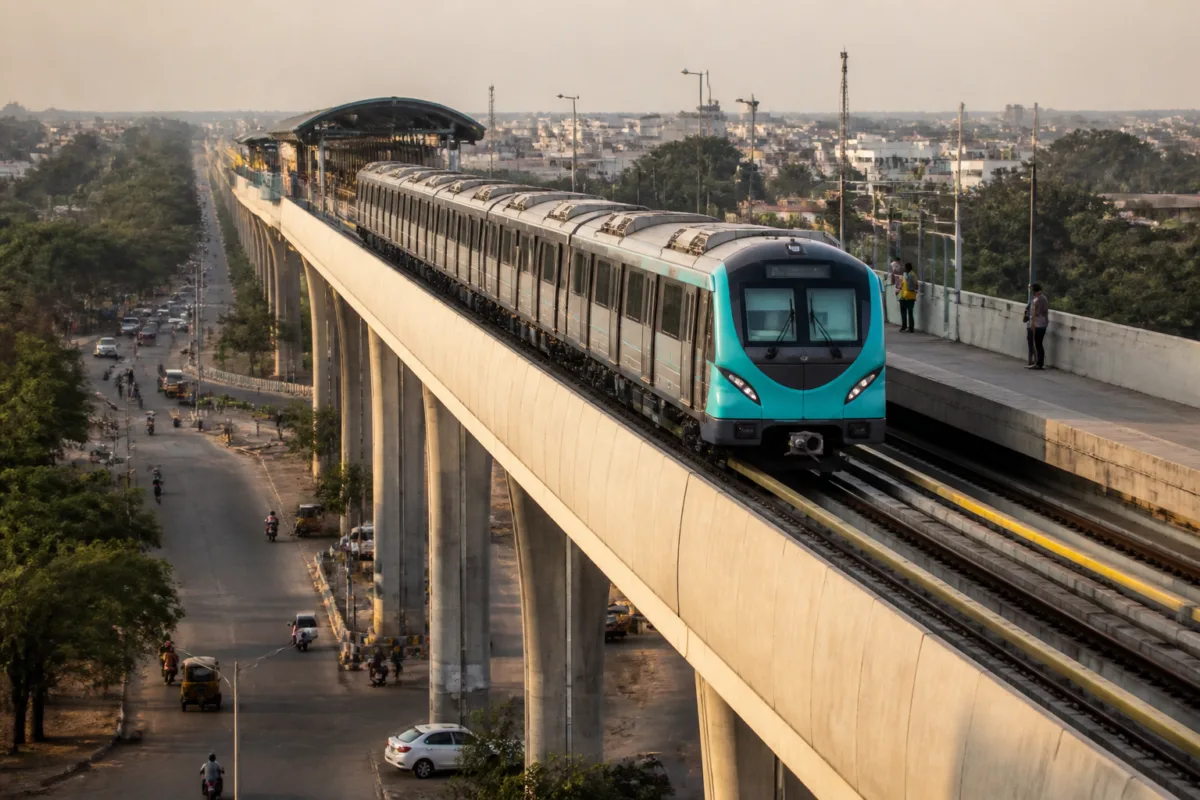
Bhopal Metro is already confronting the central financial problem that affects many new urban rail systems: the infrastructure may be operational, but the passenger base needed to support daily service has not yet arrived. According to estimates based on operating costs and passenger numbers reported by The Times of India, the nearly seven-kilometre priority corridor can spend roughly Rs 38-48 lakh a week on operations and maintenance while taking more than 100 days to collect a similar amount through fares. The figures are indicative, not audited revenue data, but they reveal a structural gap between the cost of running a metro and the limited usefulness of an isolated first phase.
The issue is not simply that Bhopal Metro needs more passengers. It is that the first corridor has opened before the network has acquired the reach that makes a mass transit system useful for everyday journeys. The eight-station section between AIIMS and Subhash Nagar opened in December 2025. Its present length restricts the number of origins, destinations and trip combinations it can serve, particularly for commuters who need a direct or convenient connection across a larger part of the city. The managing director of Madhya Pradesh Metro Rail Corporation Ltd, S Krishna Chaitanya, has said wider network coverage is expected only by 2028.
That sequence creates a difficult interim period. The corporation must operate trains, staff stations, maintain systems and keep the corridor available to passengers even while the line remains too short to generate the usage expected from a mature metro network. In this phase, fixed and semi-fixed costs continue regardless of whether trains are full. Fare revenue, by contrast, depends directly on the number of passengers, the frequency of their trips and the fares they pay.
The operating-cost estimate cited in the report puts annual operations and maintenance expenditure at Rs 20-25 crore. Spread across the year, that amounts to approximately Rs 5.5-6.8 lakh a day, or about Rs 38-48 lakh a week. The report combines those estimates with indicative ridership figures and an assumed average fare of Rs 50 to show why the farebox currently falls well short of expenditure. The calculation should not be read as a final operating loss statement: the corporation’s public relations officer did not provide current passenger numbers, and the reported fare-based estimate has not been presented as audited revenue.
Even with that limitation, the direction of the mismatch is clear. Estimated weekday ridership has ranged from 150 to 500 passengers, while weekend footfall has reached up to 1,500. Those numbers describe a service with stronger leisure or curiosity-driven usage than established commuter dependence. The report also notes that passenger figures recorded during the initial operating period were higher on a Sunday than on a weekday: ridership stood at 275 on January 15 and approached 1,000 on January 18. Between January 13 and 20, trains carried 3,350 passengers. These early figures cannot establish current demand, but they show how sharply usage can vary by day and why a few high-footfall weekends do not necessarily translate into a dependable daily farebox.
The corporation has increased daily trips from nine to around 20 since July. However, updated passenger data was unavailable, so the available material cannot establish whether the additional services have generated enough new demand to improve the operating equation. This is an important distinction in the economics of a young metro system. More services can make a line more useful and reduce waiting time, but they also increase the cost of running the system unless they attract additional passengers or serve a broader travel market.
The immediate urban question is therefore whether Bhopal Metro is being judged against the right milestone. A short first corridor cannot be expected to perform like a connected network, but it still consumes public resources from the moment it begins operations. The financial pressure is not evidence that the project has failed. It is evidence that construction completion, service commencement and commercial viability are separate stages, with different timelines and measures of success.
The corridor’s limited reach is particularly important because daily commuters choose modes based on the whole journey, not just the quality of one segment. A passenger may use the metro only if the station is accessible from home, the train takes them close to work or education, and the onward connection is convenient. The supplied report does not provide data on feeder services, station access, interchange arrangements or travel-time comparisons. It does, however, establish that the current corridor connects AIIMS and Subhash Nagar over approximately seven kilometres and that wider coverage is not expected until 2028. That gap helps explain why the line has not yet become a routine choice for a large commuter base.
The response so far has been to look beyond ticket sales. Madhya Pradesh Metro Rail Corporation has explored advertising, semi-naming rights, commercial leases, coaching spaces and private events as additional sources of income. A tender issued in November 2025 sought to lease advertising space on more than 700 elevated-line pillars. Around 620 square metres at Board Office Chauraha and approximately 2,470 square metres at Subhash Nagar were listed for commercial leasing in June. Monetisation efforts continued in October.
These efforts show that the corporation is treating the metro as more than a fare-collection operation. Stations, pillars, land parcels and trains can create commercial value, but that value depends on visibility, footfall, location and the willingness of businesses to pay. A short network with modest passenger volumes has a smaller commercial audience than a system that connects major employment, education, residential and interchange zones. Non-fare revenue can supplement the farebox, but the reported figures do not show that it has yet become a dependable income stream.
The experience with event-based use illustrates that limitation. The corporation introduced “Celebration on Wheels”, offering coaches and selected station areas for birthdays, pre-wedding shoots, film shoots and other events. The report said there were two Indore bookings over four weeks and that a Bhopal booking had been cancelled by early June. Bhopal hosted a fitness group’s event on June 7, but such bookings had not yet established a reliable revenue source. These activities may improve visibility and generate occasional receipts, but they cannot substitute for sustained passenger demand unless they develop into a regular commercial programme.
The institutional challenge is to keep the existing line operational while completing the wider network on which its usefulness depends. The current corridor is managed by Madhya Pradesh Metro Rail Corporation, while the wider expansion is linked to the stated 2028 timeline. The supplied report does not provide the project’s full capital cost, the operating subsidy arrangement, the construction schedule for each future section or the financial assumptions behind the expansion. Those missing details matter because operating losses during an initial phase can be planned for, but the scale and duration of that support determine the system’s long-term financial burden.
The available evidence also points to a measurement problem. Passenger figures are described for different periods, including the initial January operating period and later estimates of weekday and weekend usage. Current ridership was not provided, and the corporation’s higher service frequency could not be assessed against updated demand. Without a consistent public series covering passenger entries, passenger kilometres, revenue, service kilometres, operating costs and non-fare receipts, it is difficult to determine whether the gap is narrowing, remaining stable or widening.
That information is important for citizens because metro performance is not only a question of whether trains run. It affects public spending, service frequency, network planning and the timing of future investment. If the line is too limited to attract regular commuters, the city may have to sustain a costly service until additional corridors create a more useful network. If expansion improves access and ridership, the present operating gap may represent a transitional phase. The supplied evidence does not yet establish which outcome is emerging.
Bhopal Metro therefore presents a wider urban infrastructure question: how should cities sequence transport construction, operations and demand creation when the first usable segment is much smaller than the eventual network? The immediate figures show a substantial mismatch between indicative weekly costs and fare earnings. They also show why network length, passenger access and reliable public data are as important to metro viability as trains and stations themselves.
For now, the evidence confirms that Bhopal Metro is operating with a limited farebox and is pursuing non-fare revenue while waiting for wider coverage. The next developments to monitor are updated passenger numbers after the increase to around 20 daily trips, the progress of the network expected by 2028, the outcome of commercial leasing and advertising initiatives, and whether these measures produce sustained revenue rather than occasional receipts.

