


Gujarat’s development story has long been told through factories, investment commitments, ports, exports and infrastructure. The next test, according to a recent NITI Aayog policy synthesis cited by Nav Gujarat Samay, is whether that industrial base can create better jobs, equip workers for new technologies and expand into emerging services. This shifts the measure of economic progress from how much capital enters the state to how effectively that capital builds capabilities for its people.
The distinction matters because Gujarat already possesses many of the physical assets associated with industrial growth. The state has an established manufacturing network, an industrial tradition, ports, markets and engineering capabilities. The source argues that the challenge ahead is not simply to attract more enterprises, but to connect existing industrial strengths with the requirements of the next economic cycle. Those requirements include skilled workers, electric mobility, higher-value manufacturing, export readiness and services such as healthcare, accounting, engineering and elder care.
That is a different development agenda from the one that dominated the previous phase. Industrial expansion typically depends on land, power, transport links, logistics and investment facilitation. These remain essential, but the source’s account of the NITI Aayog material suggests that they are no longer sufficient on their own. A factory can be physically located in a state without automatically generating the skills, wages, technological capabilities or service ecosystems needed for broad-based economic gains.
The most important institutional question is therefore how the state and industry will align their requirements. The source says businesses will need workers trained for new technologies and that young people will need practical exposure through apprenticeships. This points to a shift from education as a largely classroom-based process towards a closer relationship between training institutions and employers. The issue is not only the number of training seats available, but whether the skills being taught correspond to actual industrial processes and changing occupational requirements.
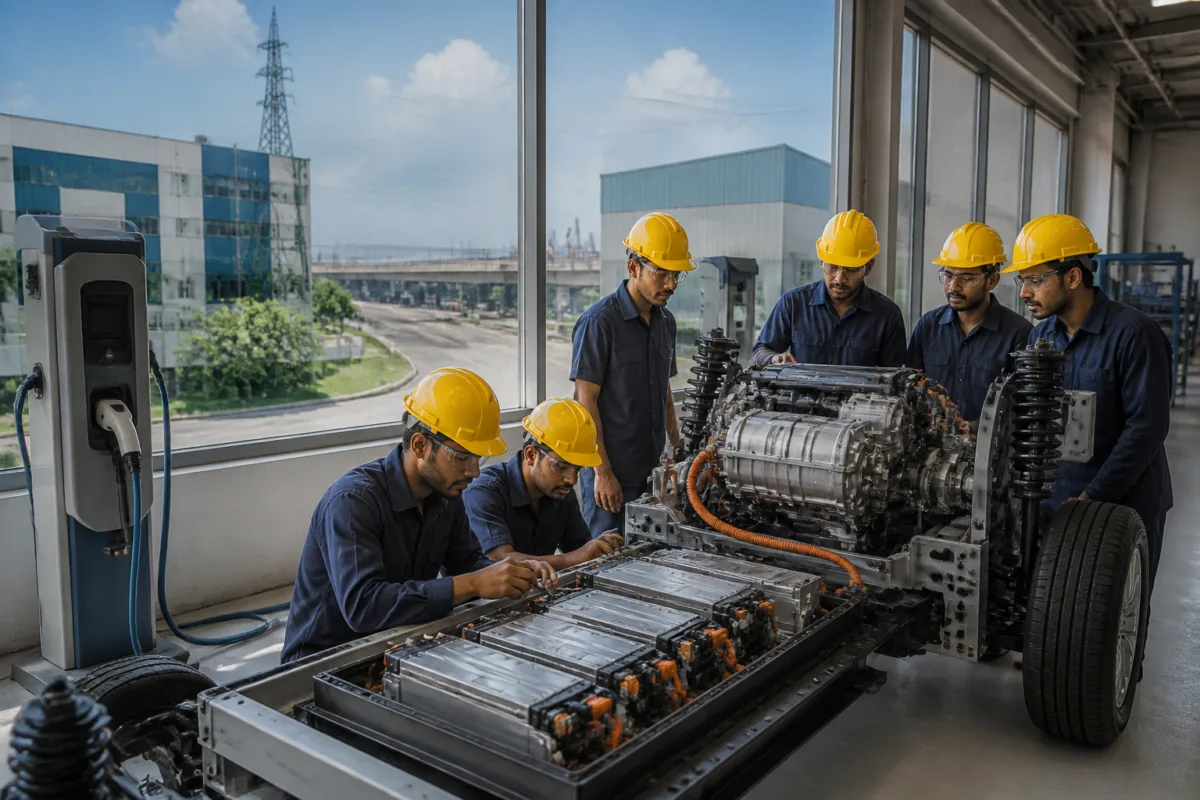
For Gujarat, this alignment is particularly relevant because its existing economic base can provide a platform for new capabilities. The source describes a state with established automobile and engineering sectors. That foundation could support expansion into electric vehicles, batteries, charging systems and related industries. However, the transition requires more than replacing one type of vehicle with another. It involves a wider industrial ecosystem, including components, energy systems, maintenance, software-linked functions and workforce training. The supplied material does not establish the scale of this ecosystem in Gujarat, but it identifies the direction in which the state’s industrial strategy is being urged to move.
Electric mobility is thus presented less as a standalone transport trend and more as an industrial and skills challenge. The India Electric Mobility Index 2025, cited in the source, reportedly places some states ahead of Gujarat. The article does not provide the comparative scores or the specific indicators used in the index, so the precise gap cannot be assessed from the available material. Its policy signal is nevertheless clear: Gujarat’s existing automobile strength will not by itself guarantee leadership in the electric mobility economy.
This distinction has direct urban implications. Electric vehicles require more than manufacturing plants. Their wider adoption is connected to charging infrastructure, electricity systems, service networks, roads, parking arrangements and the operating practices of public and private transport. The source does not provide figures on Gujarat’s charging network, EV registrations or urban transport usage, so no conclusion can be drawn about current deployment. But its emphasis on batteries, charging and related industries shows that the transition is being understood as a systems question rather than only a product question.
The workforce dimension is equally significant. A transition towards electric vehicles can change the skills required across manufacturing, repair, diagnostics, energy management and logistics. Apprenticeships become important because they can give students exposure to workplace processes before they enter full-time employment. The source specifically identifies the need to provide young people with work experience while they are studying. That proposal links the education system to the production system, but its effectiveness would depend on the quality of placements and the willingness of firms to participate. The supplied article does not provide details of an apprenticeship programme, targets or implementation mechanism.
The same logic applies to manufacturing. The source calls for a move beyond simply producing more goods towards making higher-value and more expensive products. This is an argument for capability deepening: firms would need to participate in more complex stages of production and compete on technology and quality, not only volume. The article also identifies exports as an opportunity to send more goods from Gujarat to global markets. Yet it supplies no export figures or product-level data, meaning the scale of the opportunity remains undefined in the available evidence.
The policy landscape described by the source is therefore broad rather than programme-specific. It brings together industrial policy, skills development, mobility, technology, exports and services. NITI Aayog’s reported message is that development should be assessed not only through buildings, factories and investment figures, but also through people and their capabilities. This framing places human capital alongside physical infrastructure as a core part of state development.
That principle has consequences for how public institutions divide responsibility. Industrial and investment departments may focus on enterprise formation and capital inflows, while skills institutions deal with training and apprenticeships. Transport and urban agencies may oversee mobility infrastructure, and education and health systems may support emerging services. The source does not describe a formal coordination structure between these areas. Still, the breadth of the agenda suggests that the results will depend on how effectively these policy domains are connected rather than pursued separately.
Services are another important part of the proposed transition. The source identifies legal work, accounting, engineering, healthcare and elder care as areas with potential for new employment. It also points to opportunities for women in care and related services. This broadens the development discussion beyond factory employment. A state that has built its identity around industry may increasingly need service-sector institutions, workplaces and training pathways capable of supporting an ageing population, business expansion and more specialised economic activity.
Elder care is mentioned as a potentially large future employment area, but the supplied material does not provide demographic data, demand estimates or details of a care policy. It should therefore be treated as an identified area of opportunity rather than an established growth sector. The same caution applies to the claim that new services can create opportunities for women. The source points to the possibility, but offers no employment numbers, participation rates or evidence on working conditions.
The central data story in the supplied material is consequently qualitative. Gujarat starts with industrial assets, investment capacity, ports, markets and an automobile and engineering presence. The policy question is whether these assets can produce stronger skills, newer technologies, more sophisticated manufacturing and a wider range of services. The source provides no time series on jobs, wages, EV adoption, apprenticeship participation or service-sector growth. That absence limits the ability to measure progress, but it also identifies the indicators that will matter if the new development agenda is to be evaluated.
For cities, the implications extend beyond employment statistics. Industrial transitions influence commuting patterns, housing demand, training locations, logistics networks and the infrastructure required around new production clusters. Service-sector growth can change the geography of work, while care services depend on neighbourhood-level access and a suitable workforce. The article does not identify particular cities or projects, so these effects cannot be assigned to Ahmedabad, Surat, Vadodara or any other location on the basis of the supplied evidence. They remain part of the wider urban system connected to the state’s economic transition.
What the evidence confirms is a change in the language of development. Gujarat’s next phase is being framed around the quality of employment, technological capability and the ability of institutions to prepare people for changing industries. The source identifies EVs, apprenticeships, higher-value manufacturing, exports and new services as the main areas to watch. What remains uncertain is how these priorities will be converted into funded programmes, measurable targets and coordinated implementation. The state’s progress will ultimately be assessed not only by the industries it attracts, but by the skills, jobs and urban systems those industries help create.

