


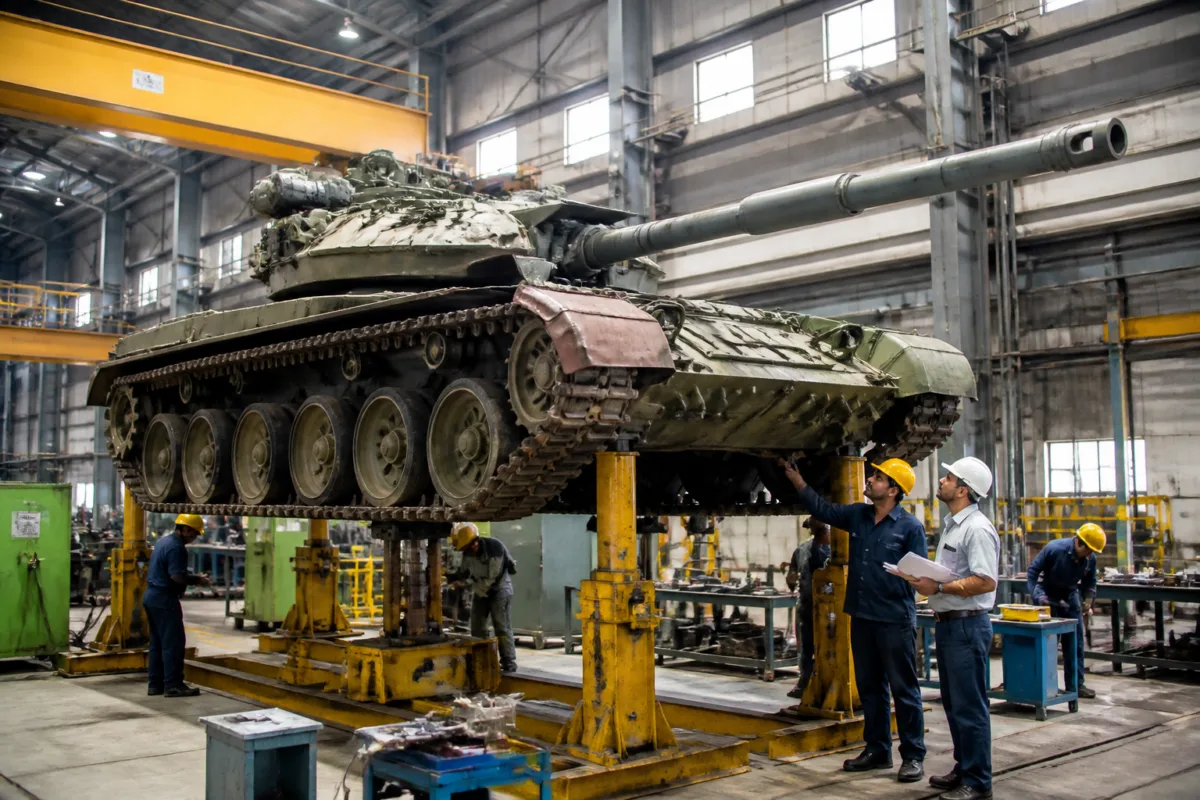
The Jabalpur tank overhaul facility is being built around an unusual industrial challenge: reconstructing a complex maintenance capability from Soviet-era documents that were written in Russian and were never intended for a new generation of Indian engineers. At Vehicle Factory Jabalpur, engineers have decoded nearly 70% of the drawings for specialised fixtures used to dismantle and rebuild T-72 and T-90 battle tanks, while developing indigenous designs where the original documentation is unavailable.
The project, estimated to cost Rs 462 crore, is intended to create a second tank overhaul centre alongside the Heavy Vehicles Factory at Avadi in Tamil Nadu. Vehicle Factory Jabalpur, or VFJ, aims to overhaul 80 Army tanks annually from April 2028. The project places a defence production facility at the centre of a broader industrial question: can India sustain and modernise legacy platforms when the original technology, documentation and production ecosystems are spread across different countries and generations of engineers?
That question is particularly relevant to Jabalpur because the project is not simply an expansion of routine vehicle servicing. An overhaul requires the tank to be dismantled completely, its systems inspected, worn components repaired or replaced, and the vehicle reassembled and tested. Each overhaul can take about four months. The work therefore requires specialised equipment, facility layouts, trained technicians, engineering coordination and testing capacity rather than only a larger workshop floor.
The Jabalpur facility is being developed by VFJ in coordination with Heavy Vehicles Factory, which is based in Avadi. Both units come under Armoured Vehicles Nigam Limited, a defence public sector undertaking. The institutional structure is important because the project depends on knowledge transfer between two facilities that have different operational histories but serve the same armoured fleet. Teams from Jabalpur have been sent to Avadi for training, while experts from the two factories are working together on the new facility.
The immediate technical bottleneck is documentation. Many of the original designs and blueprints are decades old and written in Russian. Harsh Bhatnagar, VFJ deputy general manager, said the factory had carried out detailed studies of the specialised fixtures, equipment, machinery and facility layouts required for the project. Where drawings are not available, the factory is developing designs locally. That work converts a historical dependency into an Indian engineering and maintenance process, but it also shows how much technical knowledge is embedded in physical fixtures and operating layouts rather than in easily transferable manuals.
The project’s origins lie in India’s long relationship with Soviet-origin and Russian-designed armoured vehicles. The Army’s relevant fleet includes the T-72 Ajeya and the T-90 Bhishma. In 2001, a contract was signed for the licensed production of 1,000 T-90 tanks at Avadi, following an earlier agreement to procure 310 tanks that included technology transfer. Russian experts helped establish production processes, and Indian engineers travelled to Russia for training.
Those arrangements helped create production capability, but maintaining a large fleet over decades presents a different institutional problem. Production knowledge and overhaul knowledge overlap, yet they are not identical. A factory that can manufacture or assemble a vehicle is not automatically equipped to dismantle ageing platforms, identify the failure of individual systems, replace worn components and certify the rebuilt vehicle. The Jabalpur project is therefore an attempt to build maintenance depth around an existing defence fleet rather than merely add another production line.
The workforce numbers indicate the scale of that transition. About 80 personnel are currently working on the project, mainly on the hull and turret. Work on internal systems is expected to begin in the next phase. VFJ estimates that around 650 trained personnel will be required when the facility reaches full capacity. Training has already been under way for two years, suggesting that the workforce requirement is being treated as a core part of the project rather than as a final-stage recruitment exercise.
This is where the project intersects with the urban economy of Jabalpur. A facility requiring hundreds of trained personnel creates demand not only for direct factory workers but also for technical training, equipment suppliers, maintenance contractors and supporting services. The supplied details do not establish the number of indirect jobs or the nature of local procurement, so the wider economic effect cannot yet be quantified. They do, however, show that the project’s success depends on building a specialised labour pool within the city and maintaining that capability over time.
The division of work between Jabalpur and Avadi may also reduce dependence on a single overhaul location. The available information does not specify the current annual overhaul capacity at Avadi, nor does it state how the two centres will divide the fleet. It does establish that Jabalpur is being developed as a second centre and that its planned capacity is 80 tanks a year. The significance is therefore operational as well as geographic: a second facility can create additional capacity, but only if training, fixtures, component supply and testing systems develop in step.
The project’s timeline is tied to the detailed project report. Bhatnagar said the work was progressing in line with the DPR timelines, while the targeted start of annual overhauls is April 2028. That leaves a defined period for completing the facility, finalising indigenous fixtures, expanding training and moving from work on the hull and turret to internal systems. The supplied report does not provide the project’s construction milestones, procurement schedule or commissioning tests, so the remaining implementation pathway is not fully visible.
The Jabalpur case also illustrates the administrative complexity of defence industrial infrastructure. The factory is not working in isolation. Its capability is connected to Avadi, AVNL, Army requirements, historical technology-transfer arrangements and technical documentation inherited from an earlier production era. Each layer affects delivery. A delay in one area—whether training, fixture design, machinery installation or testing—could affect the facility’s ability to meet its intended throughput, although the material supplied does not identify any current delay or risk.
The core evidence so far is capability under construction, not completed capacity. Nearly 70% of the Soviet-era drawings for specialised fixtures have been decoded, a pilot involving two T-72 tanks has been completed successfully, and around 80 personnel are engaged in the current phase. These are concrete indicators of progress. They do not yet demonstrate that the facility can sustain 80 complete overhauls annually, because that target depends on the completion of later phases and the recruitment or training of the estimated 650-person workforce.
That distinction matters for how industrial self-reliance is measured. Indigenous capability is not limited to producing a platform or replacing an imported component. It also includes the ability to interpret legacy engineering information, recreate unavailable tools, maintain specialist skills and operate a reliable repair cycle over many years. Jabalpur’s project addresses each of those elements, but at different stages of development.
For the city, the larger urban question is whether a defence manufacturing project can deepen local technical capacity rather than remain a self-contained government industrial site. The information available confirms substantial planned employment and a structured training effort, but it does not yet reveal how the facility will connect with local institutions, suppliers or technical education systems. Those links will determine whether the project produces a durable industrial ecosystem or primarily expands the footprint of one public-sector facility.
The evidence confirms that Jabalpur is being positioned as India’s second major tank overhaul centre, with an estimated Rs 462-crore investment, a planned annual capacity of 80 tanks from April 2028 and a workforce requirement of about 650 trained personnel. What remains to be established is whether the facility can move from decoded drawings and pilot work to full-scale, repeatable production. The next milestones are the completion of the project phases, the start of work on internal systems, the expansion of training and the facility’s planned operational launch.

