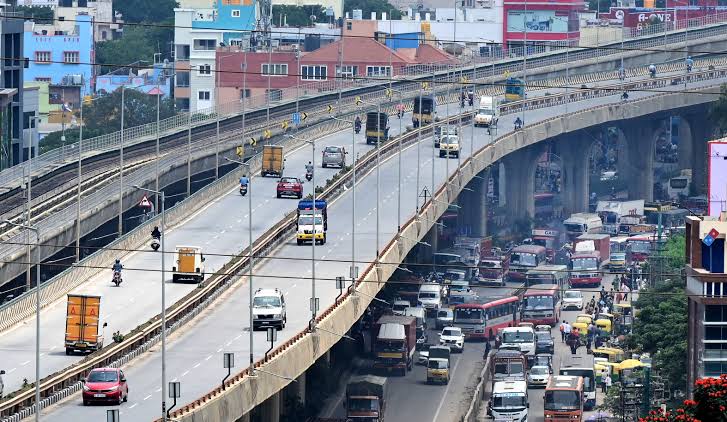
Bengaluru is introducing fresh restrictions on two-wheelers and autorickshaws across five flyovers from September 4, as authorities seek to improve traffic movement on key elevated corridors. The restrictions will apply during specified hours and are aimed at reducing congestion and improving traffic flow.
For commuters, the move could alter daily routes while testing whether targeted restrictions can deliver measurable improvements without shifting bottlenecks to nearby roads. The restrictions will cover Ejipura, Hennur, Kittur Rani Chennamma, Domlur and Nayandahalli flyovers. Two-wheelers and autorickshaws will be prohibited from using these structures during designated peak periods, making the surrounding road network an important part of the traffic-management strategy. The policy reflects a broader challenge for Bengaluru: traffic management cannot rely solely on adding road capacity. Flyovers can separate traffic streams and reduce delays at individual junctions, but their effectiveness depends on how vehicles enter, exit and connect with the wider road network. Restricting certain vehicle categories may improve movement on the structures while creating additional pressure on parallel roads if alternative routes are not adequately managed.For two-wheeler users, the impact could be particularly significant. Motorcycles and scooters form a large part of Bengaluru’s daily commuting ecosystem because they provide relatively flexible travel through congested areas.
Autorickshaws also play an important role in connecting commuters to Metro stations, bus corridors and neighbourhoods where public transport coverage is weaker. That makes Bengaluru flyover rules closely linked to the city’s public transport and last-mile mobility strategy. If restrictions push more commuters towards buses and Metro services, authorities will need sufficient frequency, capacity and convenient interchange options to absorb additional demand. Otherwise, displaced traffic could simply move to lower-level roads. The timing of the restrictions will also matter. Peak-hour enforcement needs clear signage, advance communication and consistent monitoring so that commuters can adjust routes before reaching restricted flyover approaches. Traffic authorities may also need to observe congestion on adjoining roads and modify signal timings where traffic is redirected. The restrictions come as Bengaluru continues to experiment with measures designed to manage an increasingly crowded road network. A more sustainable approach would combine traffic restrictions with stronger bus services, safer walking infrastructure, better cycling connectivity and improved feeder links to Metro stations.
For Bengaluru, the success of the Bengaluru flyover rules should therefore be measured not simply by faster movement on five flyovers, but by whether the wider network becomes more reliable. If the restrictions are supported by coordinated junction management and stronger public transport alternatives, they could become a useful traffic-management tool rather than another isolated road intervention.