


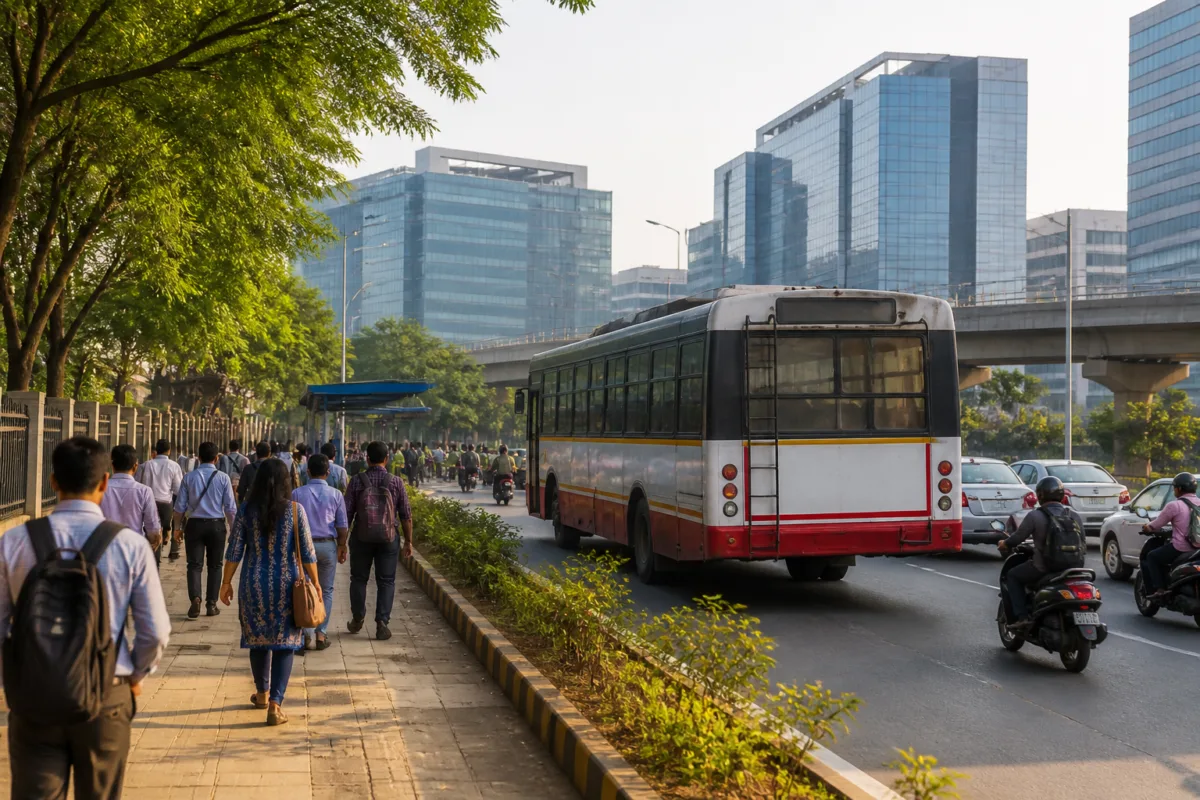
Cyberabad’s next phase of economic growth will depend heavily on whether its transport system can move more people reliably, safely and affordably, according to a recent Times of India article by Cyberabad commissioner of police Dr M Ramesh IPS, Cyberabad Municipal Corporation commissioner Dr G Srijana IAS and WRI India executive director Pawan Mulukutla.
The authors describe mobility as economic infrastructure rather than a service that follows growth. Cyberabad’s information technology districts, universities, hospitals, laboratories and commercial areas attract lakhs of daily commuters from Hyderabad and surrounding areas. But long and unreliable journeys can restrict access to employment, raise the cost of working in the region and make it harder for employers to attract and retain staff, they argue.
The article cites private vehicles as accounting for 82% of office commuting in Cyberabad’s key IT hubs, while public transport accounts for 2%. The figures are presented in the article but are not accompanied by a methodology or underlying survey in the material available for this report. The authors link this imbalance to congested junctions and the loss of commuters’ time.
Their argument challenges a road-capacity-first approach to congestion. Wider roads, flyovers and signal-free corridors may address individual bottlenecks, but the authors say the more important planning question is how more people can reach jobs, education, healthcare and essential services in less time. That shifts the focus towards more buses, dependable public transport, safer walking and cycling routes, better road connectivity and stronger first- and last-mile links.
A central element of this approach is better information about how the region moves. The article says mobility data visualisations can show where commuters live, where they travel, which corridors face the greatest pressure, which employment centres are poorly served by public transport and where connections to the network break down.
The proposed Cyberabad Moves 2026 public experience and convening is intended to make this evidence more accessible to decision-makers, employers and residents. According to the authors, it will bring together mobility data, institutional knowledge and commuter experiences to build a shared understanding of current travel patterns and identify changes needed to improve access. The source material does not provide a date, venue or confirmed list of participating organisations for the event.
Cyberabad already has an institutional basis for coordinated transport planning through the Hyderabad Unified Metropolitan Transport Authority, or HUMTA. The article also points to recent efforts by public agencies, civil society groups and communities to improve data and identify network gaps.
Among the examples cited is training organised by Cyberabad Traffic Police in traffic engineering and data-led traffic management. The article also refers to a mobility datajam conducted with WRI India and Open Data Telangana. Participants developed ideas including a combined mobility, infrastructure and environment atlas, better public transport access to schools and health centres, and improved connections to the metro network.
These initiatives point towards a planning model that combines transport, land use, public services and environmental information rather than treating individual road projects in isolation. Such coordination is important in a region where employment centres, housing communities and public transport routes do not always develop together. The article, however, does not provide project-level details, budgets or implementation schedules for the proposals it discusses.
Employers will also influence whether Cyberabad can reduce its dependence on private vehicles. The authors identify technology companies, global capability centres, hospitals, universities and commercial establishments as major generators of daily trips. They say these institutions can encourage public transport and shared mobility among employees, potentially influencing travel behaviour at a scale that public agencies cannot achieve alone.
Residential communities and resident welfare associations have a role as well. A commuter’s journey begins at the doorstep, not at a bus stop or office entrance, the authors note. This makes neighbourhood access, safe walking routes and convenient links to public transport important parts of the overall commute. Community feedback can also help planners identify problems that may not be visible in network-level data.
The Telangana State Road Transport Corporation, or TGSRTC, is identified as a central institution in improving mobility in Cyberabad. The article calls for additional buses and depots, better bus stops, real-time passenger information and digital ticketing. It also notes that buses themselves lose time in congestion, making bus priority, reliable operations and improved corridor performance important to any shift away from private vehicles.
The choices now being made about public transport, streets, road connectivity, land use and first- and last-mile access will shape daily journeys for years, according to the authors. Their broader conclusion is that Cyberabad’s mobility challenge cannot be solved by one agency or one infrastructure project. Government bodies, police, transport operators, employers, institutions, researchers, technology companies, communities and commuters will need to work from shared evidence.
The immediate value of the Cyberabad Moves 2026 initiative, if delivered as described, will therefore depend on whether it converts data and discussion into funded, coordinated actions. The source article establishes the scale of the mobility concern and identifies possible responses, but leaves open questions about targets, delivery responsibilities, financing and timelines. Those details will determine whether better mobility becomes a planning principle or a series of disconnected interventions.

