


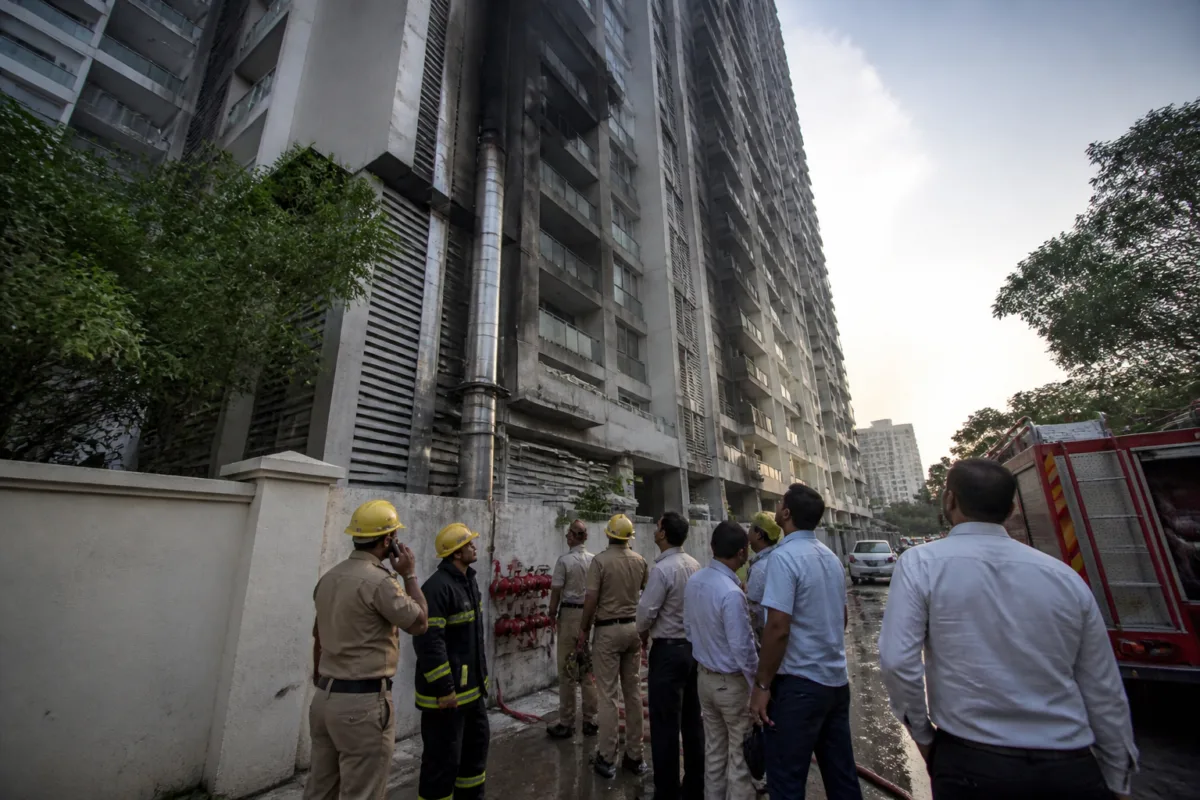
A fire at Pacifica Hillcrest in Puppalaguda has renewed scrutiny of Hyderabad’s preparedness for emergencies in high-rise housing, where firefighting access, internal protection systems and resident readiness become increasingly important as buildings rise above the reach of external equipment.
Fire officials told the Times of India that the department’s hydraulic skylifts can reach about 30 metres, or roughly nine to 10 floors. In taller buildings, this limits the scope for external firefighting and rescue operations and increases reliance on systems installed within the building, including hydrants, pumps, sprinklers, smoke detectors and evacuation arrangements.
The report said most of Pacifica Hillcrest’s fire-safety equipment was in place and that officials credited the building’s hydrants and internal fire-protection equipment with helping contain the blaze. The fire reportedly spread from the eighth to the 18th floor. Residents and officials said air-conditioning compressors inside ducts had been covered with fibre-reinforced plastic, or FRP, sheets, which were suspected of contributing to the spread. That account remains an attributed assessment rather than an independently established finding.
Ganesh Reddy Keesara, general secretary of the Hillcrest residents’ association, said gas pipelines installed according to safety norms were unaffected because the fire was contained in time. He also said sprinklers were installed in halls and bedrooms but not in bathrooms and kitchens, where the fire originated. The account underscores how the performance of a fire-safety system can depend not only on whether equipment has been installed, but also on where it is located, how it is maintained and whether residents know how to use it.
Under the National Building Code classifications cited by fire officials, buildings above 15 metres are treated as multi-storeyed buildings, while those measuring 24 metres and above fall within the high-rise category under revised norms. The source report said this replaced an earlier 18-metre threshold for high-rises. Fire-safety requirements, including extinguishers, pump rooms and sprinklers, vary according to building height.
The distinction has practical consequences for Hyderabad’s vertical growth. According to the report, more than 850 high-rise buildings are in the pipeline across the city. The list includes a proposed 72-storey tower in Ghatkesar that has received provisional approval and is being described as one of South Asia’s tallest buildings. As buildings become taller, the gap between the reach of external equipment and the upper floors makes dependable internal systems and evacuation procedures more consequential.
A fire official cited limited manpower as a difficulty in inspecting and monitoring every building regularly. Residents’ welfare associations are responsible for maintaining fire-safety equipment and conducting mock drills at least once every six months, the official said, but compliance remains a concern. The official pointed to inadequate maintenance of extinguishers, pumps, sprinklers and smoke detectors in some buildings, as well as reluctance among some associations to spend on annual maintenance.
Pujitha Balireddy, a high-rise resident and treasurer of the United Federation of RWAs, Cyberabad, also raised concerns about combustible FRP sheets used to conceal external utility pipes. She said fire safety should not be treated as merely obtaining a Fire NOC or installing equipment, and that regular maintenance was equally important.
The report cited experts who said safety could be compromised during construction and later weakened when residents’ associations reduce maintenance spending. They estimated that annual fire-safety maintenance could add 25–40 paise per square foot. The figure was presented as an expert estimate in the report and was not accompanied by a cost schedule or independent verification.
Resident preparedness is another part of the safety chain. Keesara urged residents to learn how to operate extinguishers and participate in emergency exercises, while noting that department-led mock drills need to be complemented by resident awareness. For a high-rise building, evacuation depends on more than a single response agency: installed systems, access to escape routes, smoke management, maintenance records and residents’ familiarity with emergency procedures all influence how occupants can respond.
Srinivas Valluri, national president of the Fire and Security Association of India, said the organisation would involve RWAs and residents in a later phase of its work. He also urged builders and associations to consider the voluntary Suraksha Index, a fire and security rating system based on audits by accredited professionals. SP Anchuri, vice-president of the Council for Fire & Life Safety Professionals, said fire safety should extend beyond statutory compliance to building design, construction and maintenance.
The Puppalaguda fire therefore places the focus on a continuing governance challenge: ensuring that safety systems in a rapidly expanding high-rise city remain functional after approvals are granted and buildings are occupied. The reported performance of Pacifica Hillcrest’s internal equipment shows the value of those systems, while the concerns over access, maintenance, materials and resident training point to the areas that require sustained oversight.

