


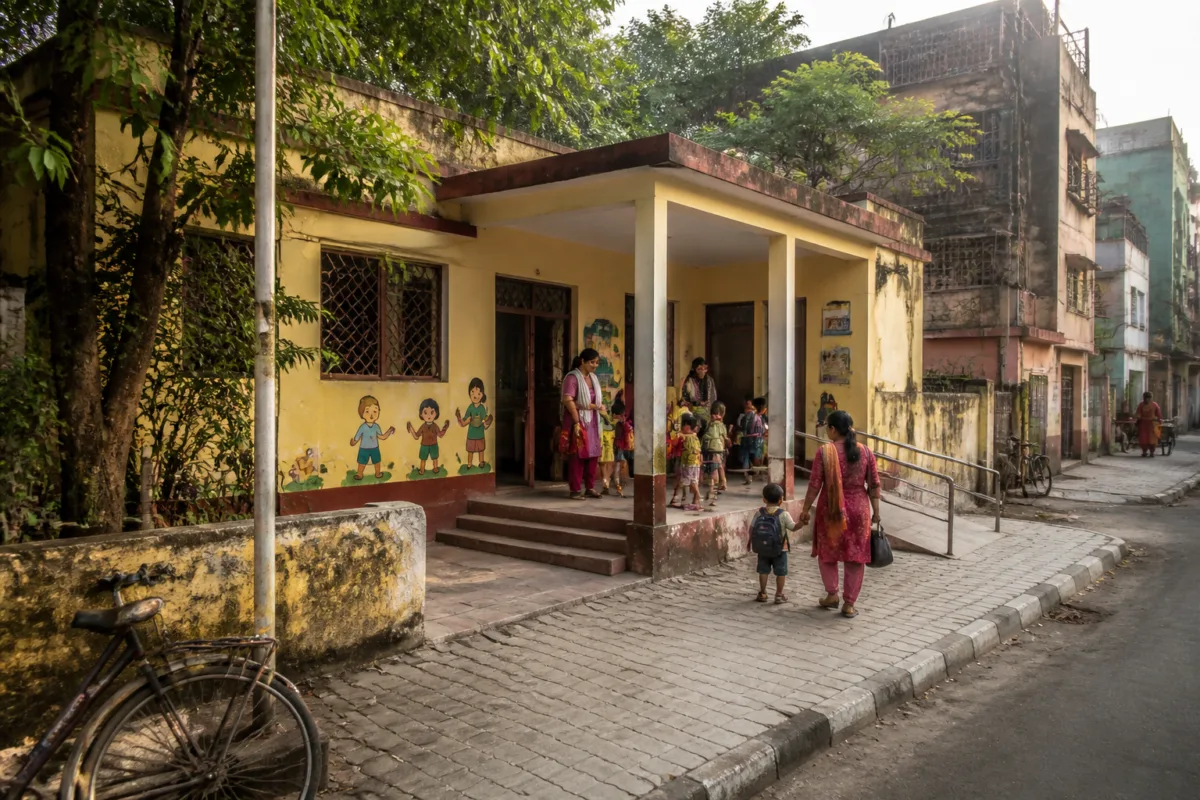
The Calcutta High Court has held that Anganwadi Centres are educational institutions for the purpose of restrictions on liquor-shop locations, preventing a proposed outlet from being established within the prohibited distance of such a centre.
A division bench of Justice Shampa Sarkar and Justice Partha Sarathi Chatterjee delivered the order on November 12 in an appeal concerning a proposed liquor shop in Hooghly. The petitioner, Aloke Kuma Dey, had challenged the rejection of his request for permission to operate the shop at a site he said was more than 1,000 feet from an Anganwadi Centre.
The court relied on Rule 8 of the West Bengal Excise (New Sites and Grant of Licence) Rules, 2003. The rule bars liquor shops within the specified vicinity of educational institutions recognised by the state or central government, as well as places of worship and hospitals. The report identifies the distance under the rule as 1,000 feet, or slightly more than 300 metres.
Dey’s counsel argued that an Anganwadi Centre could not be treated as an educational institution recognised by the state or central government. The division bench rejected that position. It referred to the National Food Security Act, 2013, which defines an Anganwadi Centre as a child-care and development centre established under the Centre’s Integrated Child Development Services scheme. The court also noted that states have established such centres to provide care and elementary education to children aged three to six years.
The state’s counsel told the court that a January 20, 2012 notification of the excise department specified that Anganwadi Centres should not be excluded from the definition of an educational institution. On that basis, the bench upheld the application of the location restriction to the centre involved in the case.
The court clarified that Dey could approach the authorities again if he believed the proposed liquor-shop site was more than 1,000 feet from the Anganwadi Centre. The order therefore does not impose a blanket prohibition on the petitioner’s proposal; it makes the distance from the centre and compliance with the applicable rule decisive.
The ruling places Anganwadi Centres within the practical framework used for regulating sensitive land uses around public-serving institutions. These centres are not limited to preschool activities. According to the report, they serve children up to six years, pregnant and lactating women and adolescent girls through supplementary nutrition, growth monitoring, play-based preschool education, immunisation, routine health checks, maternal and menstrual-health counselling and medical referrals.
West Bengal has 119,481 Anganwadi Centres, including more than 1,500 within the Kolkata Municipal Corporation area, according to the report. Their recognition in liquor-licensing decisions could therefore affect the scrutiny of proposed sites across urban and rural settlements.
The report also states that the required distance was increased in September 2026 to 500 metres in Kolkata and other municipal areas and to one kilometre in rural areas. It does not provide the specific notification or explain how the revised distances interact with the 1,000-foot limit discussed in the court order. That relationship will need to be read alongside the applicable excise rules and subsequent government notifications when authorities assess future applications.
For local licensing authorities, the immediate significance of the judgment is clear: an Anganwadi Centre cannot be disregarded when determining whether a proposed liquor outlet falls within a prohibited vicinity. Applicants and authorities will need to establish the location of the centre and measure the relevant distance before a licence can be granted.

