


AI data centre investment is no longer only a technology story. It is becoming an urban infrastructure and financial-system question, as new facilities connect technology companies, semiconductor manufacturers, cloud providers, energy firms, property markets and lenders through a rapidly expanding network of capital expenditure and commercial contracts.
That connection is at the centre of concerns raised by Jeff Schmid, president of the Federal Reserve Bank of Kansas City. Speaking about the artificial intelligence boom, Schmid questioned whether the industry could become so interconnected and economically significant that it becomes “too big to fail”. His remarks, reported by Reuters and carried by Economic Times, point to a challenge for central bankers: understanding what is being built around AI, who is financing it and how the consequences of distress could travel through the wider economy.
The concern is not that AI infrastructure has already produced a financial crisis. The supplied report does not establish such an event. Instead, it identifies a question about how policymakers should monitor a sector whose physical and financial footprint is expanding at the same time. Data centres require substantial construction, computing equipment, power and connectivity. Their development therefore involves a wider urban system than the technology companies that ultimately use them.
This makes the AI build-out different from a conventional software expansion. The ecosystem described by Schmid includes technology companies, semiconductor firms, cloud providers, data-centre operators, energy companies and financial institutions. Their relationships can be formed through investment, supply chains, financing arrangements and long-term commercial contracts. As these connections multiply, a problem in one part of the system may have implications for other participants, even when those participants operate in different sectors.
The Federal Reserve’s stated challenge is to understand “what’s inside” the emerging ecosystem and determine whether anything within it is systemic. That requires looking beyond company valuations. It means examining the underlying infrastructure, the financing structures that support construction and equipment purchases, the contracts that secure computing capacity and the dependencies linking data centres to power providers and other urban utilities.
The comparison with the 2008 financial crisis is intended to illuminate this problem, not to establish that AI and housing finance are identical. Before the crisis, financial institutions were connected through lending, securities and complex financial contracts. Exposure to the US housing and mortgage markets spread through that network, and the collapse of Lehman Brothers intensified the disruption. The episode demonstrated how institutions considered systemically important could transmit stress across the wider economy when their relationships were difficult to map or unwind.
The emerging AI ecosystem has a different structure. Its connections, as described in the report, are based largely on technology supply chains, capital expenditure, computing capacity, cloud infrastructure, semiconductor supply, power requirements and commercial agreements. These are not the same instruments that linked banks before 2008. But they can still create forms of dependence that matter for cities and infrastructure markets.
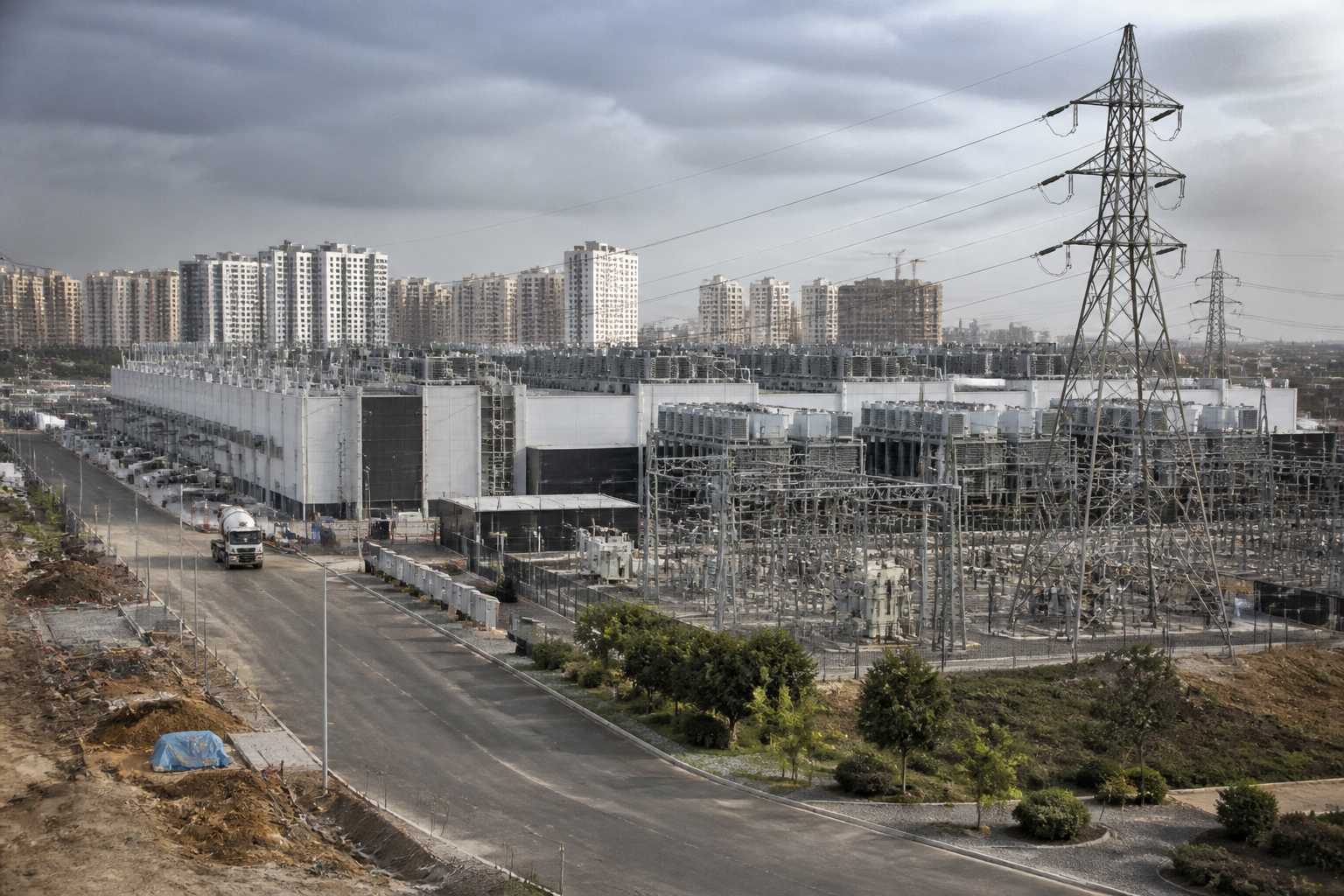
A data centre is a physical asset, not merely a digital service. Its construction draws on land, buildings, electrical systems, cooling equipment, communications networks and access to reliable power. The report also places data-centre investment in relation to real estate, utilities, construction, energy and financing. That means the expansion of AI can affect decisions about where infrastructure is built, how urban land is used and how large capital projects are funded.
The urban dimension is especially important because the infrastructure is often distributed across several institutional responsibilities. A data-centre operator may control the facility, while an energy company supplies power, cloud providers contract for capacity and financial institutions support investment. Construction firms deliver the physical asset, property interests are tied to the site and public authorities oversee aspects of planning or utility provision. The supplied material does not identify a specific city, project or regulatory failure, but it shows why the system cannot be understood through the balance sheet of a single AI company.
This network also changes the meaning of infrastructure demand. If computing capacity expands rapidly, data-centre operators may commit to new facilities and long-term arrangements before the full economic significance of the ecosystem is clear. The report does not state that these commitments are excessive or unsustainable. It does, however, identify the need to understand how investment, capacity and contracts interact. For policymakers, the question is whether a concentration of obligations could create vulnerabilities beneath the visible technology boom.
The issue is therefore partly one of institutional visibility. Central bankers traditionally monitor financial conditions, credit and economic activity. Urban authorities and infrastructure agencies deal with land, construction, energy and services. Companies manage their own commercial relationships. The AI ecosystem crosses all these boundaries. A risk may not appear as a problem in any single category while still becoming significant when the categories are considered together.
Schmid’s comments suggest that policymakers may need a clearer map of these relationships. That map would need to show which companies depend on common suppliers, how data-centre construction is financed, what commercial commitments support future capacity and how closely the sector is tied to energy and other infrastructure providers. The supplied report does not describe a new supervisory framework or a formal policy response. It establishes the concern and the analytical task: to identify connections before a disruption exposes them.
That task is complicated by the speed of investment. The report describes the AI and data-centre build-out as accelerating, which means infrastructure decisions may be made while the market is still forming. Technology platforms, chip suppliers, cloud companies, operators and financiers may all be responding to expectations about future demand. Their investments can reinforce one another, creating an ecosystem whose economic importance grows alongside its physical footprint.
For cities, this raises questions about how major digital infrastructure should be assessed. A data centre may appear as a private construction project, but its requirements connect it to power systems, land markets, roads, communications networks and local development patterns. The supplied material does not provide figures on land consumption, electricity demand, employment or municipal revenue, so those impacts cannot be quantified here. What it does show is that data-centre investment sits within the built environment and cannot be treated as an isolated technology transaction.
The financial question is equally connected to the physical one. Large facilities require capital before their economic returns are fully realised. Financing arrangements and long-term contracts can distribute exposure across companies and institutions. If those relationships become highly concentrated, difficulties at one major participant could affect suppliers, operators, lenders or infrastructure commitments. Whether that would amount to a systemic risk remains unresolved in the supplied evidence, which is why Schmid framed it as a question for investigation rather than a conclusion.
The comparison with 2008 also carries an important limitation. The earlier crisis involved a documented chain of mortgage-related financial exposures and the failure of major financial institutions. The AI ecosystem described here is still being examined through its infrastructure and commercial links. Similarity in interconnectedness does not mean similarity in cause, scale or outcome. A responsible assessment therefore requires identifying the actual contracts, financing structures and dependencies rather than assuming that the historical parallel proves a future crisis.
The bigger urban question is whether governance systems are equipped to see infrastructure as a network rather than as a series of separate projects. AI investment links digital services to construction, real estate, utilities and finance. That creates a need for information that is not confined to one company, one regulator or one planning approval. Without visibility into those relationships, policymakers may know that construction is accelerating without knowing how much of the ecosystem depends on the same suppliers, lenders, energy arrangements or commercial commitments.
Schmid’s remarks confirm that the Federal Reserve is seeking to understand this emerging network and whether it contains systemic vulnerabilities. They do not establish that the AI sector is already too big to fail, nor do they identify a specific failing project or institution. The developments that require monitoring are the scale of data-centre construction, the financing structures behind it, the concentration of commercial and supply-chain relationships, and the links between AI infrastructure and energy, real estate and other urban systems.
