


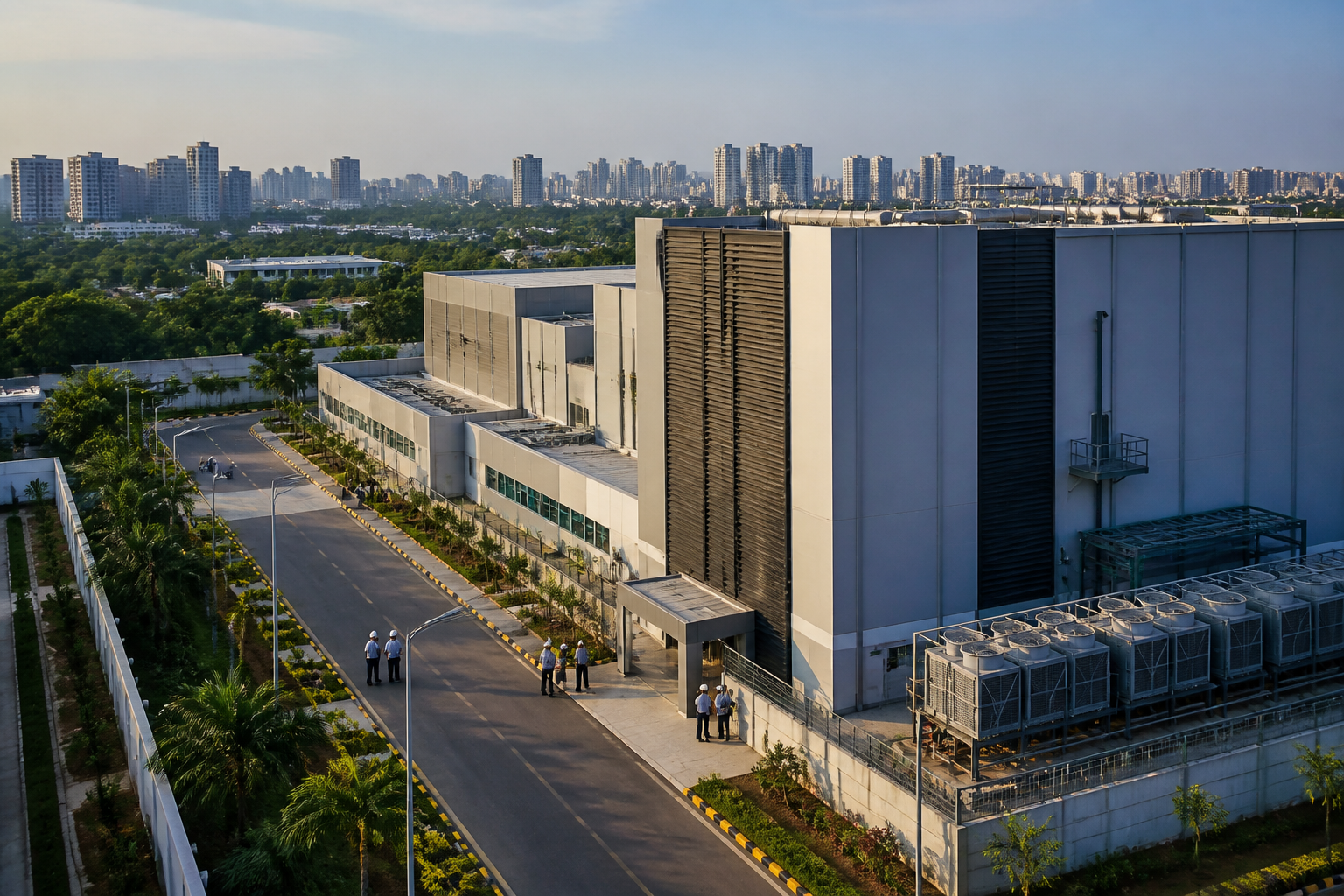
Microsoft’s opening of its India South Central cloud region in Hyderabad has given Telangana’s data-centre ambitions a more concrete form. The state is targeting 5GW of hyperscale capacity by 2029 and sees a potential $30 billion investment across the AI and digital infrastructure ecosystem. The significance of the announcement lies not only in the scale of the proposed investment, but in the physical and institutional systems Hyderabad will need to expand alongside it.
The new region is Microsoft’s fourth cloud region in India and its largest hyperscale footprint in the country, according to the report. Microsoft has described Hyderabad as a strategic hub for Asia and the Global South. The facility is intended to bring cloud and AI infrastructure closer to businesses, technology talent and innovators, supporting AI-led enterprises and digital services in the region.
That positioning builds on Microsoft’s more than two-decade presence in Hyderabad, which spans engineering, innovation, cloud infrastructure and AI. The company’s expansion therefore connects an established technology base with a new class of infrastructure: large-scale computing facilities designed to support cloud services, artificial intelligence and high-density digital workloads.
The numbers show the distance between Telangana’s current position and its stated target. The state’s hyperscale and AI infrastructure ecosystem already has 300MW of data-centre capacity in operation, while 2GW is under development. Reaching 5GW by 2029 would require the planned projects to move forward and additional capacity to be delivered within a relatively defined period. The announcement does not provide a project-by-project schedule, financing structure or details of the land and utility arrangements that would support the remaining capacity.
That gap matters because data-centre capacity is not created by buildings alone. It depends on a coordinated system of electricity supply, high-capacity telecommunications, land, construction contractors, equipment, cooling technology and operations staff. The report identifies a shift from conventional enterprise facilities towards AI-scale compute, high-density graphics processing units, hyperscale cloud and advanced cooling systems. This represents a change in the infrastructure profile of the sector as well as an increase in its technical requirements.
For Hyderabad, the expansion could reinforce an existing concentration of technology activity. Telangana’s industries minister said the state has more than 500 global capability centres and that the Microsoft development adds strength to its ambition to become India’s innovation capital. The presence of global capability centres provides an institutional and commercial base for the cloud region, but the report does not establish how many new jobs, companies or facilities the latest investment will directly create.
The urban implications are clearest in the resource requirements. Large computing facilities need dependable electricity and systems capable of maintaining operations continuously. As projects increasingly support AI workloads, the demand profile can also be different from that of conventional office-led technology activity. The supplied report does not quantify the power requirement of the proposed 5GW ecosystem or identify the generation, transmission and distribution upgrades required to serve it. Those details will be important in assessing how the expansion fits into Telangana’s wider infrastructure planning.
Water is another significant part of the discussion, particularly for a city whose technology growth is taking place within a broader urban system of competing needs. Microsoft says the India South Central region operates with effectively zero water use for cooling. This is a notable design claim because cooling is central to the operation of data centres, and newer AI facilities are being developed around advanced cooling systems. However, the report does not explain the technology used, the facility’s total water demand for purposes other than cooling, or whether other data-centre projects in the state will adopt comparable systems.
The distinction between a company-specific facility and an ecosystem-wide standard is important. Microsoft’s reported approach can reduce pressure associated with cooling at its own region, but Telangana’s 5GW target includes multiple companies and projects. The report names AWS, Iron Mountain, CtrlS, Sify, TCL, NTT DATA and CapitaLand among global and industry players investing in large-scale compute and data-centre infrastructure in the state. It does not provide the capacity, construction status or resource profile of each project. As a result, the aggregate sustainability performance of the planned ecosystem remains to be established.
The institutional model is beginning to take shape through skills programmes as well as physical investment. Microsoft’s Data Center Academy, developed with the International Institute of Information Technology Hyderabad, Young India Skills University, the Government of Telangana and Don Bosco Tech Society, is a 600-hour programme for careers in data-centre operations and infrastructure management. The programme indicates that the state and the company see workforce preparation as part of the infrastructure challenge, rather than as a separate education initiative.
This is significant because the expansion described in the report requires specialised roles across operations, electrical systems, cooling, maintenance, network infrastructure and facility management. The supplied material does not state how many people the academy will train or how its graduates will be absorbed by projects under development. It nevertheless establishes a direct link between the physical expansion of computing capacity and the need to create a local talent pipeline.
Microsoft is also supporting a Green Skills & Applied AI Centre of Excellence in Hyderabad with the Telangana government, 1M1B and MeitY Startup Hub. The initiative includes a dedicated Green Pharma track. The report presents this as part of Telangana’s sustainability and talent agenda, connecting data-centre expansion with a broader effort to develop applied skills and innovation capacity. The precise outputs, funding commitments and institutional responsibilities of the centre are not specified in the supplied material.
The policy landscape emerging from the announcement is therefore a partnership model. The state government is setting an investment and capacity ambition, Microsoft is adding a major cloud region and skills infrastructure, academic and training institutions are participating in workforce development, and several private companies are investing in data-centre projects. This multi-institutional structure can help align technology investment with local capability, but it also makes implementation dependent on coordination across agencies and companies.
The target of 5GW provides a measurable headline figure, but it does not by itself describe the quality or distribution of the infrastructure. Capacity may be located in different sites, connected to different utility systems and developed on different timelines. Nor does the figure indicate how much capacity will serve domestic businesses, global cloud customers or AI-intensive workloads. The supplied report establishes the scale of the ambition, but not its final economic or spatial outcomes.
The same caution applies to the potential $30 billion investment estimate. It signals the size of the opportunity Telangana associates with AI and digital infrastructure, but the report does not identify whether the figure represents committed capital, a projected pipeline or a broader ecosystem estimate. Treating it as realised investment would go beyond the evidence. Its immediate value is as an indicator of the scale at which the state is presenting the opportunity to investors and the public.
For Hyderabad, the larger urban question is whether data-centre growth will be planned as a connected infrastructure system rather than as a series of isolated private projects. The answer will depend on information that is not yet provided in the announcement: project-level timelines, power and connectivity arrangements, land requirements, water accounting, construction progress, employment numbers and the division of responsibility between the state, utilities and companies.
The Microsoft opening confirms that Hyderabad is strengthening its position in India’s cloud and AI infrastructure network. Telangana’s 5GW target and the reported 300MW operating base, 2GW under development and potential $30 billion ecosystem opportunity show the scale of the next phase. What remains uncertain is how quickly the pipeline will become operational capacity and whether resource efficiency, skills development and public infrastructure will expand at the same pace. Those implementation details will determine whether the target becomes a durable urban technology ecosystem or remains primarily an investment ambition.
