


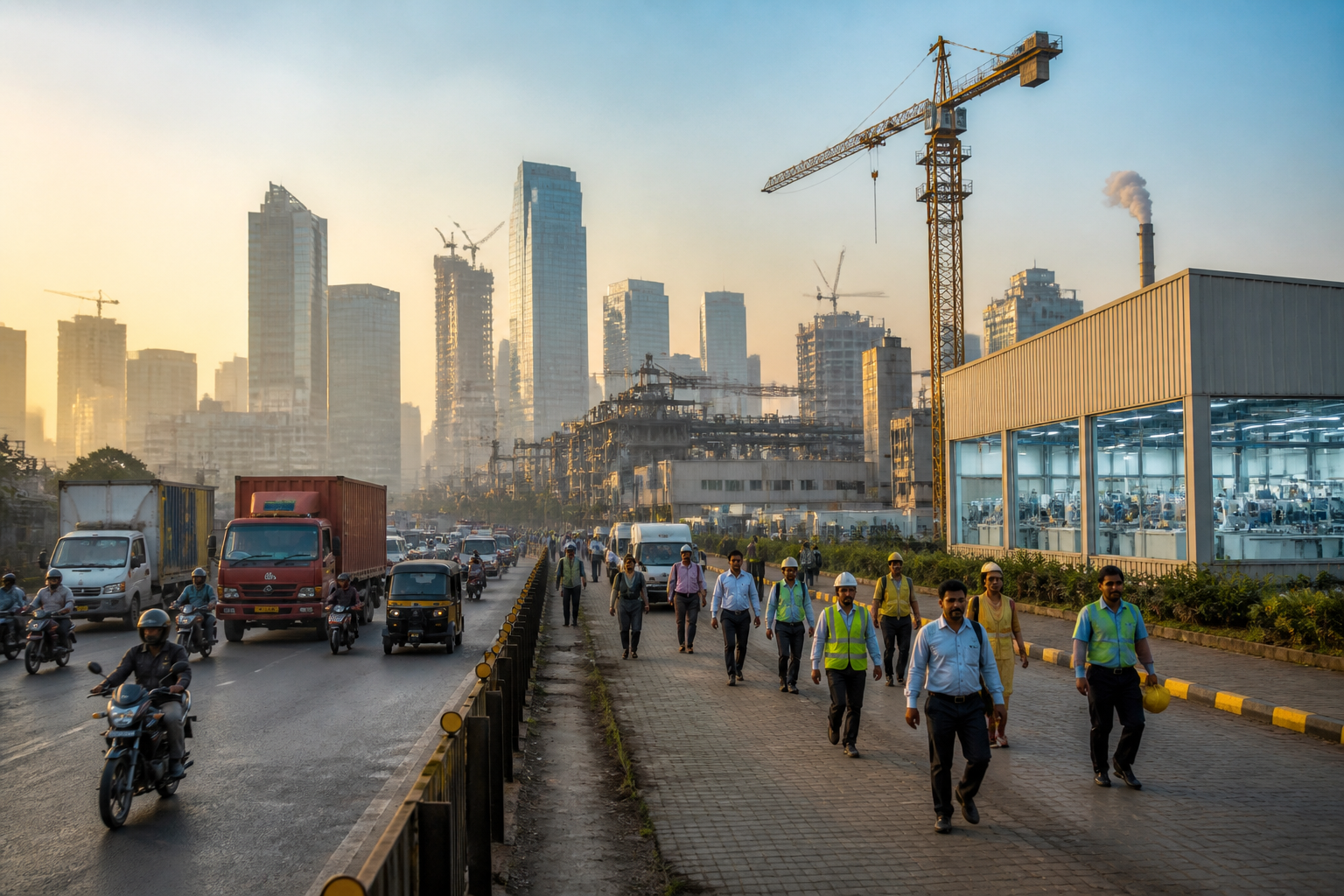
India’s economic growth remains resilient at 7.8%, but the country’s next phase of development faces three near-term risks identified by Chief Economic Adviser V Anantha Nageswaran: unsettled relations with the United States, volatile energy prices and the absence of a clear artificial intelligence-led growth strategy. His remarks place a current growth number against a more difficult institutional question: whether India can convert resilience into manufacturing capacity, employment and economic security.
Speaking at the State Bank of India’s Banking and Economics Conclave in Mumbai, Nageswaran described India-US relations as being in an “uneasy equilibrium” while trade-related differences continue. He also pointed to geopolitical tensions, the weaponisation of supply chains, climate variability and competition from China’s manufacturing capabilities as pressures shaping India’s development environment.
The significance of the remarks extends beyond the immediate risks. Each of the three headwinds exposes a different dependence in the growth model. International trade relations can affect access to markets and capital. Energy-price volatility can raise uncertainty for an economy that requires sustained investment and production. The absence of an AI play raises a different concern: whether growth will generate enough suitable employment as technology changes the way businesses operate.
Together, these concerns suggest that the debate is no longer only about maintaining a high growth rate. It is also about the composition of that growth, the strength of domestic capabilities and the ability of institutions to prepare workers and firms for a more uncertain economic environment.
India’s manufacturing challenge is central to that question. Nageswaran said manufacturing must do more than diversify economic growth. It must also strengthen resilience and economic security. He argued that India cannot choose between manufacturing and services and must pursue both while working towards becoming a developed nation by 2047.
The distinction matters because domestic production alone would not resolve the underlying problem. Nageswaran said India’s goods trade deficit remains around 3.5-4 per cent of GDP even after excluding oil and gold. He also cautioned that indigenisation cannot be limited to replacing imports with domestic production. Manufacturing capability must be accompanied by export competitiveness.
That framing shifts the policy focus from simply producing more within the country to building firms and supply chains that can compete beyond the domestic market. It also raises questions about the quality of the industrial ecosystem required to achieve that objective. In the account of his remarks, Nageswaran emphasised policies at both the state and national levels, rather than treating investment and industrial growth as responsibilities of the Union government alone.
For urban economies, this has a direct relevance through employment and the concentration of economic activity. The source material does not provide city-level employment or manufacturing data, but the CEA’s emphasis on investment, skilled workers and labour-intensive manufacturing places livelihoods at the centre of the growth discussion. The urban question is therefore not only whether economic output rises, but whether the expansion produces a sufficiently broad range of jobs and supports the services and production systems on which cities depend.
Foreign investment is the second institutional test identified by Nageswaran. As developed economies compete to attract capital, he said India would need stronger policies at both the state and national levels. He identified tax certainty and simplicity, investor protection and the availability of a skilled workforce as important conditions for attracting foreign investment.
These priorities describe investment as a governance issue as much as a financial one. Capital may respond to the size of the Indian market, but the CEA’s remarks suggest that policy predictability and workforce capability are also part of the competition. The emphasis on state-level policy is particularly important for the distribution of economic opportunity, because investment decisions are shaped through multiple layers of administration rather than by a single national announcement.
The third issue is the vulnerability of global supply chains. Nageswaran said India should build buffers in critical commodities and develop capabilities in smaller but strategically important components that could become choke points in global supply chains. This approach goes beyond headline manufacturing sectors. It places attention on the less visible parts of production whose absence can disrupt larger systems.
The remarks also connect supply-chain resilience with the broader international environment. India’s development journey, according to Nageswaran, is unfolding amid geopolitical tensions, climate variability and competition from China’s manufacturing capabilities. His call to “reimagine and be prepared to reinvent” the ways the private and public sectors operate reflects the scale of adaptation he believes the changing environment requires.
The evidence supplied does not identify specific commodities, components, schemes or funding commitments. It does, however, establish a policy direction: building domestic buffers, strengthening manufacturing and improving export competitiveness are being presented as linked objectives rather than separate programmes.
The AI challenge is different from the manufacturing and supply-chain questions because it is explicitly about the future of work. Nageswaran said India’s approach should go beyond frontier AI development and focus on how the technology could affect jobs. He called for the creation of both AI-enabled and AI-insulated jobs.
That formulation recognises that the employment effects of AI will not be limited to highly technical occupations. The CEA identified labour-intensive manufacturing as one source of employment and pointed to hospitality, tourism and elder care as services that could also play a role. The emphasis is therefore on a wider employment strategy in which some jobs use AI and others remain less exposed to it.
For cities and their labour markets, the distinction is consequential even though the supplied report does not provide a forecast of job losses or gains. A growth strategy centred only on advanced technology could leave unanswered the question of how workers without specialised technical skills will participate in the next phase of expansion. Nageswaran’s remarks instead point towards a combination of technology adoption, labour-intensive production and service-sector employment.
This is also where the three headwinds overlap. Manufacturing can support employment and reduce external vulnerabilities, but it requires investment, skilled workers and access to reliable supply chains. AI can improve productivity, but it also creates a need to prepare for changes in the nature of work. Foreign investment can support capacity, but its effectiveness depends on tax policy, investor protection and workforce availability.
The policy landscape described at the conclave is consequently cross-cutting. Digital public infrastructure, inclusion, capital expenditure and formalisation were identified as reforms that have contributed to sustained growth of 7 per cent or above. Nageswaran’s remarks place these achievements alongside a demand for further institutional strengthening in manufacturing, investment policy, supply-chain planning and employment preparation.
The available figures offer a useful contrast. India’s economy has grown 7.8 per cent, while growth of 7 per cent or above has been sustained, according to the CEA’s remarks. Yet the goods trade deficit remains around 3.5-4 per cent of GDP after excluding oil and gold. The data therefore presents both momentum and an unresolved structural gap: high growth has not removed the need to improve domestic production and export competitiveness.
No additional figures were provided in the supplied report on energy prices, foreign investment flows, AI adoption or employment outcomes. That absence limits how far the risks can be quantified. The remarks establish the areas of concern, but not the likely size of their economic impact or the timelines for addressing them.
The larger urban and institutional question is whether India’s growth can become sufficiently employment-intensive, geographically distributed and resilient to external disruptions. The source material does not answer that question, but it identifies the policy components that will shape it: manufacturing and services together, investment rules across state and national governments, critical supply-chain capabilities and jobs designed for an AI-driven economy.
What the evidence confirms is that India’s current growth momentum has not eliminated its vulnerability to external conditions or technological change. What remains unresolved is how the identified priorities will be translated into specific policies, investments and employment outcomes. Those implementation details—not the growth number alone—will determine whether resilience becomes a durable development advantage.
