


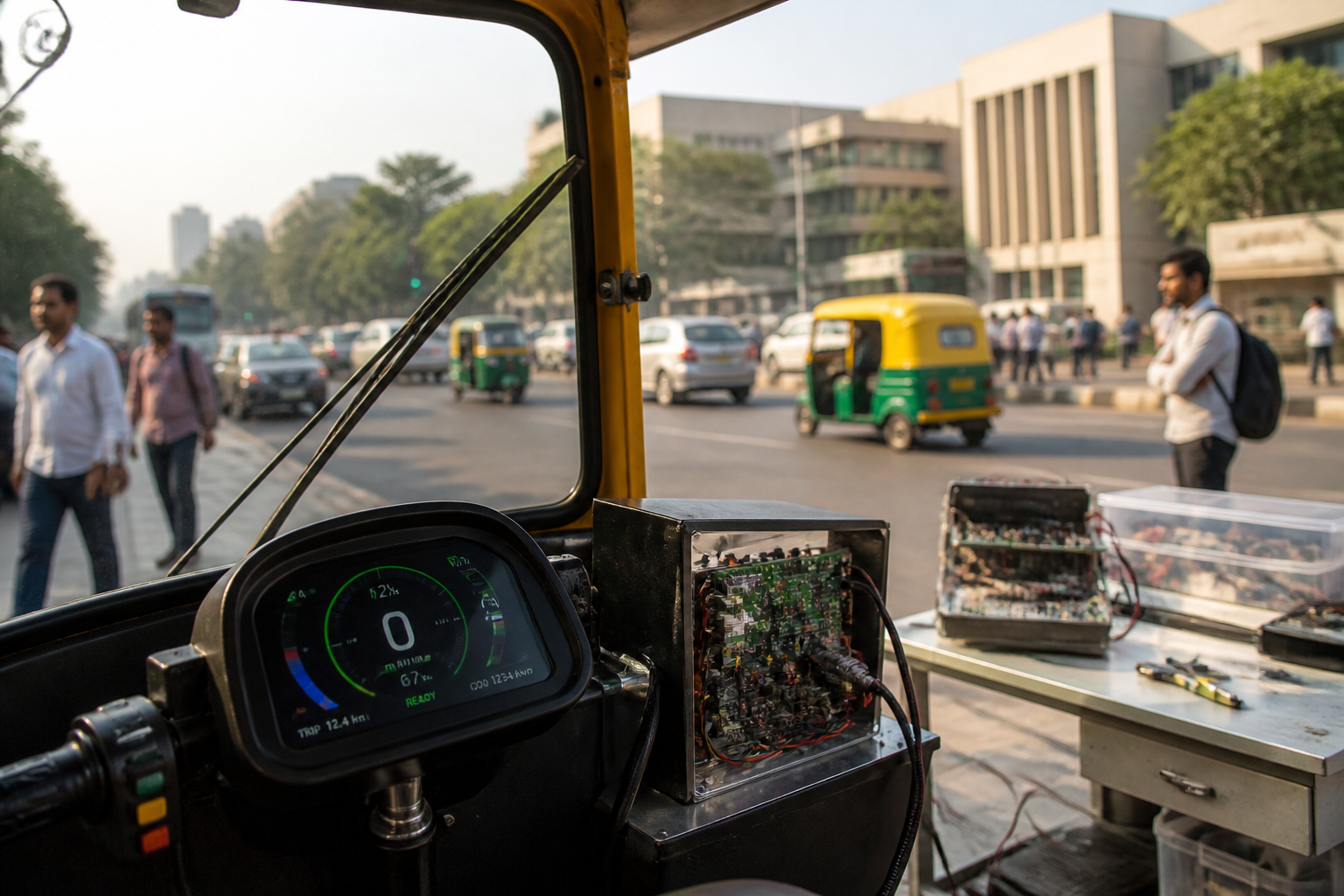
IIT Delhi researchers have developed India’s first working and demonstrable indigenous micro-GPU, a processor design that could eventually support low-cost electronic systems including e-rickshaw dashboards, industrial displays and navigation terminals.
The micro-GPU was designed by researchers in the institute’s Department of Electrical Engineering. According to the institute, the development is the first such micro-GPU designed and developed by an Indian university to be successfully demonstrated.
A graphics processing unit, or GPU, is a processor used to handle image, video and graphics-related calculations in computers and electronic devices. GPUs are also used in artificial intelligence and machine-learning applications. IIT Delhi said that all GPUs currently used in India are imported, meaning the new design could help reduce dependence on overseas technology if it is developed for commercial use.
The research team worked under the guidance of Professor Jayadeva and Professor Kaushik Saha. MTech students Nammi Akash and M. Ravi Teja worked on the project, which was created as a fully digital design and tested on specialised programmable hardware.
During the demonstration, the micro-GPU showed that it could generate graphics and display them on a screen. The current design is intended for applications where affordable graphics-processing capability is required rather than for high-end consumer computing or advanced data-centre workloads.
Potential uses identified by the research team include displays for industrial machines, human-machine interfaces, e-rickshaw dashboards, navigation terminals on small fishing vessels and educational e-book readers. The design can also be used on programmable hardware platforms such as application-specific integrated circuits and field-programmable gate arrays.
For urban transport, the stated e-rickshaw application points to a possible use in dashboard and vehicle-interface systems. The report does not establish that the micro-GPU has already been deployed in e-rickshaws or other vehicles. Its current status is a demonstrated design, while further development and commercialisation work remains to be completed.
The team is now working on an upgraded version based on an eight- to 16-core vector graphics processor. It also plans to develop a compiler, graphics software and an initial chip model for the technology.
The researchers will seek financial support for commercial applications and work towards taking the technology to the market. No commercial deployment timeline or confirmed industry partner has been announced in the supplied report.
