


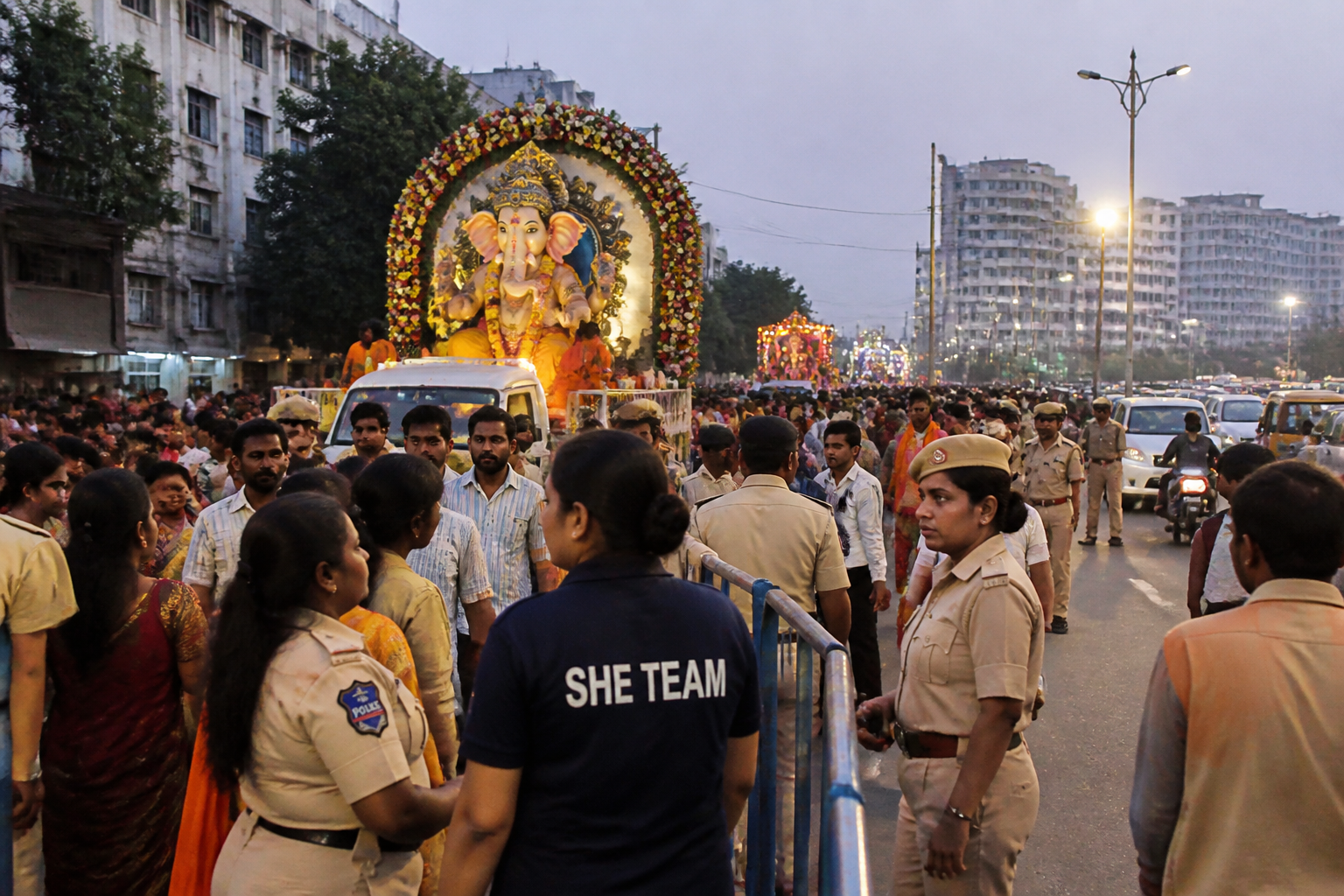
Hyderabad police’s reported detention of 1,530 people during the city’s Ganesh festivities offers more than a festival-season enforcement update. It reveals the scale of the public-safety task created when religious gatherings, crowded public spaces, immersion routes, vehicles and social-media-driven behaviour converge in a dense urban setting. The figures also show that festival policing involved two distinct challenges: preventing harassment and objectionable behaviour around crowded locations, and stopping dangerous acts during processions.
According to the Times of India report, Hyderabad police’s SHE Teams acted during pre-immersion Ganesh festivities held from September 14 to 23. The teams were deployed at major Ganesh pandals, crowded places and immersion routes, with particular attention to the Khairatabad and Balapur celebrations. Police said 1,530 people were apprehended for eve-teasing and other objectionable activities during this period.
The enforcement response did not result in the same outcome for everyone detained. Of those apprehended, 724 were counselled, warned and released after verification, while 48 were convicted. The report does not provide details of the offences, the courts involved, the legal provisions applied or the status of the remaining cases. That distinction matters because a detention figure is not the same as a conviction figure, and the supplied report does not establish the complete legal outcome for all 1,530 people.
The number of people apprehended nevertheless indicates how festival management extends beyond traffic arrangements and the movement of processions. Large public celebrations require authorities to monitor conduct in places where crowds can make it difficult for individuals to report harassment, identify offenders or move away from unsafe situations. The deployment of SHE Teams at pandals, crowded places and immersion routes suggests that policing was organised around the places where people gathered and moved, rather than limited to a single event venue.
That location-based deployment is significant for understanding urban safety. A festival procession is not contained within a conventional public building. It uses streets, junctions, road edges and temporary gathering points. The same public space can function as a pedestrian route, a vehicle corridor, a viewing area and an emergency access path within a short period. The report does not provide a map of deployments or details of road closures, but its reference to immersion routes shows that the safety operation covered a moving urban environment rather than a fixed site.
## What the enforcement figures reveal
The 724 people who were counselled, warned and released after verification represent a preventive and corrective layer of policing. The report does not state what proportion of this group was accused of harassment, other objectionable conduct or another category of behaviour. It also does not explain the verification process. Those limitations prevent a detailed assessment of how the teams classified incidents, but they show that the response included intervention before every case reached a conviction or a more serious legal proceeding.
The 48 convictions represent a separate and smaller number within the total apprehension figure. Without additional information, the report cannot establish whether these convictions related to eve-teasing, other conduct during the festivities or specific cases that received judicial determination. The figure should therefore be read as a reported legal outcome, not as a measure of all unsafe or objectionable behaviour observed during the festival.
The report also records four cases linked to dangerous activities identified through social-media monitoring. These cases included a person hanging and swinging beneath a moving truck, another person dancing on top of a vehicle while balancing a glass on his head, and minor children dancing on the edge of a moving vehicle. In the fourth case, police booked a person for dangerous two-wheeler riding while a pillion rider wearing a large gorilla costume interacted with people on the road.
These incidents are important because they show how procession-related risks can arise from behaviour on or around vehicles, not only from crowd density. A moving truck, a two-wheeler and people positioned on vehicle edges create different kinds of risk for participants, pedestrians and other road users. The report does not state whether anyone was injured in these incidents. It does establish that police treated the conduct as sufficiently dangerous to register cases after identifying videos online.
Social-media monitoring adds a second layer to conventional festival policing. Officers were not relying only on what teams saw at the pandals or along immersion routes. Videos posted on social platforms became material for identifying conduct that could have taken place amid a moving procession. The report does not specify which platforms were monitored, how quickly the videos were located or whether the people shown were identified at the scene or later. Even so, the cases indicate that digital footage formed part of the enforcement process.
## The institutional challenge behind festival policing
The reported operation brings together several responsibilities that are often treated separately: protection from harassment, crowd observation, road safety, vehicle-related enforcement and digital monitoring. In practice, these responsibilities meet in the same public spaces. The presence of SHE Teams at crowded locations addresses personal safety and objectionable conduct, while the cases involving moving vehicles concern the broader management of procession behaviour.
The institutional arrangement described in the report is led by Hyderabad police, with SHE Teams serving as a visible enforcement presence. The supplied material does not identify the roles of the municipal corporation, traffic police, organisers, transport agencies or emergency services. It therefore does not support conclusions about how responsibilities were divided or how the operation was coordinated across departments. That missing information is itself relevant to any fuller assessment of festival management, because the safety of a procession depends on more than arrests or counselling alone.
The report also does not say how many officers were deployed, how many locations were covered, how long the teams remained at each site or whether complaints increased or decreased compared with an earlier festival. Without those figures, the 1,530 apprehensions cannot be used to measure whether safety improved, whether enforcement became more intensive or whether the underlying behaviour changed. The number is significant as a record of police action, but it is not by itself an indicator of operational success.
The same caution applies to the four dangerous-activity cases. Four cases may represent a limited set of identified incidents, but the report does not provide the total number of videos reviewed, the number of complaints received or the number of unsafe acts that were stopped without a case being registered. The available evidence confirms enforcement action, not the full scale of risk across all processions and immersion routes.
## The larger urban safety question
The Hyderabad figures point to a wider question about how Indian cities manage temporary surges in the use of public space. Festival periods can change the purpose and intensity of streets without altering the built environment itself. Roads designed for ordinary traffic may also carry processions, spectators, decorated vehicles and pedestrians. Pandal areas can become concentrated gathering points, while immersion routes can extend the pressure across several parts of the city.
In such conditions, public safety depends on the interaction between policing, crowd movement and the physical organisation of streets. The supplied report does not provide evidence on barriers, pedestrian segregation, lighting, emergency access, route design or traffic diversion. It would therefore be inaccurate to claim that any one of these factors caused the reported incidents. But the locations identified by police—pandals, crowded places and immersion routes—show where the urban system was under particular pressure.
The cases involving people on moving vehicles also raise a question about the boundary between celebration and road safety enforcement. Police action addressed conduct that placed people on or near moving vehicles in dangerous positions. The report does not describe public-awareness measures, organiser interventions or the penalties imposed in these cases. It does, however, show that authorities used both direct deployment and later digital identification to respond to behaviour during the processions.
The evidence available at this stage is therefore clear on the scale of reported police intervention but limited on outcomes. Hyderabad police apprehended 1,530 people during the September 14-23 festivities; 724 were counselled, warned and released after verification; 48 were convicted; and four cases were registered over dangerous activities identified through social-media videos. The report does not establish the full legal status of the remaining cases, the comparative trend from previous years or the effect of the operation on complaints and injuries.
Those are the facts that should guide the next stage of public discussion. A more complete assessment would require police data on complaints, arrests, convictions, deployment and incident locations, along with information on traffic management and coordination with festival organisers. Until that information is available, the reported figures are best understood as evidence of an extensive enforcement operation—and as a reminder that the safety of large urban festivals depends on managing both human behaviour and the streets through which celebrations move.
