


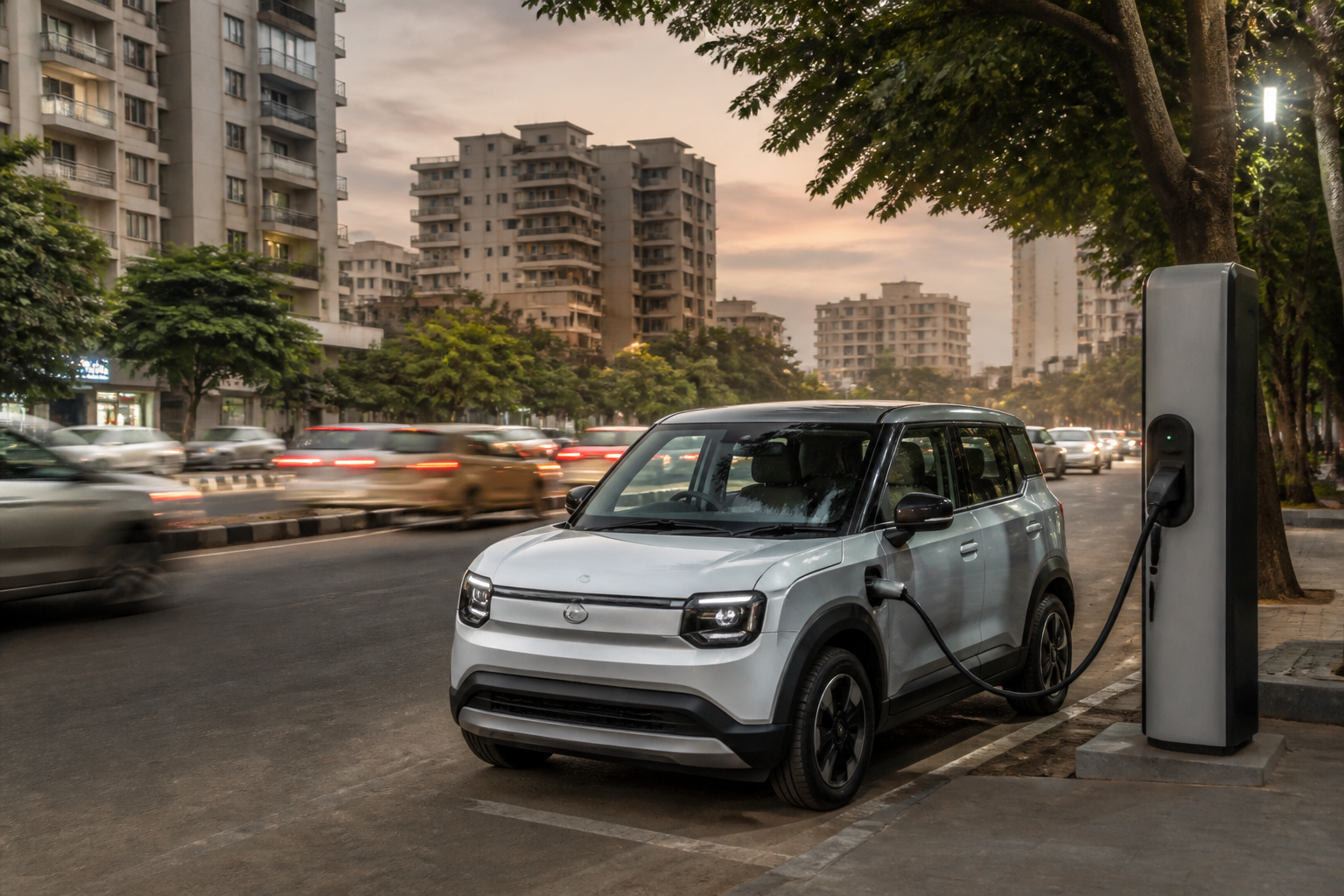
Suzuki’s decision to add range-extender electric vehicles to its global product roadmap signals a potentially important shift in India’s electric-mobility transition: the next contest may not be over which car carries the largest battery, but over how much battery an everyday vehicle actually needs. The approach combines electric drive with a smaller battery and an onboard generator, seeking to address two persistent barriers to wider EV adoption—high battery costs and limited charging access—without abandoning electric propulsion.
Suzuki Motor Corp President Toshihiro Suzuki outlined the company’s Technology Strategy 2026 in Japan on Friday, saying that power-source choices must reflect differences in each country’s electricity mix, fuel conditions and infrastructure development. The company’s proposed REEV Light sits within a broader multi-powertrain strategy that includes battery electric vehicles, hybrids, compressed natural gas and compressed biogas. India is emerging as a key testing ground for that strategy, while also becoming a major manufacturing and export hub for Suzuki.
The immediate significance of the announcement is that range-extender technology is moving from a niche engineering discussion into the product plans of several manufacturers operating in India. Suzuki is developing a series-hybrid system for compact cars in which a fuel-powered generator produces electricity while an electric motor drives the wheels. The proposed REEV Light would add external charging capability and use what the company describes as a “right-sized” battery rather than an oversized one.
That distinction matters because the battery is one of the most expensive and resource-intensive components of an electric vehicle. A larger battery can provide more electric range, but it also adds weight and cost. Suzuki’s “lean-battery” philosophy attempts to match battery capacity with real-world driving requirements instead of occasional long-distance journeys. The generator would provide electricity when the battery’s charge is insufficient, allowing the vehicle to continue operating without depending entirely on a public charger.
The company has not disclosed the proposed battery capacity, electric-only range or engine specifications. It has also not confirmed an India launch timeline. Those omissions mean the technology remains a strategic direction rather than a defined product available for consumers to assess. The eventual urban impact will depend on how the system performs in daily traffic, how efficiently it uses fuel and electricity, and how regulators classify it.
The case for range-extender EVs is closely tied to the uneven development of charging infrastructure. A battery-electric vehicle depends on access to suitable charging at home, at work or in public spaces. That dependence is easier to manage for households with predictable parking and charging access, but more difficult for residents of dense urban areas, rented homes and apartment buildings where parking is shared and electrical upgrades may be complex. The source material does not establish the scale of these infrastructure gaps, but it identifies them as a central challenge shaping automakers’ powertrain decisions.
Range anxiety is the other problem the technology is designed to address. Drivers may rarely need the full range offered by a large battery, yet may still value the ability to undertake an occasional longer trip without planning around charger availability. A range extender separates the vehicle’s everyday battery requirement from its reserve for longer journeys. In principle, that can lower the battery cost while retaining a measure of flexibility associated with conventional vehicles.
Randheer Singh, chief executive officer of automotive consulting firm Foresee, described range extenders as a possible bridge for India because they allow manufacturers to size the battery around everyday driving rather than occasional long-distance travel. He said the approach could reduce battery cost and weight while addressing range anxiety and dependence on public charging infrastructure. His assessment captures the technology’s central proposition, but it does not settle whether the resulting vehicles will be cheaper or cleaner in actual use.
That uncertainty is partly institutional. A range-extender vehicle does not fit neatly into the conventional categories of a pure battery EV or a conventional hybrid. It can be externally charged, uses an electric motor to drive the wheels and carries a fuel-powered generator. The classification will influence taxation, consumer pricing and potentially the policy benefits available to the vehicle. JSW MG Motor India Director Parth Jindal has identified taxation as a key challenge and argued that a lower goods and services tax could be important to making range-extender vehicles affordable.
This creates a policy question that is larger than the engineering design. India’s vehicle policy has to determine whether range extenders should receive treatment closer to battery EVs, hybrids or a distinct category. That decision will affect the economics of the technology before customers have a chance to choose between it and other powertrains. Singh said the economics would need to work for both manufacturers and consumers if range extenders were to occupy a position between hybrids and pure EVs.
The emerging manufacturer interest suggests that the industry is testing several routes through the same transition. Suzuki is developing REEV Light and a compact-car series-hybrid system. Mahindra & Mahindra is developing range-extender solutions based on its EV architecture, according to people familiar with the company’s product plans. JSW MG Motor India has publicly committed to the technology, with its ADAPT architecture designed to support range-extender EVs alongside battery EVs and plug-in hybrids.
These plans also reveal how India’s market is being positioned within global vehicle development. Suzuki’s stated approach is to share technology across markets while regionally optimising products. The company has identified India as a key global production hub and is targeting annual manufacturing capacity of about four million vehicles by financial year 2030. This gives the country a role that extends beyond being a market for imported technology. Product choices developed for Indian conditions could also form part of Suzuki’s wider manufacturing and export strategy.
The possible shift towards smaller batteries therefore has implications for the built environment and urban mobility, even though the technology is being developed within the automotive industry. If range-extender vehicles become viable, the pressure on cities may not be to build an entirely new charging system for every long-distance requirement. Instead, the infrastructure challenge could become more differentiated: reliable charging would still matter for routine electric driving, while the onboard generator would provide a fallback where charging is unavailable.
That would not remove the need for urban charging infrastructure. A smaller battery may increase the importance of convenient, reliable charging if vehicles are expected to operate electrically for most daily trips. Public authorities, housing societies, workplaces and commercial parking operators would still face questions about where chargers should be installed, who pays for electrical upgrades and how access is managed. The source material does not provide a policy framework or implementation plan for those questions, but the REEV debate makes clear that powertrain choices and city infrastructure cannot be treated as separate systems.
The same applies to affordability. A smaller battery could reduce vehicle cost, but the final price would also depend on the generator, electric motor, power electronics, charging hardware, taxation and manufacturing scale. No company in the supplied material has disclosed a retail price, battery capacity or launch date for a range-extender model in India. It is therefore too early to conclude that REEVs will be cheaper than battery EVs or conventional hybrids.
The evidence currently supports a narrower conclusion. Automakers are responding to a market in which battery costs, charging infrastructure and range anxiety remain important constraints. Their response is not a single technology but a portfolio of powertrains adapted to different conditions. Suzuki’s announcement adds momentum to range-extender development, while the parallel plans of Mahindra and JSW MG show that the idea is being evaluated across more than one manufacturer.
For India’s cities, the larger question is whether this portfolio can align vehicle technology with the way people actually travel and park. A vehicle designed around everyday driving could reduce the need to carry unused battery capacity, but its value will depend on how often it is charged, how its generator is used and how regulators define it. Those facts are not yet established in the supplied evidence.
What is clear is that India’s next EV debate will involve more than the number of vehicles sold or the size of their batteries. It will involve the relationship between vehicle design, taxation, charging access, manufacturing strategy and the physical constraints of urban life. The milestones to watch are Suzuki’s disclosure of REEV Light specifications and India launch plans, the regulatory treatment of range-extender vehicles, and the product timelines announced by Mahindra and JSW MG Motor India.
