


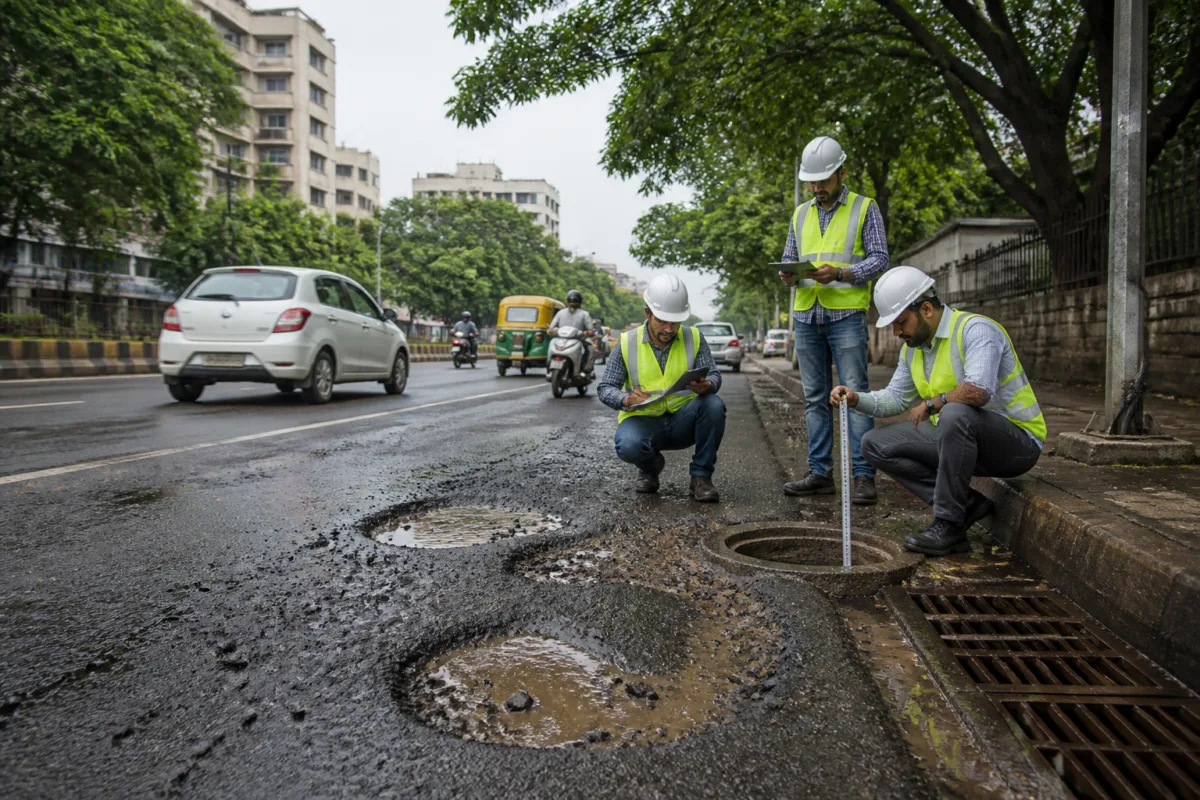
Ahmedabad road survey requirements have been tightened under new state guidelines that make it mandatory for municipalities to inspect all roads before and after the monsoon and act on the findings. The directive places particular emphasis on road quality, drainage coordination, bridge safety and time-bound repairs.
The instructions apply to Ahmedabad and other municipalities in Gujarat. According to the report, the state government issued the guidelines in response to growing traffic problems and as part of efforts to improve urban infrastructure and civic facilities. The guidelines cover road construction, street and junction design, signage and maintenance standards.
Municipalities have been told to record the existing road surface and the thickness of underlying layers before taking up work. Officials must also document the level of roads near the entrances of houses and residential societies. The stated objective is to prevent a common urban problem in which repeated resurfacing raises the carriageway while homes and society entrances remain at a lower level, increasing the risk of water entering properties.
The guidelines prescribe different timelines for repairs. Large cracks or joint failures on river bridges, railway bridges and flyovers will require immediate action. Damaged concrete surfaces must be repaired within 15 days, while minor patchwork must be completed within 30 days. Small potholes should be repaired immediately, and roads with dangerous potholes must be restored within 48 hours.
The directive also requires municipalities to strengthen old drainage lines, stormwater lines and manholes that repeatedly fail before a road is constructed or resurfaced. Manholes must be brought to the correct level after road construction. This requirement links road maintenance to underground infrastructure, an area where poorly coordinated work can lead to fresh excavation, uneven surfaces and recurring repair costs.
Bridge and flyover inspections are another focus of the guidelines. Municipal engineering departments will have to identify major cracks and joint failures and take prompt measures where structural or surface damage is found. The report attributes the details to municipal engineering department sources and states that the instructions were issued through a state government circular.
The guidelines also identify locations where reinforced cement concrete roads should receive priority. These include areas with weak soil, high groundwater levels or a high risk of waterlogging; industrial zones with heavy vehicle movement; Bus Rapid Transit System corridors; roads that develop potholes repeatedly; accident-prone stretches; and roads that have required unusually high repair expenditure.
The approach marks a shift from treating potholes and damaged surfaces as isolated maintenance complaints to assessing roads through their full construction and drainage context. However, the report does not specify the total number of roads to be surveyed, the budget allocated for the exercise, or the agency responsible for publishing survey findings. Implementation will therefore depend on municipal surveys, departmental coordination and compliance with the repair deadlines set out in the state guidelines.

