


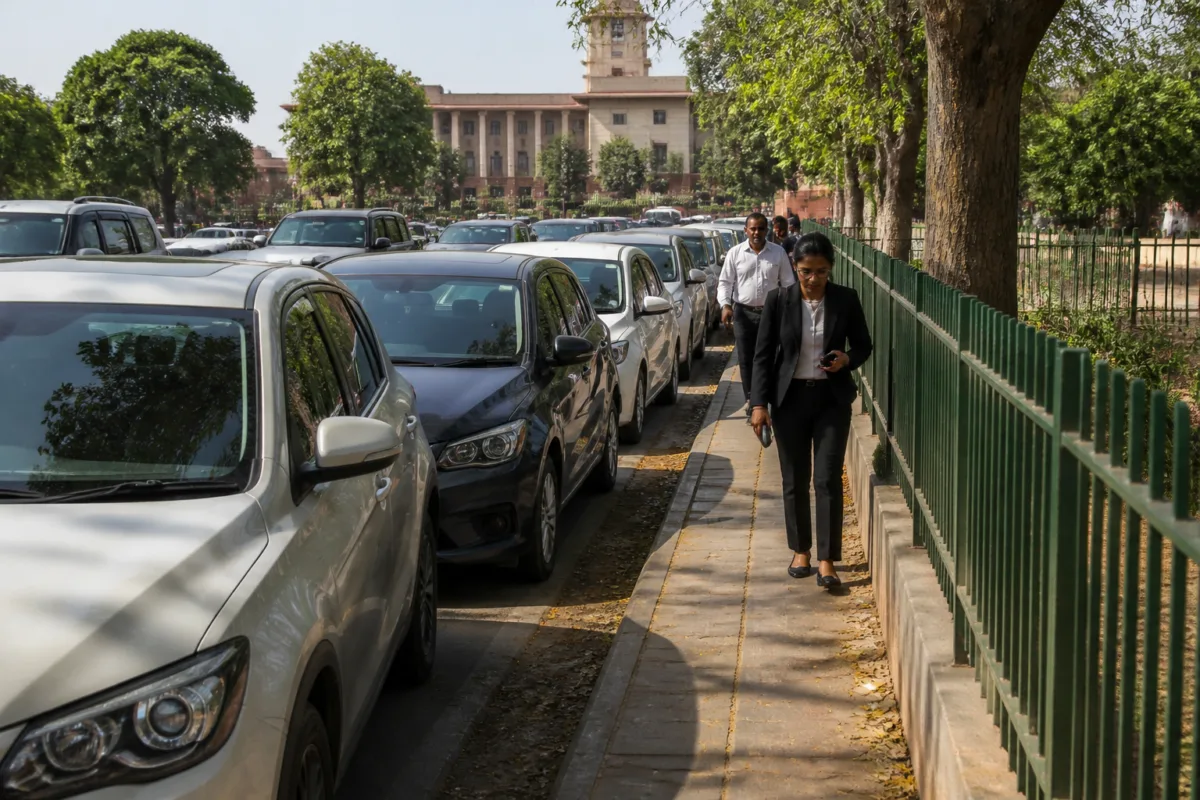
The Delhi High Court has criticised the use of roads and footpaths for parking during a hearing on a public interest petition seeking the removal of encroachments from pedestrian paths in the capital. The court said that even the roads outside the High Court were being used for parking, with vehicles occupying four lanes.
A bench comprising Acting Chief Justice Nitin Vasudev Sambre and Justice Sanjay Sharma made the observations while hearing a petition concerning the stretch between Jaipur House and the Delhi High Court. The petitioner’s counsel told the bench that footpaths along the route were being used to park vehicles, restricting space meant for pedestrians.
Addressing the lawyer, the bench said, “You are talking about the footpath. Here, even the roads are being used for parking.” The court also said that people could see four lanes occupied because of parking outside the court. According to the report, the bench remarked that the situation was partly caused by fellow lawyers.
The hearing also referred to a recent Supreme Court judgment recognising pedestrians’ right to walk on footpaths. The Supreme Court had said that motorists could not take away this right and had underlined the importance of protecting basic infrastructure for people walking in cities.
The High Court noted that several cases relating to encroachments were already pending before it. The bench referred to an order passed on September 20, 2018, in a writ petition concerning the issue. It also mentioned a Special Task Force constituted by the Delhi Development Authority under directions of the Supreme Court.
The reference to the task force places the immediate dispute within Delhi’s wider enforcement structure. The issue before the court is not limited to the condition of one footpath. It also concerns how roads and pedestrian spaces are managed when parking demand exceeds available designated capacity, and which authority is expected to respond to complaints.
The bench allowed the petitioners to place their complaints before the relevant authorities, including the task force. It directed that a copy of the September 20, 2018 order be made available to the petitioner’s counsel. The counsel sought time to study the order.
The court said the petitioners could submit their grievances to the task force and return with a response after seeing the authorities’ position. The matter will be heard again after three weeks.

