


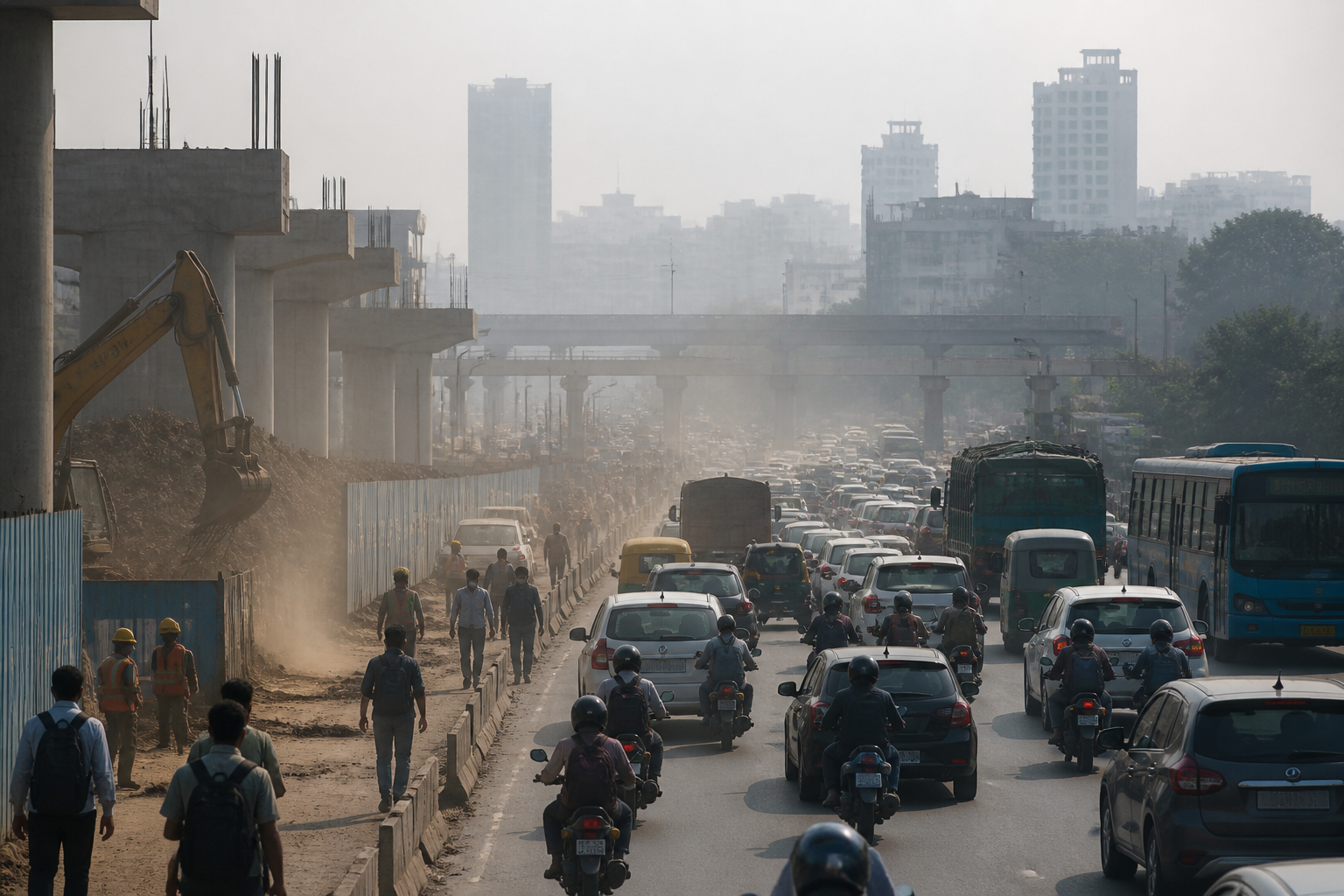
Bengaluru’s air pollution problem is no longer adequately described through isolated readings from individual pollutants. A study by researchers from BMS College of Engineering has calculated the city’s overall health hazard index at 3.29, more than three times the internationally accepted benchmark of less than 1 established by the United States Environmental Protection Agency. The finding points to a central urban challenge: even when individual pollutants do not separately cross their danger thresholds, their combined presence can impose a substantial long-term burden on residents.
The study analysed air-quality data from Bengaluru and four other Karnataka cities—Belagavi, Yadgir, Mangaluru and Madikeri—for 2024. Bengaluru recorded the highest particulate pollution among the cities evaluated. Its annual mean concentration of fine particulate matter, or PM2.5, was 40.2 micrograms per cubic metre, while PM10 reached 80.4 micrograms per cubic metre.
Those figures place the city’s pollution within a wider gap between regulatory compliance and actual health protection. The study found that Bengaluru’s PM2.5 concentration was at the edge of India’s National Ambient Air Quality Standards, but far above the World Health Organization’s annual guideline of 15 micrograms per cubic metre. PM10, meanwhile, exceeded national limits by approximately 34 per cent. The comparison shows why a city can appear to be near a domestic standard while still exposing residents to pollution levels associated with significant health concern under stricter health-based guidelines.
The most important finding is the contribution of PM2.5 to the overall hazard. The study calculated a standalone hazard value of 2.680 for PM2.5, accounting for more than 81 per cent of Bengaluru’s total health hazard index. These particles are fine enough to be inhaled deeply into the respiratory system, making their concentration more consequential than a simple count of visible dust or general air-quality complaints.
The study assessed a combination of pollutants, including PM2.5, PM10, nitrogen dioxide, sulphur dioxide and carbon monoxide. Researchers reported that none of these pollutants crossed the danger threshold individually. However, their combined presence was found to place greater strain on the human body than an assessment of each pollutant in isolation would suggest. This is the institutional significance of the hazard index: it shifts attention from single-pollutant monitoring to the cumulative exposure experienced by people living, working and travelling in the city.
The pattern also reveals the limits of treating air pollution as a seasonal inconvenience. Bengaluru’s southwest monsoon can temporarily improve air quality by removing pollutants from the atmosphere. But the study’s findings indicate that short periods of cleaner air do not resolve the underlying sources of emissions. Temporary weather-driven relief is different from sustained improvement produced by changes in transport, construction practices and civic enforcement.
Researchers identified the city’s extreme vehicular density and extensive construction activity as the main factors behind the elevated pollution levels. These are not isolated sources. They are embedded in the way Bengaluru has expanded: daily travel depends heavily on motor vehicles, while construction and infrastructure activity generate dust and particulate emissions across a rapidly changing urban landscape.
That combination complicates the responsibilities of public authorities. Vehicle emissions can be addressed through enforcement, monitoring and a shift towards cleaner public transport, but each measure depends on different institutions and forms of implementation. Construction dust requires rules that apply to project sites, material handling, road edges and debris movement, as well as the capacity to inspect and penalise violations. Air-quality improvement therefore cannot be delivered by a single department or by monitoring stations alone.
The study’s health implications are particularly important for children. Researchers found that children’s daily inhalation doses were approximately 1.5 times those of adults. Their lower body weight and faster breathing rates mean that they absorb a higher proportion of pollutants relative to their bodies. The result is an uneven distribution of risk: the same urban air affects residents differently depending on age, health and exposure patterns.
A city-based healthcare expert cited in the report said children are especially vulnerable to high particulate matter levels, while senior citizens and pregnant women are also at higher risk. Prolonged exposure to fine particulate matter was linked by the expert to reduced lung capacity and the aggravation of conditions such as asthma. In severe cases, the expert said, it may contribute to heart problems and lung cancer. These observations underline that air pollution is not only an environmental issue but also a public-health and urban-planning concern.
The study’s evidence raises a question about what Bengaluru’s air-quality governance is designed to measure. If monitoring focuses mainly on whether individual pollutants remain below separate thresholds, the cumulative burden may be less visible in routine public communication. The hazard index does not replace pollutant-specific monitoring, but it adds a method for understanding how multiple exposures may affect residents together.
The policy response identified by the researchers is correspondingly broad. They called for stronger vehicular emission controls, stricter construction-dust mitigation rules and a faster transition to clean public transport. They also emphasised control over emission sources, continuous monitoring of air-quality parameters and protection of the city’s blue-green spaces.
These measures point to three connected policy areas. The first is mobility. A cleaner public-transport system can reduce dependence on private vehicles, but the study does not provide a transition timetable or quantify the reduction required. The second is construction governance. Dust-control rules are meaningful only when authorities can monitor sites continuously and enforce requirements across the city’s large construction ecosystem. The third is urban ecology. Protecting blue-green spaces is presented as one part of a broader air-quality strategy, alongside source control and monitoring.
The evidence also exposes a distinction between measuring pollution and managing it. Bengaluru’s annual mean PM2.5 level of 40.2 micrograms per cubic metre and PM10 level of 80.4 micrograms per cubic metre provide a record of exposure during the evaluated period. The health hazard index of 3.29 provides an interpretation of what the combined pollutant load may mean for residents. But neither measure, on its own, confirms that remedial action has been implemented or that exposure has since declined.
That limitation matters because the study is based on data from 2024, while the report was published in 2026. The findings establish the scale of the problem during the period examined, but the supplied material does not establish a newer citywide trend. Nor does it provide neighbourhood-level readings, a breakdown of emissions by source, or an assessment of how current enforcement is performing. Those gaps do not diminish the study’s central finding, but they define what can and cannot be concluded from it.
Bengaluru’s case illustrates why urban air quality cannot be separated from the functioning of the city. Traffic patterns, construction practices, public transport capacity, open-space protection and health vulnerability all shape exposure. The city’s air is produced by a network of everyday systems, and the response must operate across the same network.
The study confirms that Bengaluru’s combined pollution burden is well above the cited international health-hazard benchmark, with PM2.5 responsible for most of the calculated risk. It also identifies children and other vulnerable groups as requiring particular attention. The next questions for authorities are whether emissions are being reduced at their sources, whether construction-dust rules are being enforced, and whether monitoring can track cumulative exposure rather than only individual pollutants.
