


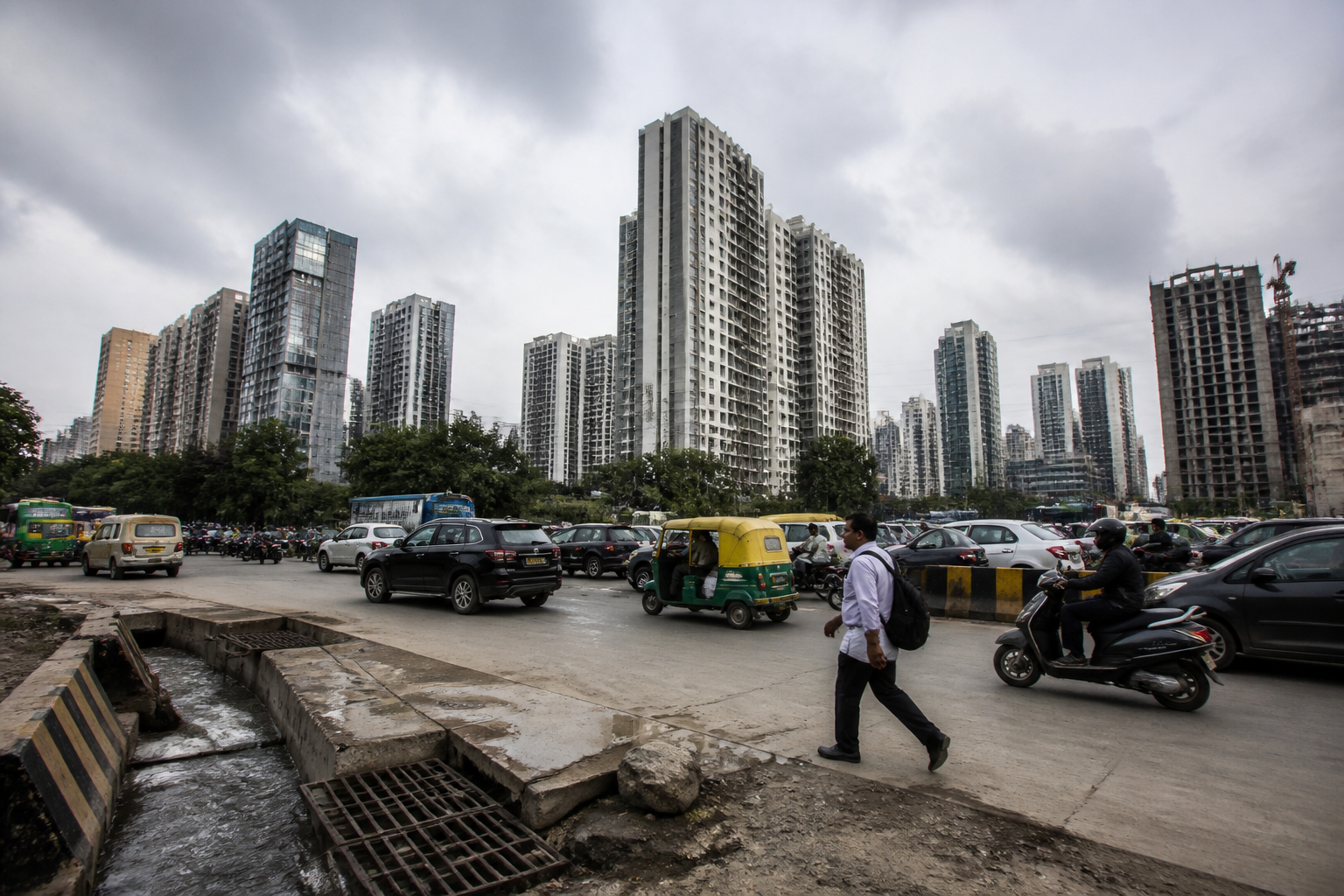
The Supreme Court has directed the Karnataka government not to use premium Floor Area Ratio (FAR) to regularise illegal buildings, while questioning whether Bengaluru’s civic infrastructure can support further construction in high-density areas. The court also said approvals granted under the premium FAR scheme would remain subject to its final judgment.
A bench comprising Chief Justice of India Surya Kant and Justices Joymalya Bagchi and V. Mohana issued notice to the Karnataka government and asked it to file an affidavit within four weeks. The matter was heard on a special leave petition filed by Citizens Action Forum.
During the hearing, the bench noted that traffic congestion in Bengaluru had become “a nightmare”. The proceedings have placed the state’s premium FAR policy under scrutiny because the scheme allows additional construction in return for payment of an extra fee.
The Karnataka High Court had upheld the validity of the state government’s decision in June. Under the policy, construction of up to 16 floors, instead of 10, can be permitted in Bengaluru by paying an additional charge. The Supreme Court’s direction means that approvals issued under the scheme will not be insulated from the outcome of the ongoing legal challenge.
Senior advocate Aditya Sondhi, appearing for the petitioner, argued that road width was being treated as the sole criterion for granting premium FAR. He said this could place further pressure on Bengaluru’s already weak civic infrastructure. He also raised concerns that the scheme could be misused to regularise illegal buildings within the jurisdiction of the Greater Bengaluru Authority, alongside the state’s controversial illegal-building regularisation policy.
Solicitor General Tushar Mehta, appearing for the Greater Bengaluru Authority, rejected the allegation. He told the court that no unauthorised building would be regularised under the premium FAR scheme and that the scheme had no connection with the illegal-building regularisation policy. He said the additional FAR was limited to 0.6 of the original FAR, while mandatory parking and setback requirements would continue to apply. Revenue generated through the scheme, he added, would be transferred to an infrastructure fund.
The bench nevertheless questioned whether additional construction should be permitted without visible improvements in urban infrastructure. Chief Justice Surya Kant observed that cities had not seen visible improvements in their infrastructure and referred to the way systems could fail during natural disasters. He questioned the decision to increase the load on infrastructure by permitting more high-rise construction without first developing supporting systems.
The court also raised concerns about the problems residents may face after construction is completed. The Chief Justice said builders often leave the site after completing projects, leaving residents to deal with inadequate parking, water supply and drainage. These concerns connect the legal challenge to the everyday effects of higher development intensity: more floors can increase the demand placed on roads, parking, water networks and sewage systems in the same neighbourhood.
The bench referred to planned infrastructure development in Greater Noida, observing that its systems had been designed with the needs of the next 50, 60 or 100 years in mind. It said there would be less objection to high-rise construction where infrastructure planning had kept pace with development.
FAR is the extent of construction permitted on a plot in relation to its area. The permissible built-up area and number of floors are calculated with reference to the size of the site and the width of the road on which it is located. In addition to basic FAR, development rights transferred through TDR and premium FAR can allow construction beyond the base limit. The Supreme Court’s next consideration will follow the Karnataka government’s affidavit due within four weeks.
