


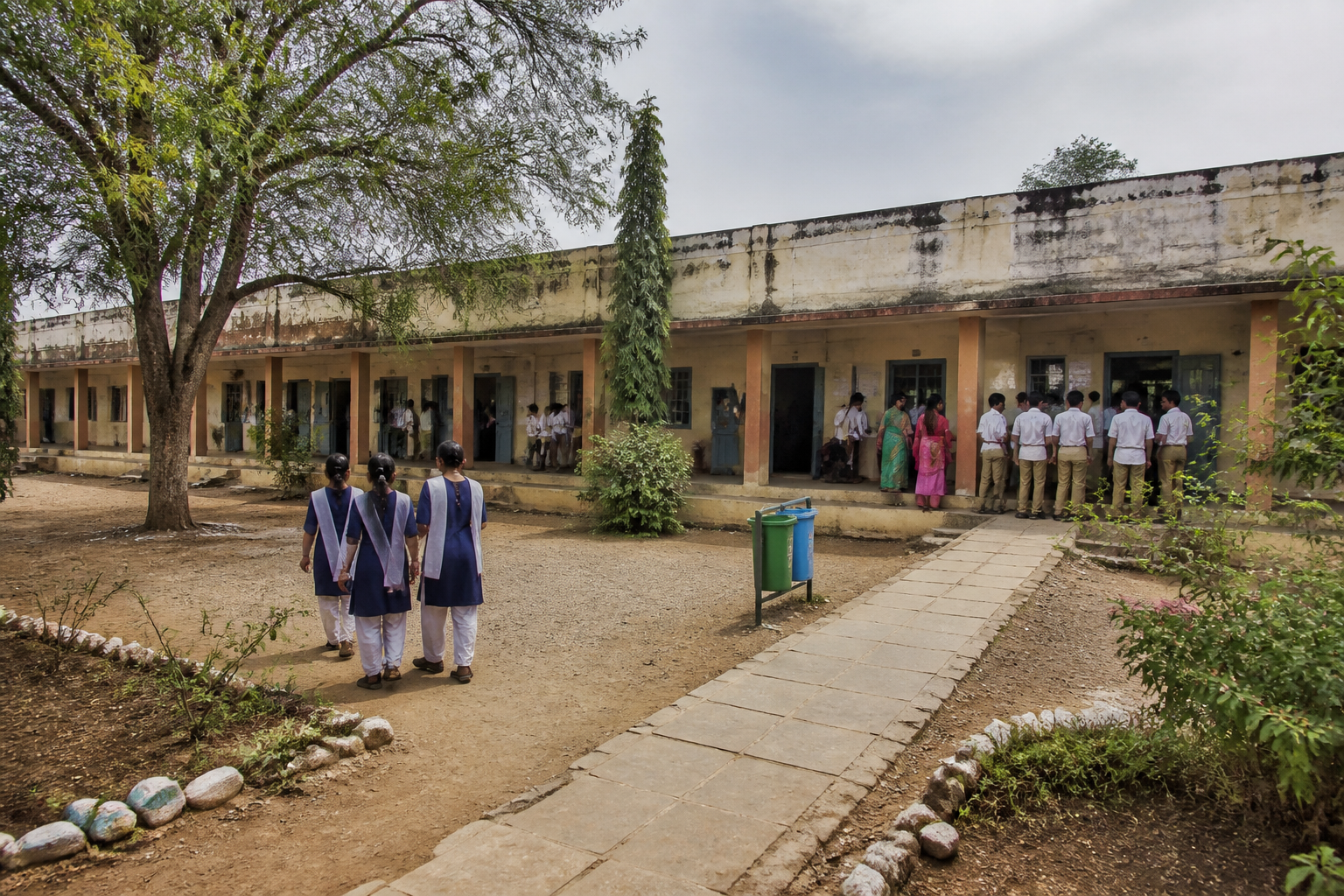
The nine-month delay in announcing results and distributing prizes under Maharashtra’s Maji Shala Sundar Shala Abhiyan is more than an administrative postponement. It exposes how a school-improvement programme can lose momentum when its public commitments, evaluation schedule and funding arrangements are not carried through together. The third phase was conducted between 3 November and 31 December 2025, but the results and awards had still not been announced, according to a report by Loksatta – Mumbai published on 20 September 2026.
The programme was designed for schools across management types and teaching mediums in Maharashtra. Its stated objectives went beyond academic performance. It sought to promote awareness among students about health, cleanliness, the environment and sports, while also improving physical facilities in schools and encouraging students’ intellectual development. In that sense, the campaign combined educational quality with the condition and everyday functioning of school spaces.
That combination makes the delay important for the built environment as well as for education administration. A school-improvement competition is not only a ceremonial exercise if its assessment criteria include physical facilities, sanitation, environmental awareness and student development. It creates an administrative mechanism through which schools are expected to demonstrate improvements and compete across different levels and categories. When the final evaluation and rewards remain pending, the programme’s operational purpose becomes difficult to assess.
The third phase was announced for November and December 2025. The report states that evaluation was completed in February and that a state-level award ceremony was expected thereafter. However, the results were not declared, the prize money was not released and the award ceremony did not take place. The delay therefore extends across three linked stages: communicating the outcome, transferring the promised funds and completing the public recognition process.
The amount involved is ₹72.22 crore. That figure was earmarked for prizes to winning schools across various levels and categories. The available report does not provide a category-wise distribution, the number of winning schools, the source of the allocation or the administrative reason for the funding shortfall. It identifies lack of funds as the reason the results and award distribution have remained pending. These missing details matter because they determine whether the problem is a delayed budget release, an incomplete sanction, a procurement or financial-control issue, or a wider interruption in the campaign.
The programme’s own history suggests that implementation has not followed a consistent pattern. The first phase was conducted successfully between January and February 2024. The second phase took place between August and September 2024. According to the report, prize money was paid to winning schools after the second phase, but the award ceremony was not held. The third phase was subsequently announced for November and December 2025, followed by evaluation in February and then the prolonged delay.
This sequence shows that the problem is not limited to one missed event. The second phase reportedly saw a separation between financial disbursement and public completion: schools received the prize money, but the ceremony did not take place. In the third phase, both the results and the money remained pending. The two phases therefore point to different forms of implementation weakness. One affected public closure and recognition; the other affected the core outcome as well as the ceremony.
For schools, prize money under such a programme can have a practical value if it is intended to support facilities or institutional improvements. The supplied report does not state how earlier awards were spent or whether the third-phase prizes were linked to specific works. It does, however, describe the campaign as one intended to increase physical facilities and support multiple aspects of student development. The absence of information on the release and use of funds makes it impossible to establish what improvements are currently stalled or what schools may have planned around the promised awards.
This is also why the issue cannot be reduced to a question of delayed publicity. The results determine which schools are recognised, while the prize money represents a financial commitment to the winners. If evaluation has already been completed, the administrative process has apparently reached the point at which the state must convert assessment into a formal outcome and payment. The longer that conversion is delayed, the harder it becomes for schools and administrators to know whether the competition has concluded or remains operational.
The programme’s design places several responsibilities within one chain. Schools participate and present their work; evaluators assess them across the relevant levels and categories; the education administration consolidates the results; and the state releases the announced awards. The report does not identify the precise departments or offices responsible for each stage, nor does it record an official explanation for the funding shortage. That absence is itself a gap in public accountability because the delay has lasted for nine months after the third phase’s evaluation was expected to be completed.
A well-functioning school-improvement initiative requires more than an announcement and an evaluation framework. It requires a predictable financial architecture. The amount promised, the timing of the assessment, the process for declaring results and the mechanism for transferring awards need to be aligned before schools are asked to participate. If funds are not available when the programme is launched, the competition risks becoming an administrative exercise whose most visible commitment cannot be fulfilled.
The available evidence also shows how repeated programme phases can create institutional expectations. The first phase was described as successful. The second phase delivered prize money but not the ceremony. The third phase proceeded through implementation and evaluation but then stalled before results and payments. Each interruption can weaken confidence in the next cycle, particularly when schools are expected to invest time, documentation and effort in demonstrating improvements.
The data in the report is limited but clear on the central chronology. There have been three phases. The first ran in January and February 2024. The second ran in August and September 2024. The third ran from 3 November to 31 December 2025. Evaluation for the third phase was completed in February, while results and awards remained pending for nine months. The planned prize pool was ₹72.22 crore. These dates reveal an expanding gap between the programme’s formal timetable and its administrative delivery.
What the evidence does not establish is equally important. It does not say that the campaign has formally been cancelled. It reports that the initiative is facing a funding-related setback and that implementation of the third phase has been stalled. It does not provide a government order withdrawing the programme, a revised award date, an official departmental statement or a fresh funding commitment. The available material therefore supports a conclusion about delay and uncertainty, not one about permanent closure.
The wider urban question concerns the reliability of public institutions that are responsible for maintaining everyday civic environments. Schools are among the most important public buildings in a community. Their sanitation, physical condition, environmental practices and access to facilities directly shape the daily experience of students and staff. A programme that links these conditions to measurable assessment can help the administration identify and recognise improvements. But that mechanism works only when assessment, funding and follow-through are treated as one administrative responsibility.
The Maji Shala Sundar Shala Abhiyan case also illustrates the difference between announcing a public programme and completing it. The state has run three phases, but the available account describes incomplete closure in the second phase and a more substantial delay in the third. For readers, schools and administrators, the unresolved questions are specific: when will the third-phase results be declared, when will the ₹72.22 crore in awards be released, and which authority will provide a documented explanation for the delay?
The evidence currently confirms a nine-month hold-up after the third phase and identifies lack of funds as the reported cause. It does not confirm cancellation, provide a new timetable or record an official response. The next meaningful development will therefore be a formal announcement of the results, a funding release, or a government explanation that clarifies whether and how the programme will continue.
