


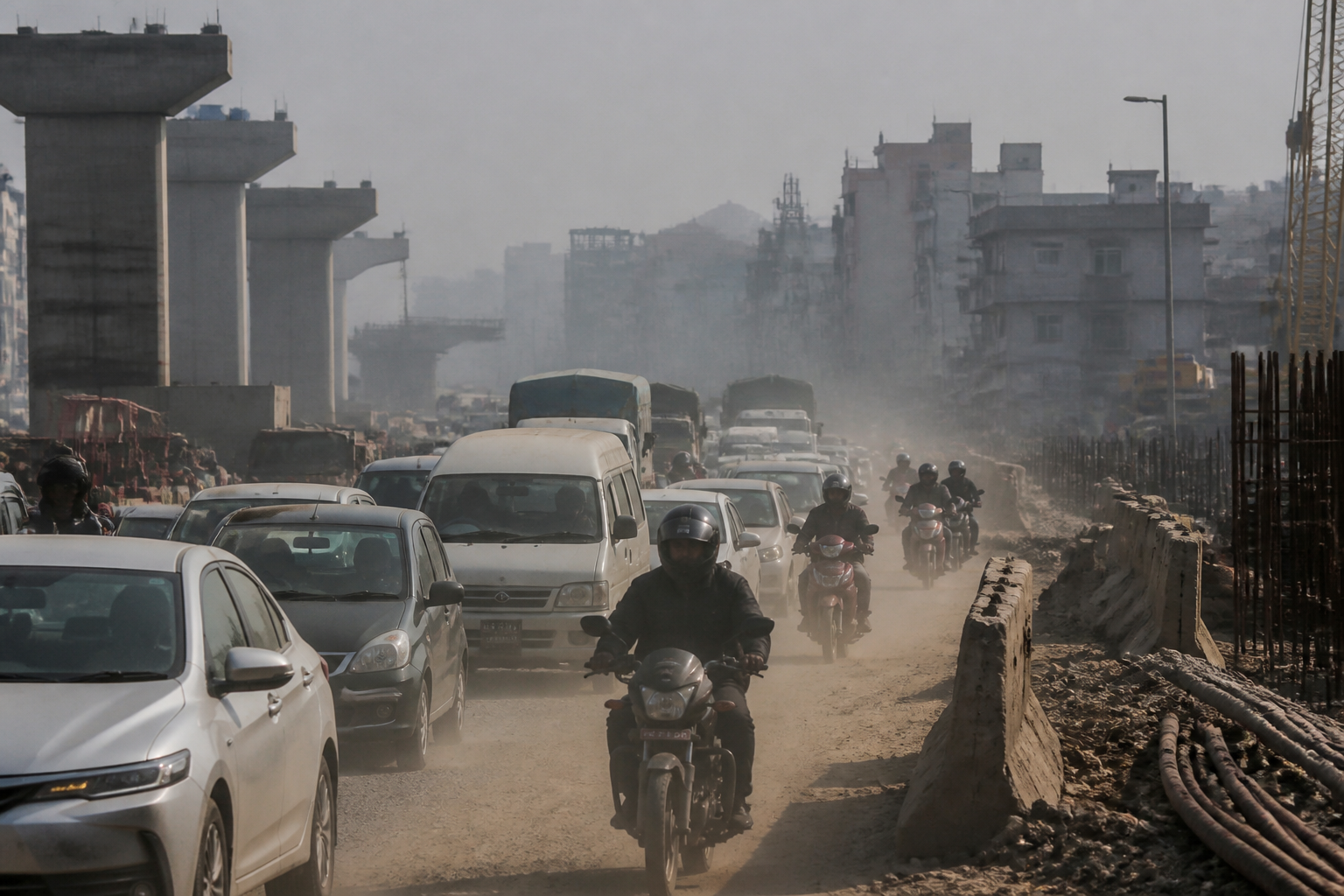
Delhi’s air pollution problem is often treated as a winter emergency, but the evidence cited in a recent report points to a more persistent urban governance challenge: most of the pollution is generated within the city and the wider region throughout the year. According to a Centre for Science and Environment analysis of data from the Indian Institute of Tropical Meteorology’s Decision Support System, local sources account for 80 to 85 per cent of Delhi’s pollution. Vehicles are the largest local contributor, with a 46 per cent share, followed by industry at 22 per cent.
That distribution changes the way Delhi’s air-quality crisis must be understood. External sources, including pollution transported from neighbouring regions, remain part of the problem, particularly during specific weather conditions. But the figures cited in the report indicate that the city cannot rely on seasonal restrictions or external explanations to deliver sustained improvement. The larger challenge is whether Delhi’s institutions can enforce controls on everyday urban activity: traffic, industrial operations, construction, road dust, household fuel use and waste burning.
The seasonal framing has shaped both public attention and administrative response. Measures such as restrictions on truck entry, intensified inspections and emergency pollution-control actions are generally associated with the period when air quality deteriorates sharply in winter. The report argues that this approach leaves a gap during the rest of the year, allowing emissions to accumulate or remain poorly controlled until adverse weather makes the problem visible.
The issue is not that winter measures are unnecessary. Delhi’s pollution becomes more hazardous when lower temperatures, weaker winds and atmospheric conditions trap pollutants close to the ground. The problem is that emergency action cannot substitute for routine enforcement. If the same sources operate throughout the year, an administrative system that becomes active only when the Air Quality Index deteriorates is responding to the symptoms of an established emissions problem rather than controlling its causes.
The source profile makes the institutional challenge clear. Vehicles account for 46 per cent of local emissions in the analysis cited by the report. This places mobility policy at the centre of air-quality management. Vehicle emissions are connected not only to the number of vehicles on Delhi’s roads, but also to congestion, fuel quality and compliance with pollution-control requirements. The report notes that the Commission for Air Quality Management has directed that vehicles without a valid Pollution Under Control Certificate should not receive fuel from May 2026. It also says that electric three-wheelers have been mandated for new registrations in Delhi and the National Capital Region.
These measures address compliance and fleet transition, but their effect depends on implementation. A rule requiring a valid certificate is meaningful only when testing is reliable, enforcement is consistent and violations carry consequences. Similarly, a shift towards electric three-wheelers can reduce emissions from a specific vehicle segment, but the report does not establish how quickly this will alter the overall vehicle contribution. What it does establish is that transport cannot be treated as a secondary issue in Delhi’s pollution-control framework.
Industry is the second-largest local source in the cited assessment, with a 22 per cent share. The report refers to separate directions issued by the Commission for Air Quality Management in 2026 for particulate emissions from industries. Delhi Pollution Control Committee monitoring also covers industrial sources, along with construction, generators, vehicles and open waste burning. This creates a broad regulatory responsibility, but it also raises the question of coordination between agencies and the consistency of field-level action.
The distinction between having rules and enforcing them is central to the city’s pollution problem. The report lists directions for controlling dust at construction and demolition sites, managing debris and operating mechanical road-cleaning machines. It also describes real-time pollution-source identification and forecasting arrangements under the Delhi Pollution Control Committee. These mechanisms indicate that the administrative system has formal tools for monitoring several major sources. The continuing pollution burden suggests that the existence of tools has not removed the implementation gap.
Construction and road dust together account for smaller shares in the figures cited: construction at 6 per cent and road dust at 3 per cent. Their percentages should not be read as evidence that these sources are unimportant. Construction activity is highly visible across Delhi, and dust from broken roads, uncovered material, demolition and poorly managed sites affects local neighbourhoods even when its citywide share is lower than that of vehicles or industry. The report specifically points to dust rising from a damaged road near Zakhira on Rohtak Road, illustrating how routine infrastructure conditions can become part of the pollution problem.
The governance implication is that pollution control cannot be limited to large, easily identifiable episodes. It must extend to the everyday management of streets and construction sites. Dust control depends on site inspections, covering materials, managing debris, maintaining roads and ensuring that contractors comply with prescribed procedures. Road-cleaning standards are useful only if equipment is deployed where it is required and if the outcome is monitored. These are municipal and regulatory functions that operate at street level, often far from the seasonal public debate over Delhi’s air.
The report also attributes 11 per cent of local pollution to domestic sources and 4 per cent to waste burning. These categories show that the problem is distributed across formal and informal urban systems. Household fuel use, waste collection failures and open burning cannot be addressed only through air-quality alerts. They require coordination between local administration, sanitation services, enforcement teams and communities. The supplied material does not provide a detailed assessment of the performance of these systems, but it identifies them as continuing components of the local emissions profile.
A further complication is the variation between pollution-source studies. To address this, the Commission for Air Quality Management has prepared a high-resolution emissions inventory and source-apportionment framework based on 500-by-500-metre grids, according to the report. The stated objective is to reduce differences between studies and create a more consistent scientific basis for identifying sources. This is important for governance because pollution-control resources cannot be targeted effectively if agencies are working from incompatible estimates of what is driving emissions in particular areas.
A grid-level framework could also make the city’s response more geographically precise. Citywide percentages identify broad priorities, but they do not show whether a neighbourhood’s exposure is driven mainly by traffic, construction, industry, waste burning or a combination of sources. The report does not provide the grid-level findings, so it is not possible from the supplied evidence to assess how the new framework changes enforcement priorities. Its significance lies in the attempt to connect scientific measurement with administrative action.
The timing of Delhi’s air-quality deterioration reinforces the argument for a year-round system. The report states that the city’s AQI was below 100 in August but crossed 170 by September, before a major fall in temperature. These figures are presented as an indication that pollution is not confined to the coldest months. They also challenge the assumption that winter weather alone creates Delhi’s air-quality crisis. Weather can intensify pollution, but emissions are present before the winter peak arrives.
That distinction matters for planning. If action begins only after air quality has already deteriorated, agencies are likely to rely on short-term restrictions rather than sustained source control. By September, traffic congestion, construction activity and industrial emissions are already part of the city’s daily operating pattern. A year-round plan would therefore need to treat air quality as a continuous municipal and regional management responsibility, rather than as a temporary emergency that begins with the onset of winter.
The policy landscape described in the report is already extensive. The Commission for Air Quality Management issues directions covering industries, vehicles, construction and demolition, road dust and fuel access. The Delhi Pollution Control Committee monitors multiple source categories and has systems for real-time source identification and forecasting. The challenge identified by the report is not an absence of policy instruments but their seasonal application and uneven enforcement.
This places responsibility across several layers of government. Air-quality regulators set standards and issue directions. The pollution-control committee monitors regulated sources. Municipal bodies are connected to roads, construction oversight, waste management and dust control. Transport authorities and enforcement agencies influence vehicle compliance and traffic conditions. Regional coordination is required for issues such as truck movement and crop-residue burning. The source material does not evaluate the performance of each institution separately, but it shows why no single agency can resolve the problem alone.
The regional dimension remains relevant even when local sources dominate. The report says neighbouring states must coordinate on timely disposal of crop residue to prevent open burning. However, its central finding is that local emissions account for 80 to 85 per cent of Delhi’s pollution. The policy consequence is a dual responsibility: regional cooperation is necessary for transported pollution and residue burning, while Delhi must continuously control the sources generated within its own urban boundary.
For residents, the distinction between local and external pollution does not change the immediate experience of poor air. It does, however, change the accountability question. When a large share of emissions originates from vehicles, industry, construction, domestic activity, waste burning and road conditions, improvement depends on the daily performance of public systems. The air-quality crisis is therefore also a test of transport management, construction regulation, waste services, industrial compliance and municipal maintenance.
The evidence supplied in the report confirms three broad points. First, Delhi’s pollution is substantially local according to the cited source-apportionment analysis. Second, vehicles are the largest identified local contributor, followed by industry. Third, the regulatory architecture covers many of the relevant sources but is criticised in the report for focusing mainly on winter conditions. What remains less clear from the supplied material is how consistently the existing directions are enforced throughout the year and how the new 500-by-500-metre emissions framework will alter operational decisions.
Those are the developments that deserve monitoring. The effectiveness of the PUC certificate fuel rule, enforcement of construction and industrial controls, the adoption of electric three-wheelers, the use of mechanical road-cleaning standards and the functioning of the new emissions inventory will determine whether Delhi’s response moves beyond seasonal crisis management. Until those systems operate continuously, the city’s air pollution will remain not only an environmental emergency but also a test of urban governance.

