


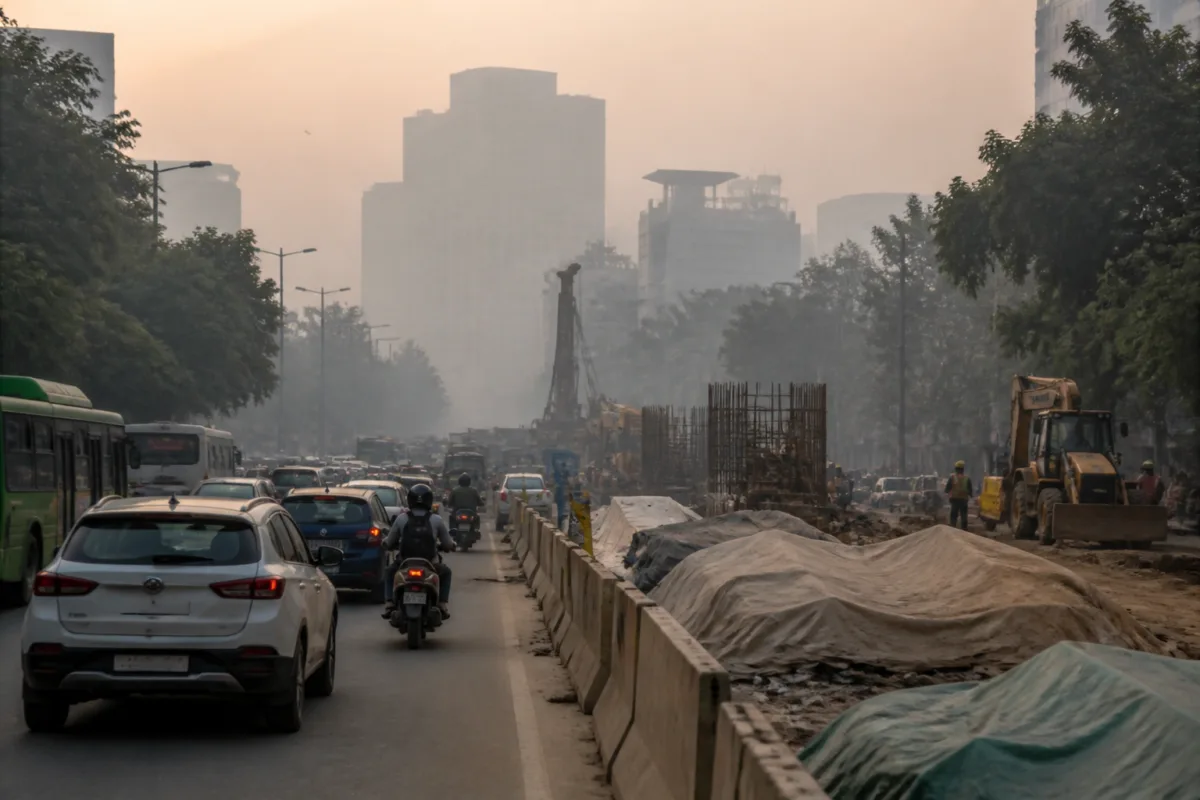
Delhi recorded the weakest progress among the five Delhi-NCR units assessed by the Commission for Air Quality Management (CAQM) between January and October 2026, according to the commission’s first pollution-control report card. Uttar Pradesh registered the highest progress during the period.
The report assessed pollution-control efforts in Delhi and the National Capital Region states of Uttar Pradesh, Haryana, Rajasthan and Punjab against targets set in their respective action plans. Uttar Pradesh recorded 64.82% progress, followed by Punjab at 58.28%, Haryana at 51.54%, Rajasthan at 51.23% and Delhi at 50.88%.
Delhi’s assessment covered 32 specified actions. Only eight, or 25%, were found satisfactory, while 18, or 56.25%, were classified as unsatisfactory. Two actions were identified as requiring improvement, and four were placed in a category where action was not considered necessary at present.
Across the five assessed units, the action plans contained 165 tasks. Of these, 76, or 46.06%, were classified as unsatisfactory. Thirty-seven tasks, or 22.42%, were found satisfactory, 18 required improvement and 34 were categorised as not currently necessary.
The assessment covers the implementation of pollution-control measures across vehicle emissions, road dust, industrial pollution, construction activity and crop-residue management. These areas require coordination across multiple government departments and jurisdictions because emissions and pollution sources in the NCR do not follow administrative boundaries.
CAQM has described the document as an interim report card for January to October 2026. The commission is scheduled to issue the final report card for the full year in January 2027, leaving Delhi and the other assessed units time to improve implementation during the remaining months of the year.
The report therefore provides an administrative measure of progress rather than a new air-quality reading. Its significance lies in identifying how far the actions listed in regional pollution-control plans have been implemented. For Delhi, the low overall progress figure and the high proportion of unsatisfactory tasks point to an implementation gap that will be examined again in the final annual assessment.

