


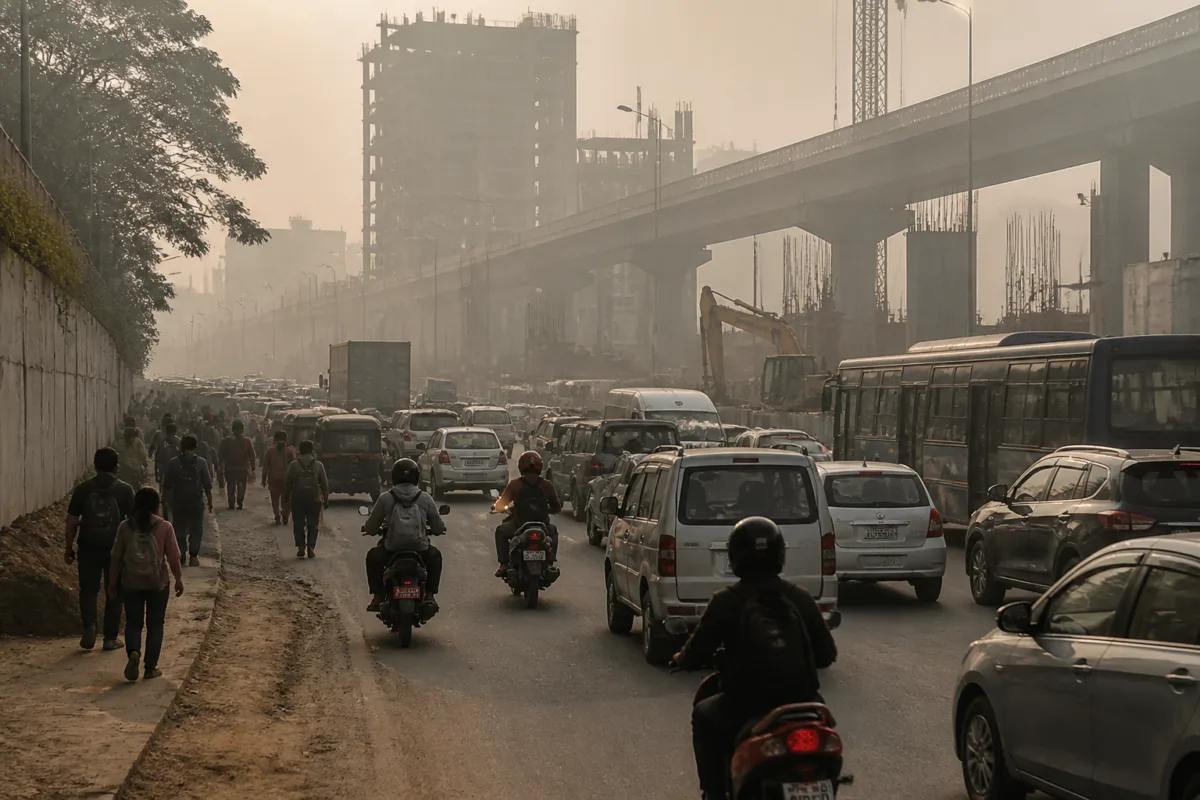
Bengaluru’s air quality deteriorated sharply over the past week, with the city’s average air quality index (AQI) rising from 76 on November 14 to 139 on Saturday, according to a report by Bangalore Mirror. The report said the city entered the ‘unhealthy’ category and recorded its worst air-quality levels around this time of year in four years.
Jayanagar recorded an AQI approaching 250 at 8 am on Saturday, with PM2.5 identified as the primary pollutant. The AQI at Silk Board junction had crossed 200, while readings in Hebbal were close to the same level. Several other neighbourhoods also recorded AQI readings above 200, the report said.
The deterioration is significantly higher than readings recorded around the same period in 2024 and 2025, when the maximum AQI in the reported areas was around 100. PM2.5 concentrations in several neighbourhoods entered the red zone.
The report attributed the worsening conditions to a combination of urban emissions and weather. Construction activity, diesel exhaust, waste burning, traffic-related pollution and road dust were cited as pollution sources. Lower temperatures, reduced wind speeds, stagnant air and limited rainfall can reduce the dispersal and removal of pollutants, allowing particulate matter to remain suspended for longer.
Dr R Subramanian, an air-quality expert quoted by Bangalore Mirror, said Bengaluru needed to control emissions within its jurisdiction, particularly from transport, construction and waste management. He called for a transition to electrified mobility across buses, cars, trucks and last-mile transport, as well as cleaner construction practices to reduce dust and emissions.
Subramanian also said pollution transported from outside Bengaluru would require coordinated action across the wider region. His comments point to the need for both city-level controls and regional coordination when weather conditions limit pollution dispersion.
The report said building density may also influence local pollution conditions. Areas with increasing construction and clusters of tall buildings may experience slower and less effective dispersion of pollutants, although the impact depends partly on the location and movement of emissions.
Healthcare professionals in Bengaluru are reporting more respiratory complaints during periods of poor air quality, including aggravated asthma, worsening chronic obstructive pulmonary disease symptoms, persistent cough, wheezing, breathlessness and throat irritation. Doctors cited in the report cautioned that it may be too early to attribute an increase in hospital admissions solely to pollution.
Dr Shivaraj A L, a Bengaluru-based pulmonologist, said higher concentrations of PM2.5 and PM10, along with pollutants from vehicles, construction, road dust and industrial sources, can aggravate respiratory conditions. Fine particles can penetrate deep into the lungs and trigger inflammation, he said.
Children, older adults and people with existing health conditions were identified as particularly vulnerable. People without a previous history of respiratory illness have also reported discomfort, especially when spending long periods outdoors or commuting through congested areas.

