


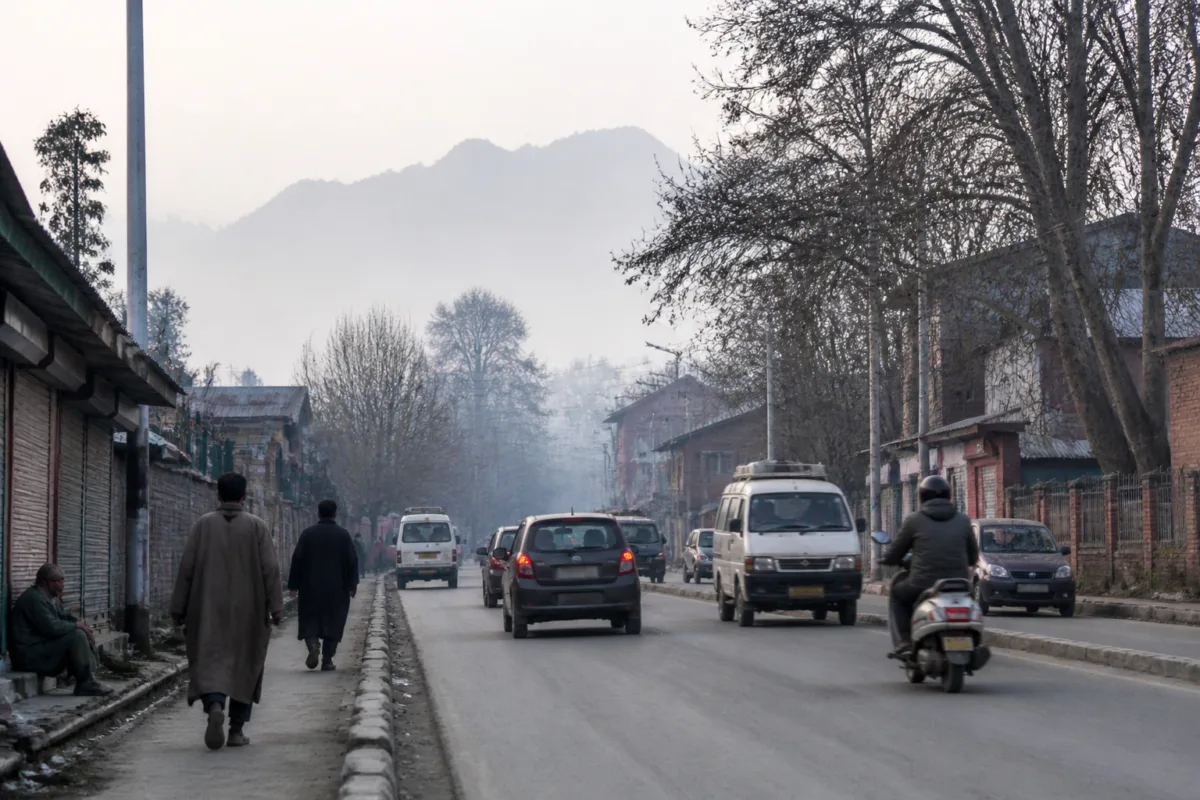
Conflicting air-quality readings from official monitoring stations and private platforms have left Srinagar residents uncertain about the severity of pollution in the city, as haze covered the Valley on Saturday amid cold, cloudy conditions.
Around 5 pm, the website aqi.in reported Srinagar’s air-quality index at 269, categorised as severe, with PM2.5 at 194 micrograms per cubic metre and PM10 at 252 micrograms per cubic metre. The platform briefly ranked Srinagar as the world’s second-most polluted city.
IQAir, another widely used air-quality tracker, reported an AQI of 181, in the unhealthy category, and PM2.5 at 97.9 micrograms per cubic metre. Its readings had also risen during the preceding night, according to the report.
The official readings presented a markedly different picture. The Central Pollution Control Board portal showed an AQI of 38 at the Rajbagh station, operated by the Jammu and Kashmir Pollution Control Committee, on Saturday afternoon. PM10 was identified as the prominent pollutant. The Khunmoh station recorded a higher AQI of 103. The aqicn.org website, which draws on CPCB station data, showed Rajbagh at 39, in the good category, around 1 pm.
The contrast has persisted since Friday. The report said the official reading was around 59 that day, while aqi.in at one point placed Srinagar’s reading above 350. The differing figures have created confusion for residents trying to understand whether the city’s haze reflects a broad pollution episode or conditions affecting particular locations.
The J&K Pollution Control Committee has attributed the variation to differences in monitoring networks, equipment and calculation methods. According to committee officials cited in the report, CPCB stations use calibrated reference-grade equipment and generally publish averaged and validated readings under the National Air Quality Index. Private platforms may rely on denser networks of lower-cost sensors, real-time snapshots and different averaging periods. Some also use indices based on the US Environmental Protection Agency’s approach, which can produce different values from the National AQI scale.
This means that the numbers are not necessarily measuring the same exposure in the same way. A station reading represents conditions at a particular location and over a defined period, while a private platform may combine readings or highlight a more immediate local change. The source report, however, does not establish which reading most accurately represents exposure across the entire city.
Weather and seasonal activity are also part of the reported context. Srinagar appeared hazy under cold and cloudy skies on Saturday, with daytime temperatures reported at 14-16 degrees Celsius and colder nights. Agricultural activity was ending across Kashmir, while instances of agricultural waste and biomass burning, including leaf burning, were reported in areas around the Valley. Winter heating and stagnant air were also identified as possible contributors to higher particulate levels.
The India Meteorological Department has forecast mostly dry conditions in the coming days. The report said this could limit the natural dispersion of pollutants. It also noted that winter conditions in Kashmir are associated with haze, higher particulate emissions and temperature inversion, while the region’s topography can trap particulate-laden air.
For residents, the immediate problem is not only whether the AQI is good, moderate or unhealthy, but also how the information is produced and communicated. Conflicting readings can make it difficult to judge the significance of visible haze, compare conditions between neighbourhoods or decide whether precautionary action is warranted.
The episode points to the importance of transparent public reporting on station locations, monitoring methods, averaging periods, pollutants and the AQI scale being used. Until these differences are clearly explained alongside each reading, residents may continue to see sharply different assessments of the same city’s air on the same day.

