


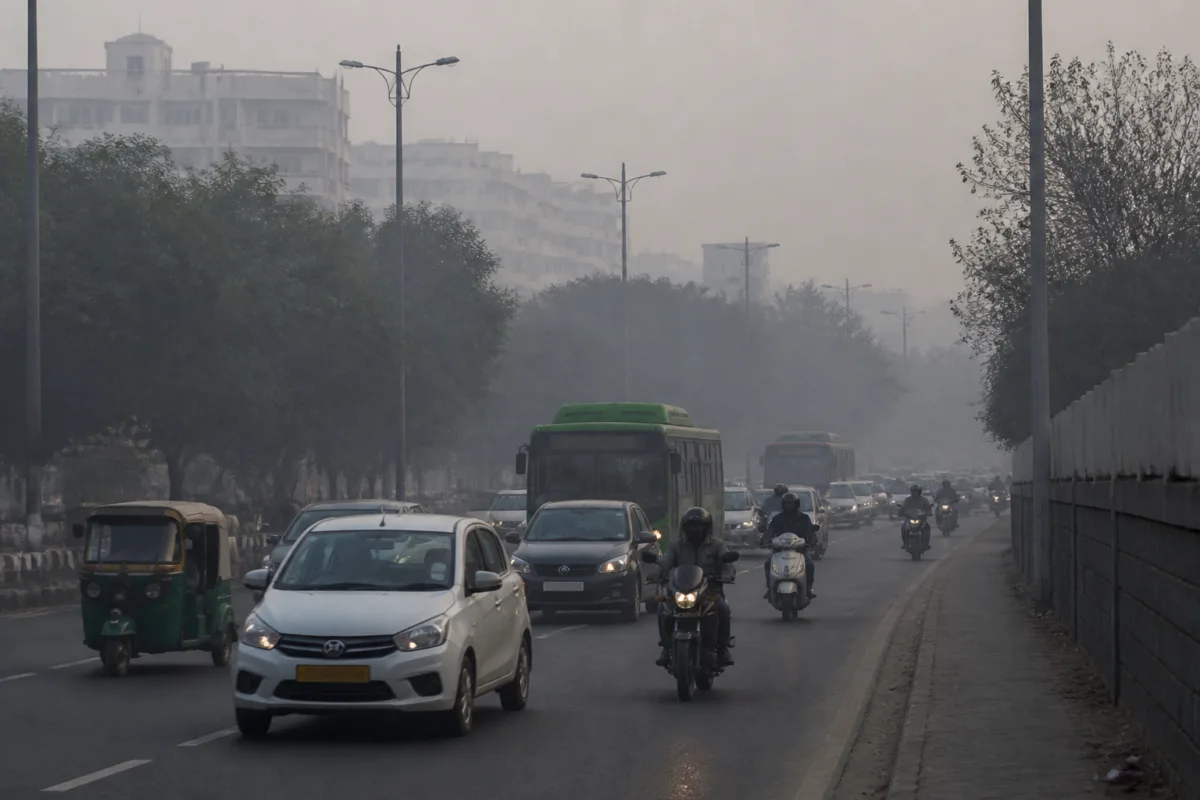
Delhi’s air quality may deteriorate from the poor category to the very poor category over the next six days, according to the air-quality early warning system cited in a Jagran report published on November 22.
The city recorded an Air Quality Index (AQI) of 265 on Saturday, which falls in the poor category. The AQI had improved marginally from 280 on November 19 to 270 on November 20 and 265 on November 21. The report said Delhi’s air quality had remained poor for seven consecutive days.
Of the city’s 56 monitoring stations, 32 recorded AQI readings in the poor category, 16 were in the very poor category, seven were in the moderate category and one was in the satisfactory category. Delhi Technological University recorded the highest AQI at 362, while Delhi Cantonment recorded an AQI of 80.
Real-time source-apportionment estimates from the air-quality early warning system attributed about 33.1% of Delhi’s PM2.5 concentration on Saturday to vehicle emissions, making them the largest reported contributor. Organic aerosols accounted for 16.5%, biomass burning—including crop residue, wood and dung cakes—for 13.9%, and waste burning for 9.5%.
The system forecast that Delhi would remain in the poor category on Sunday before potentially entering the very poor category over the following six days. The report did not provide a separate institutional action plan linked to the forecast.
Advice cited in the report urged residents to take additional precautions for children and older people during the period. People were advised to avoid going outdoors unless necessary and to wear masks when they do go out.
Delhi recorded a maximum temperature of 27.6 degrees Celsius, 0.2 degrees below normal. The minimum temperature at Safdarjung was 12.2 degrees Celsius, 0.1 degrees below normal, according to the report.

