


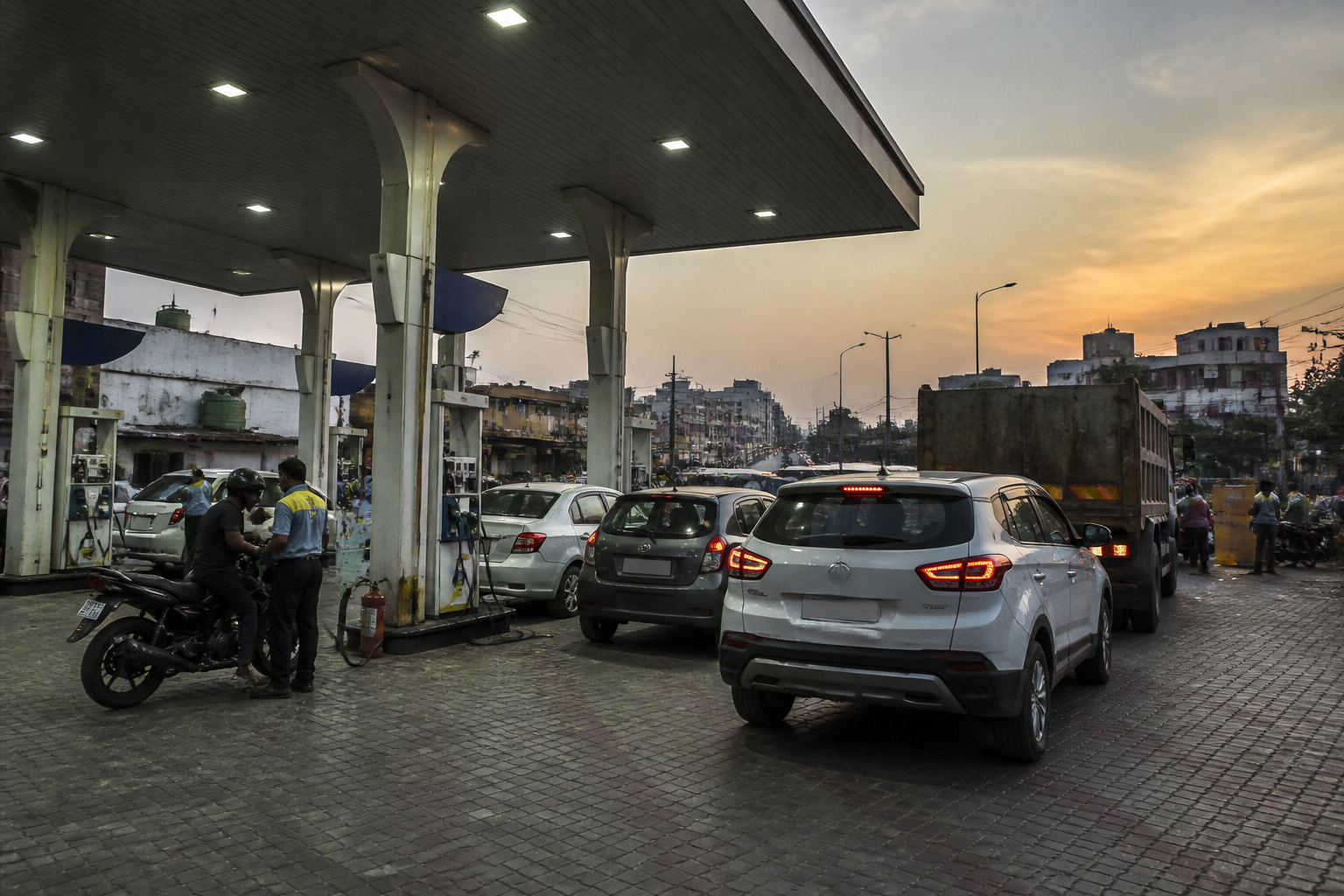
Subheadline: State-owned fuel retailers are absorbing losses on petrol and diesel while higher crude prices raise pressure on transport, inflation and the import bill.
Standfirst: International crude prices crossing $100 a barrel has exposed a widening gap between India’s import costs and unchanged retail fuel prices. State-owned oil marketing companies are reportedly losing about Rs 5 a litre on petrol and Rs 23 a litre on diesel, while domestic LPG is also recording under-recoveries. The immediate issue is not only whether pump prices will change, but how long fuel retailers can absorb the difference between international input costs and domestic prices. This analysis examines the evidence supplied in the report, the exposure of India’s urban economy to imported oil, and the policy pressures created when fuel prices, inflation and public-sector balance sheets move in different directions.
The immediate trigger is a sharp rise in international crude prices amid renewed tensions in West Asia. Brent crude, the global benchmark, rose 2.5 per cent to above $100 a barrel, while US West Texas Intermediate gained nearly 2 per cent to around $95. The report said Brent had last touched the $100 mark on July 23. For India, which imports more than 88 per cent of its crude oil requirements, the movement has direct consequences for the cost of supplying fuel to cities, industries and households.
The report, citing Prashant Vasisht, senior vice-president and co-group head for corporate ratings at ICRA, said marketing margins had turned negative for both petrol and diesel. At the average price for September up to the time of the assessment, the estimated margin was negative Rs 5 per litre on petrol and negative Rs 23 per litre on diesel. Domestic LPG was also seeing under-recoveries of about Rs 200 per cylinder.
These figures describe the gap between the cost environment faced by fuel retailers and the prices paid by consumers. Retail petrol and diesel prices have remained unchanged for more than three months, according to the report. The last revision took place on May 25, when petrol rose by Rs 2.61 a litre and diesel by Rs 2.71. Across four revisions in the second half of May, petrol prices increased by Rs 7.35 a litre and diesel prices by Rs 7.53.
The sequence matters because retail prices have not moved in step with the latest crude-price increase. When international oil becomes more expensive but pump prices remain unchanged, the difference must be absorbed somewhere in the supply chain. In the assessment cited by the report, state-owned fuel retailers are carrying the immediate burden through negative marketing margins. The report does not establish how long that arrangement can continue or how the losses may ultimately be addressed.
The exposure is particularly significant for urban economies because fuel is embedded in nearly every movement of goods and people. Petrol and diesel power private vehicles, buses, trucks, construction equipment and generators. Diesel costs also affect freight movement between production centres, warehouses, wholesale markets and urban neighbourhoods. The report identified aviation, paints, tyres, chemicals, logistics and fast-moving consumer goods as sectors that could face higher costs if crude prices remain elevated.
That transmission is broader than the price displayed at a petrol station. A logistics company may face higher operating expenses even when freight rates have not yet changed. A manufacturer may see the cost of petroleum-linked inputs rise before the effect appears in the retail price of a finished product. Construction and infrastructure activity can also be exposed through transport, equipment and materials costs, although the supplied report does not quantify the effect on any individual project or sector.
The import bill provides a measure of the pressure already visible in India’s external accounts. According to data from the Oil Ministry’s Petroleum Planning and Analysis Cell, the crude oil import bill rose more than 56 per cent to $63.4 billion during April-July, compared with $40.5 billion in the same period a year earlier. Import volumes remained broadly unchanged at 81.9 million tonnes, against 81.5 million tonnes a year earlier.
The contrast between largely stable import volumes and a sharply higher import bill indicates that price, rather than a major change in the quantity imported, was the principal factor in the increase reported for the period. This distinction is important for urban planning and economic management: reduced consumption or lower demand is not the only way the oil bill can change. External price movements can increase the cost of maintaining broadly similar levels of mobility, freight and energy use.
The Indian crude basket averaged $108.91 a barrel on September 8, while its average for September up to that point was $102.11. That compared with an average of $90.19 in August and $82.04 in July. The progression shows how quickly the domestic cost benchmark had moved over the period covered by the report. It also explains why a retail price decision based on earlier averages can become increasingly difficult to sustain when global prices rise rapidly.
The report attributed the rise in Brent partly to tensions involving the United States and Iran and to supply concerns around the Strait of Hormuz. Rajeev Sharan, head of research at Brickwork Ratings, said Brent’s movement above $100 was driven mainly by those tensions and supply concerns. He also cited steady OPEC+ output and continuing geopolitical risk in describing the market as firm and volatile.
For India’s cities, the Strait of Hormuz is not a distant issue without domestic consequences. The country’s high dependence on imported crude means that disruptions or fears of disruption can affect the cost assumptions behind transport, distribution and industrial activity. The supplied evidence does not establish an actual interruption to India’s crude supplies. It does, however, show how concerns about supply can coincide with higher benchmark prices and increase pressure on an import-dependent economy.
The policy landscape contains several competing pressures. Keeping retail fuel prices unchanged limits the immediate effect on households and businesses that buy petrol and diesel. It can also contain a direct contribution to consumer inflation at the pump. At the same time, unchanged prices transfer the immediate cost pressure to fuel retailers when international prices rise. Domestic LPG under-recoveries add another layer because cooking fuel carries a direct household and welfare dimension.
The report also linked higher crude prices to pressure on the trade deficit and the rupee. A larger import bill can increase the amount India pays for energy from overseas, while currency pressure can affect the domestic cost of imported commodities. The supplied material does not quantify the effect of the reported crude-price increase on the rupee or trade deficit, but it identifies the channels through which the pressure could operate.
Monetary policy is another part of the equation. Sharan said the Reserve Bank of India was expected to hold the repo rate at 5.25 per cent and remain watchful, while a tightening bias could not be ruled out if Brent stayed above $100 and fed into broader inflation. This is an attributed assessment, not a confirmed policy decision. It highlights the tension between protecting demand through stable borrowing costs and responding to inflationary pressure generated by imported energy.
The data supplied with the report therefore points to a three-part exposure. First, fuel retailers face negative margins while pump prices remain unchanged. Second, India’s import bill has already risen substantially even with broadly stable import volumes. Third, higher energy costs can spread through transport, logistics, manufacturing and consumer goods, creating pressure beyond the fuel market itself.
What remains uncertain is how the reported losses will be managed if crude prices stay at elevated levels. The material does not provide a decision from the government or the fuel retailers on future price revisions, compensation, subsidy treatment or the duration of the current pricing approach. It also does not establish whether the September margin estimates will persist, widen or narrow.
The immediate evidence confirms that India’s fuel-pricing system is under pressure from a sharp external shock. It also shows why urban economies are vulnerable to changes in a commodity they largely import: fuel prices influence the movement of people, goods and materials, while the cost of shielding consumers can appear in the finances of retailers, the import bill and wider inflation risks. The next developments to monitor are international crude prices, retail petrol and diesel revisions, domestic LPG under-recoveries, the rupee, and any official response from the government, oil marketing companies or the Reserve Bank of India.
