


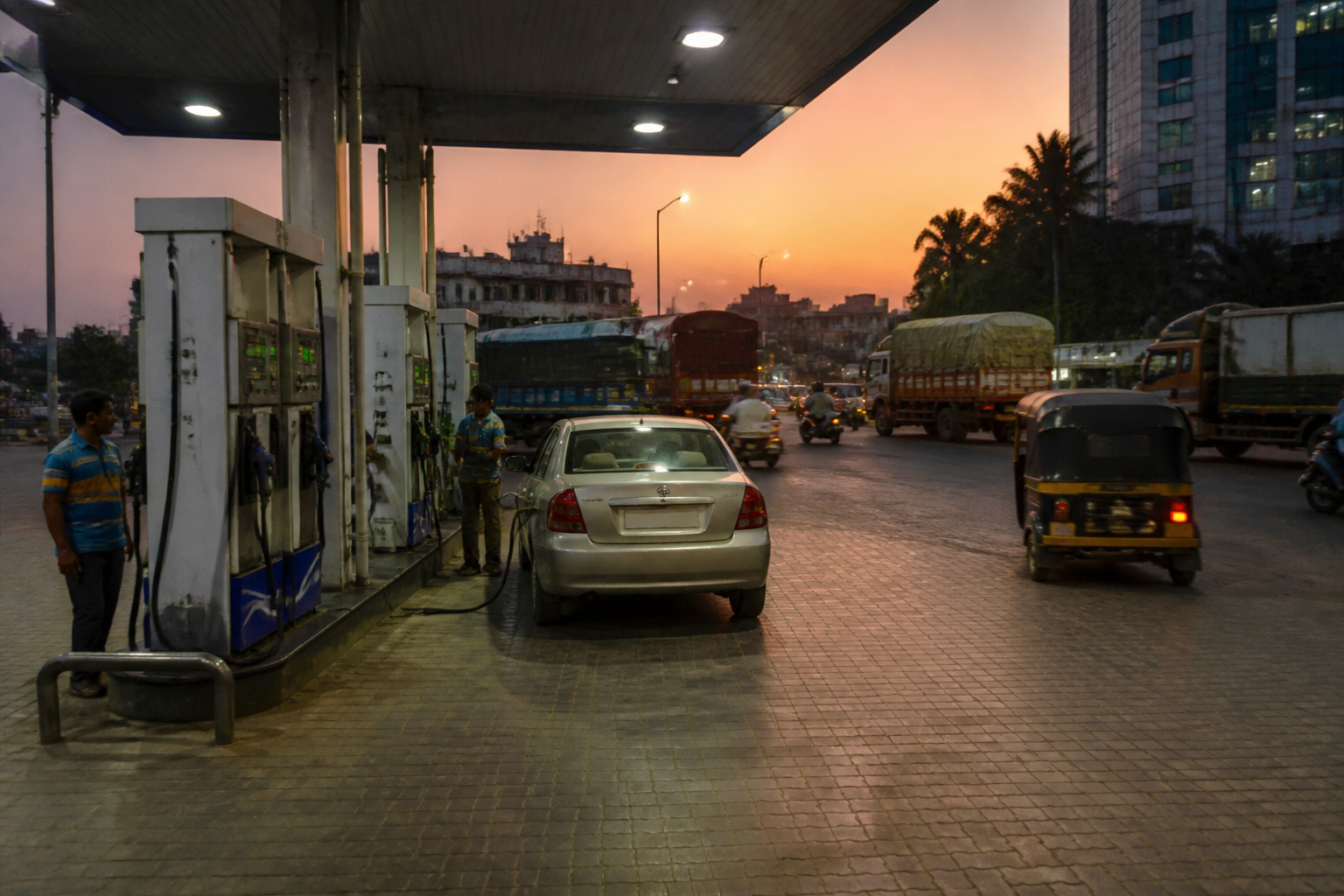
Crude oil prices in India have moved sharply higher, but retail petrol and diesel rates have remained unchanged for more than three months. The gap is creating losses for state-owned fuel retailers while shifting the immediate pressure into the wider economy, where transport, logistics, aviation, manufacturing and household consumption are closely tied to energy costs.
State-owned fuel retailers are reportedly losing about Rs 5 per litre on petrol and Rs 23 per litre on diesel as international crude prices rise above $100 a barrel. The figures, cited by Times of India from analysts, describe a market in which domestic pump prices have not moved in line with the cost of imported crude. The immediate question is not only whether fuel prices will eventually be revised, but how long the resulting under-recoveries can be absorbed without affecting public finances, inflation or the operations of companies that distribute fuel.
The trigger has been renewed tension in West Asia. Brent crude, the global benchmark, rose 2.5 per cent to above $100 a barrel, while US West Texas Intermediate gained nearly 2 per cent to around $95. The report attributes the rise to US-Iran tensions and concerns about supplies moving through the Strait of Hormuz. Rajeev Sharan, head of research at Brickwork Ratings, said the combination of geopolitical risk and steady OPEC+ output could keep prices firm and volatile over the coming month, while adding that prices could ease if tensions cool.
For India, the exposure is structural. The country imports more than 88 per cent of its crude oil requirements, according to the report. That dependence means a rise in international prices quickly increases the import bill, even when the volume of crude entering the country changes little. The report said India’s crude oil import bill rose more than 56 per cent to $63.4 billion during April-July, from $40.5 billion in the same period a year earlier. Import volumes were broadly stable at 81.9 million tonnes, compared with 81.5 million tonnes in the corresponding period.
The numbers indicate that the increase in the import bill was driven primarily by price rather than a substantial change in the quantity imported. The Indian crude basket averaged $108.91 a barrel on September 8, while the average for September so far stood at $102.11. That compared with an average of $90.19 in August and $82.04 in July. These movements matter because crude is not an isolated commodity cost. It enters the economy through fuel distribution, freight, public and private transport, industrial production and the supply chains that connect urban consumers to distant producers.
The effect is visible first in the accounts of fuel retailers. Prashant Vasisht, senior vice-president and co-group head for corporate ratings at ICRA, said marketing margins had turned negative, with losses of about Rs 5 per litre on petrol and Rs 23 per litre on diesel at the average price for September so far. He also said domestic LPG was seeing under-recoveries of about Rs 200 per cylinder.
Retail prices were last revised on May 25, when petrol increased by Rs 2.61 per litre and diesel by Rs 2.71. The report said petrol prices had risen by Rs 7.35 per litre and diesel prices by Rs 7.53 through four revisions in the second half of May. Since then, consumers have faced stable pump prices even as the international cost base has changed. This stability limits the immediate pass-through to motorists, but it does not remove the underlying cost. It leaves the burden with retailers or moves it elsewhere through margins, fiscal decisions and later price adjustments.
That transmission is especially significant for cities. Diesel remains important to freight movement, commercial vehicles, construction equipment and backup power systems, while petrol prices affect private mobility and operating costs for many service providers. A higher fuel cost can therefore reach urban residents indirectly through delivery charges, bus and taxi operations, food distribution, building materials and everyday goods. The supplied report does not establish the size of these secondary effects, but it identifies logistics, aviation, paints, tyres, chemicals and fast-moving consumer goods as sectors exposed to higher crude prices.
The urban economy is particularly sensitive to such cross-sector pressure because the movement of people and materials is energy-intensive. A city may have stable pump prices while transport operators, manufacturers and distributors face higher replacement costs. If those costs are absorbed, company margins narrow. If they are passed on, prices rise for businesses and households. If they are deferred, the adjustment can appear later through revised retail rates or weaker spending elsewhere in the economy. The report provides evidence of the first stage of this process—negative fuel marketing margins and higher import costs—but does not establish how individual cities or companies will respond.
The policy landscape is shaped by the tension between market-linked fuel pricing and the public importance of petrol, diesel and LPG. State-owned fuel retailers occupy a central position in this system. Their prices are visible to consumers and have consequences for transport costs, inflation expectations and political decision-making. Keeping retail rates unchanged can moderate the immediate impact on households and businesses, but it also means that the difference between domestic prices and international costs must be carried by the companies or addressed through other policy mechanisms.
Domestic LPG adds another layer to the issue. Vasisht’s estimate of an under-recovery of Rs 200 per cylinder suggests that the pressure is not limited to vehicle fuels. LPG is used by households and commercial establishments, making its price relevant to food preparation, small businesses and service-sector operations. The supplied material does not specify how the under-recovery is being financed or whether a policy change is planned. That uncertainty is important because the fiscal and operational treatment of these losses will determine how much of the shock remains hidden from consumers and how much eventually reaches them.
Higher crude prices also complicate monetary policy. Sharan said the Reserve Bank of India was expected to hold the repo rate at 5.25 per cent and remain watchful, while adding that a tightening bias could not be ruled out if Brent crude stayed above $100 and fed into broader inflation. This is an assessment attributed to the analyst, not a stated central bank decision. It nevertheless shows how an external energy shock can affect domestic financial conditions: imported inflation can put pressure on prices, the trade deficit and the rupee at the same time.
The currency channel is significant because crude is purchased internationally. A larger import bill can increase demand for foreign currency, while a weaker rupee can make imports more expensive in domestic terms. The report identifies pressure on both the trade deficit and the rupee, but it does not provide a forecast or quantify the currency effect. What it does establish is the country’s high import dependence and the sharp year-on-year increase in the value of crude imports despite broadly unchanged volumes.
The wider data story is therefore one of exposure rather than demand expansion. India imported 81.9 million tonnes of crude during April-July, only modestly above the 81.5 million tonnes recorded a year earlier. Yet the import bill increased from $40.5 billion to $63.4 billion. The distinction matters for urban planning and infrastructure because it shows that the cost pressure can intensify without a proportionate increase in physical consumption. Roads, fleets, industrial facilities and supply chains continue to require energy, but the financial cost of maintaining those systems can rise because of events outside the country.
The immediate evidence does not show whether crude prices will remain above $100 or how long fuel retailers will continue absorbing losses. It also does not establish whether petrol, diesel or LPG prices will be revised. The report records analysts’ expectations of continued volatility and identifies the Strait of Hormuz, US-Iran tensions and OPEC+ production decisions as relevant factors. Those are conditions to monitor rather than confirmed outcomes.
What the episode confirms is that stable retail fuel prices do not mean stable energy costs. India’s urban economy remains connected to international crude markets through imports, freight, mobility and industrial supply chains. The current losses at state-owned fuel retailers, the rise in the crude import bill and the potential pressure on inflation show how an external geopolitical shock can travel through the built environment and everyday city life. The next significant developments will be any change in international crude prices, domestic fuel rates, LPG policy, retailer margins or official assessments of inflation and the rupee.
