


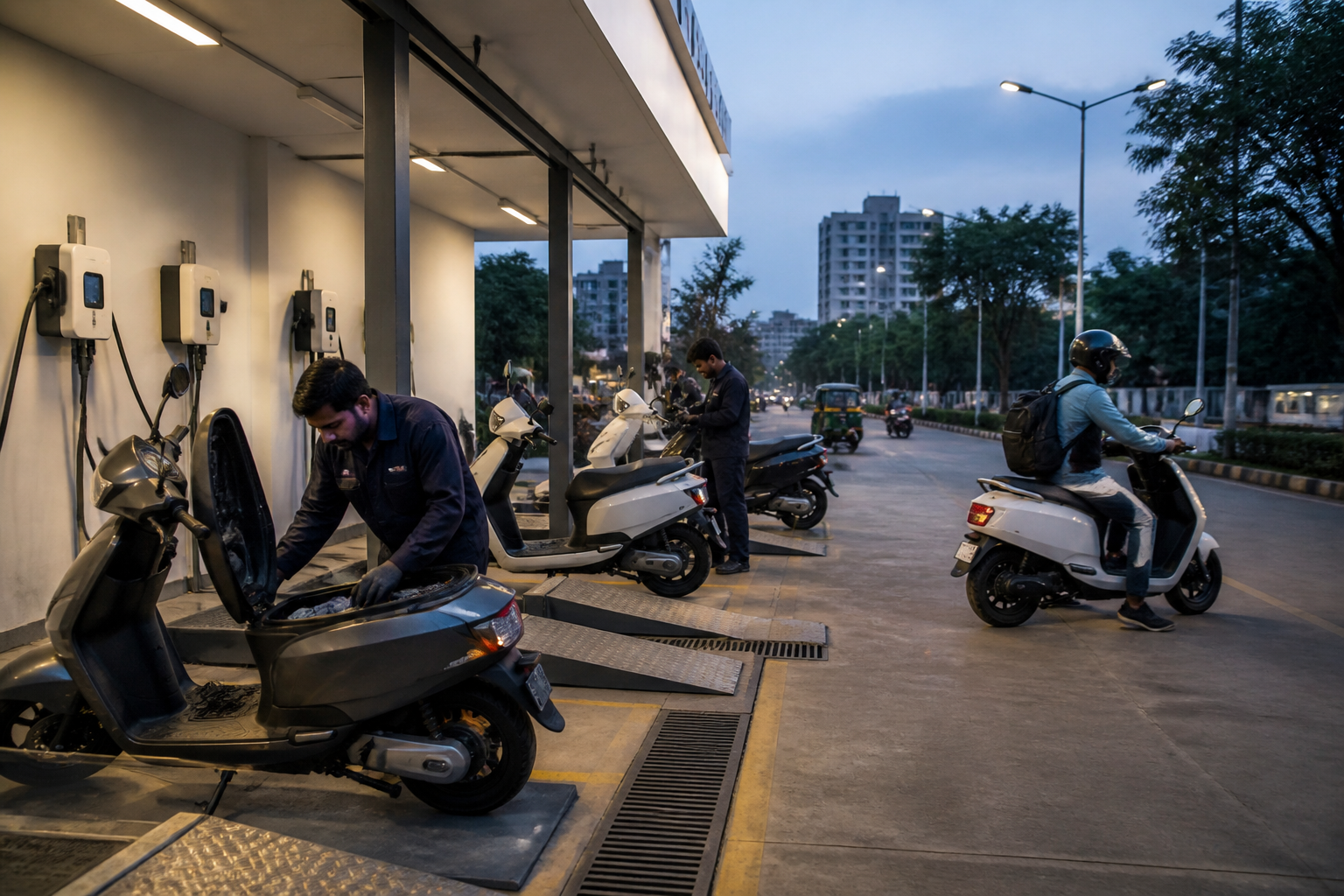
Ather Energy and Ola Electric began as prominent bets on India’s electric two-wheeler future. Their trajectories now offer a sharply contrasting account of how that future is being built: one company is expanding from a premium, engineering-led base, while the other is attempting to recover from product, service and brand problems after a rapid rise.
The contrast matters beyond the fortunes of two Bengaluru-based companies. Electric scooters are becoming part of the everyday transport system in Indian cities, where their success depends not only on purchase prices or battery range but also on service networks, spare-parts availability, charging access, product reliability and consumer trust. The experience of Ather and Ola suggests that the transition from early adoption to mass urban mobility is less likely to be determined by headline-making launches alone than by the less visible systems that support ownership.
According to the Economic Times report, Ather’s average monthly sales rose to around 29,000 units in the first five months of the current fiscal year, compared with 18,400 in the first half of fiscal 2026. Ola Electric’s average monthly sales fell to about 13,800 units from approximately 18,000 over the comparable period. The report also notes that Ola had reached a monthly sales peak of 33,974 units in 2024.
The difference is reflected in market share and financial performance. Ather’s revenue from operations in the quarter ended June rose 89% year on year to ₹1,216.9 crore, while its market share increased to 16.8% from 14.2%, according to the report. Ola’s share of the electric two-wheeler market, meanwhile, was reported to have fallen to 7% in August from a peak of 50% in 2023.
The figures do not establish that one company’s approach alone determines market success. They do, however, show how quickly the electric two-wheeler market can redistribute demand when customers encounter differences in design, reliability, service and availability. For cities, this is important because private electric scooters are not isolated consumer products. They are part of the wider mobility network, affecting daily commuting, local deliveries, parking, charging demand and the operation of dealerships and repair facilities.
Ather’s strategy began with a deliberate decision to design an electric scooter from the ground up. When the company launched its first scooters in 2018, the Ather 340 and 450 were priced at about ₹1.1 lakh and ₹1.25 lakh. Cofounder and chief executive Tarun Mehta said the bill of materials alone had initially cost ₹3.6 lakh, creating a substantial gap between production cost and the eventual retail price.
That early mismatch produced what Mehta described as a “near-death experience”. The founders considered selling the company’s intellectual property, shifting towards software or shutting down. The company eventually continued with a premium positioning rather than competing primarily on price. Mehta told the Economic Times that Ather had never promised to launch a scooter below ₹1 lakh and had not done so.
The approach required patience at a time when the electric two-wheeler market was still being formed. Ather spent years developing products and expanding distribution, while Ola’s 2021 launch of the S1 series generated substantial attention and pre-bookings. The two companies therefore represented different versions of the EV startup model: one built around gradual product development and a premium customer proposition, and the other around rapid scale and a high-profile mass-market push.
The report attributes this distinction partly to product development and engineering discipline. Deepesh Rathore, founder and head of research at Insight EV, said Ather spent significant time and effort on product development. He also argued that Ola often rushed products to market in response to competitive pressure or public-market expectations, resulting in products that had not been fully validated or still had unresolved problems.
Those observations are relevant to urban mobility because an electric scooter’s performance is determined after the sale as much as at the point of purchase. Repair delays, software failures, unavailable spare parts and weak communication can immobilise a vehicle that a commuter may depend on every day. They can also undermine confidence in the wider technology, particularly in markets where many buyers are still comparing electric vehicles with established petrol alternatives.
The Economic Times report says consumer complaints against Ola exceeded 10,000 between September 2023 and August 2024, citing the Policy Research Action Network. It also reports that consumer commissions in Kerala, Thane, Dakshina Kannada and Telangana ordered refunds ranging from ₹89,999 to ₹1.64 lakh, along with compensation, in cases involving service deficiencies. These reported decisions point to a central challenge for electric mobility: sales growth without dependable after-sales support can create costs for consumers and weaken adoption beyond the affected brand.
Ather’s product strategy is now moving beyond its original technology-focused identity. The company is preparing the Konarc, described in the report as its first scooter with a metal body. The product is intended to appeal to conservative and family-oriented buyers who associate metal construction with durability, unlike the composite panels used by many technology-led startups.
This shift illustrates how electric two-wheeler companies are negotiating between innovation and familiarity. Early adopters may value software features, design differentiation and connected technology. Wider adoption requires manufacturers to address more conventional expectations as well: robustness, repairability, dependable service and the confidence that a vehicle can withstand regular family use. Product design is therefore also a form of market segmentation.
Manufacturing capacity is another part of the equation. Ather’s new Maharashtra plant is expected to begin production early next year and, according to the report, will more than double the company’s current capacity of 35,000 units a month. Capacity expansion can reduce supply constraints and support distribution, but it also creates a requirement for the company to maintain quality and service standards as volumes grow.
Hero MotoCorp’s continuing investment gives Ather additional financial and institutional backing. The report says Hero first invested ₹205 crore for a near-30% stake in October 2016, followed by further participation, including a ₹960 crore preferential allotment and a ₹1,758 crore purchase of shares from existing investors. Hero’s chief executive, Harshavardhan Chitale, described the support as consistent backing and said the company’s participation reflected its conviction in electric mobility.
Hero’s involvement is notable because it operates its own electric scooter business under the VIDA brand. Chitale described the relationship as a deliberate dual-brand strategy. The two brands also share a charging network of nearly 6,000 chargers, which the report describes as the industry’s largest. This arrangement shows how established two-wheeler companies can contribute more than capital to the EV transition: they can bring manufacturing knowledge, distribution capabilities, supplier relationships and infrastructure partnerships.
Ola’s experience demonstrates the risks of compressing adoption into a short period. The company’s S1 launch in 2021 was accompanied by ambitious positioning and strong initial consumer interest. But the subsequent reported problems placed pressure on the relationship between marketing promises and ownership experience. During an investor call, cofounder and chief executive Bhavish Aggarwal acknowledged that the brand had taken a hit, while also pointing to a sales increase between the March and June quarters.
The report says Ola’s shares were trading at around half their August 2024 initial public offering price, while Ather’s stock had risen significantly since its listing in May 2025. It also says Hero MotoCorp bought stakes in Ather twice within two months at a stock price nearly six times its listing level. Investor behaviour is not a direct measure of urban transport performance, but it indicates how financial markets are interpreting the companies’ operating trajectories.
The reported market valuations further underline the divergence. Ola Electric was valued at under ₹17,500 crore based on the stock price cited in the report, while Ather’s market value was more than three times higher at approximately ₹62,500 crore. Sagar Shetty, a research analyst at Stox Box, said Ather had outperformed Ola on revenue, volumes, market share and loss management, while describing inconsistency and weaker-than-expected earnings growth as concerns for Ola.
The larger lesson is not that premium products will always defeat low-cost products, or that rapid expansion is inherently unsustainable. Rather, the comparison shows that electric mobility depends on coordination across several layers. Product engineering must align with manufacturing. Manufacturing must align with service capacity. Service must align with the number and geography of vehicles on the road. Charging infrastructure must expand alongside sales, and consumer communication must remain credible when products face technical problems.
For Indian cities, the location and reliability of these systems will matter as much as the vehicles themselves. A scooter that cannot be repaired quickly can disrupt a worker’s commute or a small business’s deliveries. A charging network that is concentrated in a few corridors may not serve outer suburbs or smaller cities. A company that expands faster than its service network can support may transfer operational risk to households.
The Ather-Ola comparison therefore offers a snapshot of a broader transition in the electric two-wheeler market. The early phase rewarded visibility, novelty and the ability to attract bookings. The next phase is likely to be judged through repeat purchases, reliable service, durable products, production consistency and the ability to build trust across a much larger customer base.
The evidence in the report confirms a widening gap between the two companies in sales, market share, revenue growth, investor confidence and reported customer experience. It does not settle whether the gap is permanent. Ather still has to scale its manufacturing and infrastructure while preserving its product standards, and Ola’s reported sales recovery will need to be sustained. The developments to monitor are therefore clear: Ather’s Maharashtra plant, the market response to the Konarc, the expansion of shared charging infrastructure, and Ola’s ability to restore product and service confidence.
