


JSW Group and Volkswagen Group’s proposed 51:49 joint venture for Volkswagen’s passenger-vehicle operations in India is still at the memorandum stage. Yet the agreement already raises a larger question for India’s automotive manufacturing landscape: can an established global vehicle operation, supported by existing plants and brands, be reorganised around higher localisation, wider product coverage and greater plant utilisation?
The two companies have signed a non-binding memorandum of understanding and begun exclusive discussions on valuation and other terms. A binding agreement is targeted by December 2026. Until that agreement is signed, the proposed venture does not establish final ownership, investment levels, liability allocation or operational control. Those matters remain under negotiation.
The structure under discussion would give JSW a 51 per cent stake and Volkswagen a 49 per cent stake. The proposed venture would initially include the eight Skoda and Volkswagen brands sold in India, as well as future launches, including electric vehicles. Luxury marques such as Audi, Porsche, Lamborghini and Bentley are expected to remain outside the venture at the outset, although the reports indicate that JSW is open to their inclusion later and Volkswagen would eventually like all its brands to be brought into the alliance.
The proposed arrangement is significant because it is not simply a new vehicle project. It could cover manufacturing operations, employees, suppliers, model sharing, common platforms, sales and marketing, research and development, and the use of existing production facilities. In that sense, the negotiations involve the restructuring of an operating industrial ecosystem rather than only the creation of a new corporate entity.
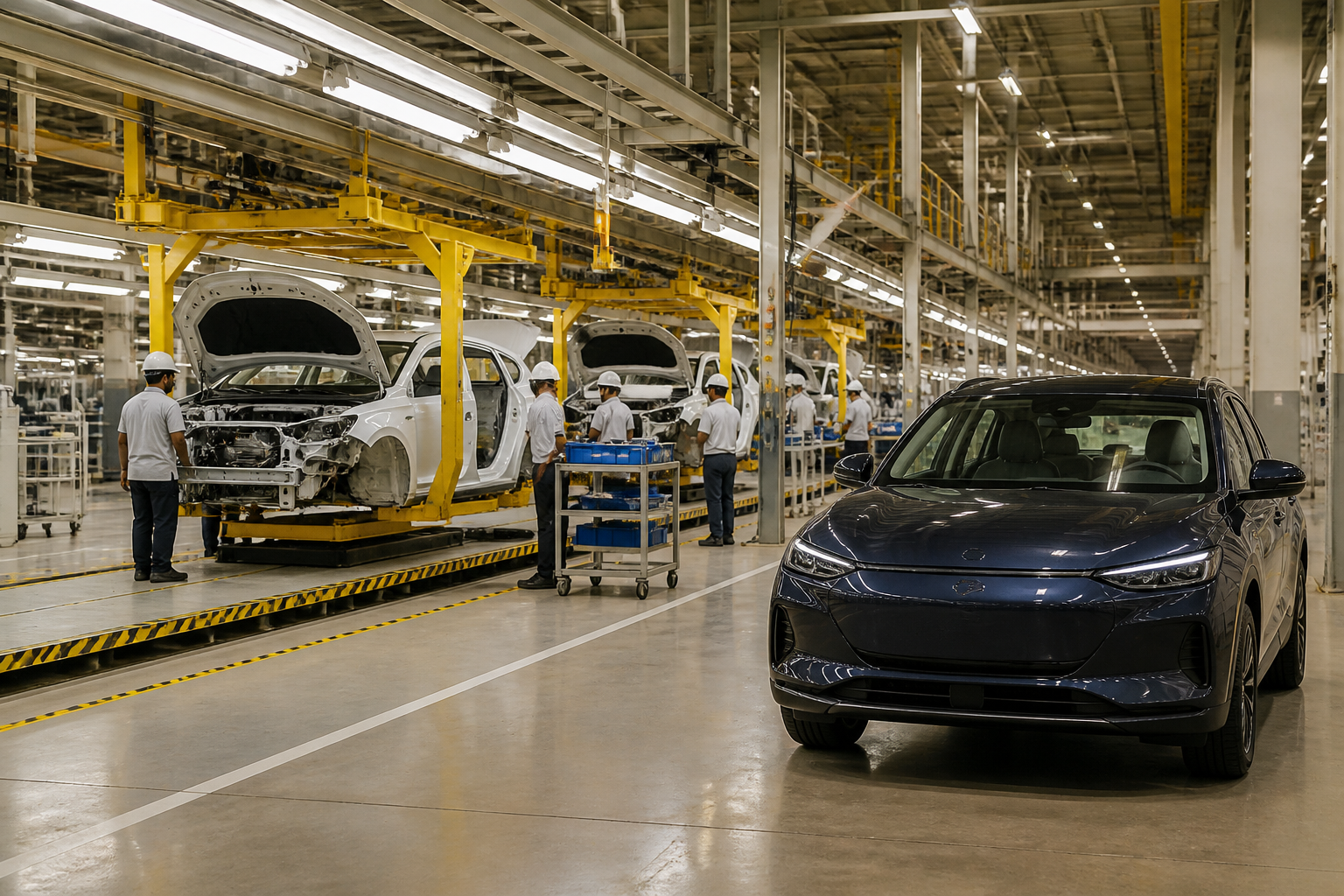
Volkswagen’s existing manufacturing footprint in India includes plants at Chhatrapati Sambhajinagar and Chakan. Together, the facilities have a stated capacity of about 400,000 vehicles a year. The proposed venture is expected to use these plants, which means the immediate industrial question is how effectively the existing assets can be used across a broader portfolio of internal-combustion, hybrid and electric vehicles.
Higher utilisation could allow development and manufacturing costs to be distributed across larger volumes. That logic is central to the proposed partnership. Automotive plants, supplier networks and product-development programmes require substantial fixed investment. If several models can share platforms, components and manufacturing systems, the cost associated with those assets can potentially be spread across more vehicles. The supplied reports do not establish the future production volume or utilisation rate, however, so the extent of any such benefit remains undetermined.
The proposed venture is also expected to focus on mass-market vehicles. Its product scope would include internal-combustion engine vehicles, hybrids and electric vehicles, rather than being limited to one powertrain or one brand. This gives the arrangement a wider industrial remit, but it also creates a complex integration task. The two companies are still working out how models, platforms, manufacturing, employee transfers, sales and marketing operations would be organised.
That organisational question is important for the workforce and supplier ecosystem attached to Skoda Auto Volkswagen India. The reports indicate that the manufacturing operations, employees and suppliers could become part of the joint venture. The use of “could” is significant: the final treatment of these elements has not been confirmed. Until the binding agreement and implementation plan are disclosed, it is not clear which assets and employees would transfer, which functions would remain with the parent companies, or how supplier contracts would be handled.
The partnership would also bring a new ownership model to Volkswagen’s passenger-vehicle operations in India. For Volkswagen, a local partner could support deeper localisation and further investment in the market. For JSW, the proposed transaction would provide a majority stake in an established passenger-vehicle manufacturing operation rather than requiring the group to build an automotive business entirely from the beginning.
The reported investment estimates show the scale of the opportunity, but they should not be treated as confirmed transaction terms. Market estimates cited in the supplied material have placed project investment and capital commitments at more than €1 billion, or about ₹10,000 crore. The final transaction value has not yet been determined. The distinction between estimated project commitments and the eventual valuation of the joint venture will be important as negotiations progress.
One of the principal valuation issues is Volkswagen’s potential tax exposure in a customs-duty case. The Customs Department has alleged that Volkswagen imported nearly complete vehicles in an unassembled state but declared them as individual components, resulting in lower duties. The potential liability has been reported at around ₹20,000 crore. The supplied material does not establish the final status of the case or the amount, if any, that Volkswagen will ultimately be required to pay.
The tax dispute matters to the proposed transaction because liability allocation can affect valuation. According to the reported details, JSW is unlikely to take on liabilities arising from the case. If that position remains part of the negotiations, the potential exposure would need to be considered when the parties determine the value of the business and the terms of the joint venture. This is one of the issues that could shape the final agreement even though it is separate from the physical operation of the plants.
The proposed use of India as an export hub, particularly for electric vehicles, adds another dimension. Export-oriented production would connect the Indian facilities not only to domestic demand but also to Volkswagen’s wider manufacturing and sales strategy. However, the supplied material does not specify export destinations, production targets, tariff arrangements or the timing of electric-vehicle exports. The export ambition is therefore a stated direction rather than an operational plan.
The joint venture’s success would depend on how its different industrial components are aligned. Manufacturing capacity alone does not determine competitiveness. The partnership would also need to coordinate product planning, supplier development, platform use, workforce arrangements, research and development, and distribution. The spokesperson’s stated objectives—wider product choice, deeper localisation, and stronger manufacturing and research capabilities—identify the intended direction, but they do not yet provide details of implementation.
This is particularly relevant to India’s evolving automotive market, where companies are managing several powertrain technologies at once. The proposed venture is intended to cover conventional engines, hybrids and electric vehicles. That broad portfolio could help the companies serve different parts of the market, but it also requires decisions on investment sequencing, component sourcing and plant configuration. No final product timetable or powertrain-specific capacity plan has been announced in the supplied material.
The proposed structure also illustrates how industrial partnerships can be used to combine different forms of strength. Volkswagen brings established passenger-vehicle brands, manufacturing assets and technical capabilities. JSW would bring a majority local ownership position and a broader industrial presence. The arrangement is therefore designed around complementarity: one side has an existing automotive platform, while the other would become the local majority partner in an operating business.
For cities and industrial regions, the consequences would be connected to the performance of the existing facilities and their surrounding supplier networks. Chakan and Chhatrapati Sambhajinagar are not merely locations listed in a corporate transaction. They are production sites linked to jobs, logistics, industrial land, component manufacturers and service providers. Any expansion, consolidation or change in output would have implications for these connected systems. The available information does not establish whether the venture will require new land, major plant expansion or additional infrastructure.
The proposed partnership therefore should not yet be read as a confirmed expansion announcement. It is an agreement to negotiate exclusively, with a binding transaction targeted for December 2026. The ownership ratio has been identified, but the valuation, liability allocation, asset transfers, employee arrangements and operating model remain open. The final scope of the brands is also unsettled, particularly in relation to the luxury marques.
The evidence currently confirms an intended framework rather than a completed deal. The framework includes a 51:49 JSW-Volkswagen structure, eight initial Skoda and Volkswagen brands, coverage of internal-combustion, hybrid and electric vehicles, possible integration of manufacturing and supplier operations, use of plants with combined capacity of about 400,000 vehicles a year, and an ambition to deepen localisation and exports. What remains uncertain is how those elements will be financed, governed and implemented.
The next significant milestone is the targeted binding agreement by December 2026. Its terms should clarify the final transaction value, the treatment of the customs-duty liability, the assets and employees included, the role of the supplier ecosystem, the future of the luxury brands and the production strategy for electric vehicles. Until then, the proposed joint venture is best understood as a potentially important restructuring of Volkswagen’s India operations, not yet as a completed change in the country’s automotive manufacturing map.
