


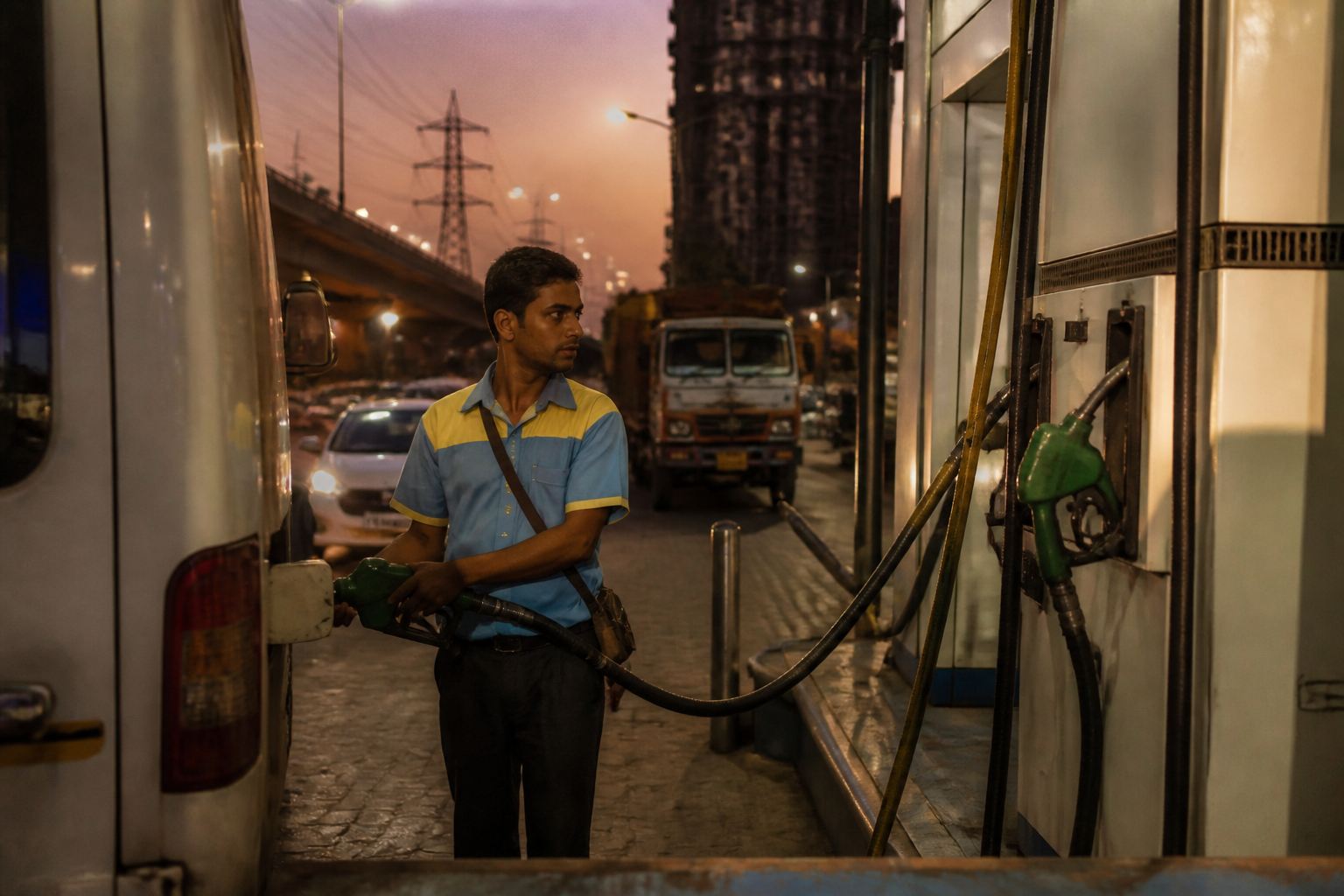
Subheadline: State-owned fuel retailers are absorbing sharply negative marketing margins as higher crude prices raise pressure on India’s import bill, inflation and the rupee.
Standfirst: Brent crude has moved above USD 100 a barrel after an escalation in tensions involving the United States and Iran, while petrol and diesel prices in India have remained unchanged for more than three months. The immediate effect is a widening gap between international input costs and domestic pump prices. But the data in the latest report points to a broader urban-economic issue: India’s dependence on imported oil transmits geopolitical shocks into transport, logistics, manufacturing and household costs. This analysis examines what the reported margins, import figures and crude-basket trends reveal about the exposure of the Indian economy, and what remains uncertain while retail fuel prices stay frozen.
The latest rise in crude prices has exposed the financial pressure building behind India’s unchanged petrol and diesel rates. According to the Economic Times report, Indian fuel retailers are losing around Rs 5 per litre on petrol and Rs 23 per litre on diesel, while Brent crude has crossed the USD 100-a-barrel threshold. The report attributes the increase to an escalation in tensions involving the United States and Iran and to concerns over energy supplies from West Asia.
The immediate event is a movement in the international oil market. Brent, the global benchmark, rose 2.5 per cent to above USD 100 a barrel, while US West Texas Intermediate crude increased by nearly 2 per cent to around USD 95. The Indian crude basket, which reflects a combination of Brent and Oman-Dubai grades, averaged USD 108.91 a barrel on September 8, according to data from the Petroleum Planning and Analysis Cell, or PPAC.
Yet the significance for India comes from the gap between those costs and domestic retail prices. Petrol and diesel prices have been frozen for more than three months, with the last reported revision taking place on May 25. Petrol was increased by Rs 2.61 a litre and diesel by Rs 2.71 at that time. Across four instalments in the second half of May, prices had risen by Rs 7.35 a litre for petrol and Rs 7.53 for diesel.
The reported negative marketing margins indicate that fuel retailers are selling below the level needed to fully reflect current international crude costs and associated pressures. Prashant Vasisht, senior vice-president and co-group head at ICRA, told PTI that average marketing margins in September so far were negative Rs 5 per litre for petrol and negative Rs 23 per litre for diesel. He also said under-recoveries on domestic LPG had reached Rs 200 per cylinder.
These figures do not describe a single cost in isolation. Crude is purchased in international markets, and the price India faces is affected by global benchmarks, the mix of grades in the Indian basket and currency movements. The reported Indian crude-basket average rose from USD 82.04 a barrel in July to USD 90.19 in August and USD 102.11 in September so far. That sequence shows how quickly the domestic input reference has moved even while pump prices have remained unchanged.
India’s exposure is amplified by its import dependence. The country is the world’s third-largest oil importer and consumer and imports more than 88 per cent of its crude-oil requirements, according to the material cited in the report. This means that a sustained rise in international prices can affect the import bill even if the volume of crude entering the country changes little.
The available import data shows that pattern. India’s crude-oil import bill rose by more than 56 per cent to USD 63.4 billion during April-July, compared with USD 40.5 billion in the corresponding period a year earlier, according to PPAC data cited by the report. Import volumes were broadly unchanged at 81.9 million tonnes in the first five months of the current fiscal year, against 81.5 million tonnes a year earlier.
The contrast between largely stable volumes and a sharply higher bill is central to understanding the shock. The increase reported in the import bill is primarily a price exposure story in the supplied data: India is paying more for a broadly similar quantity of crude. For an economy that imports most of its requirements, this creates pressure on the external account and on the availability of dollars needed to pay for energy.
The report links higher crude costs to possible pressure on the trade balance and the rupee. Those effects are not automatic or uniform, but they are established risks identified by the experts quoted. A wider dollar-denominated import bill can increase demand for foreign currency. If that pressure persists, the rupee may face additional strain, while higher domestic energy costs can feed into inflation.
The urban economy is particularly exposed because petroleum products are embedded in mobility and supply chains. The report identifies aviation, paints, tyres, chemicals, logistics and parts of the fast-moving consumer goods industry as oil-sensitive sectors. Diesel prices also matter to freight movement and operating costs across supply networks, while petrol prices affect private mobility and household transport expenses. The supplied material does not quantify the pass-through to specific city-level fares or goods prices, but it establishes the channels through which crude affects urban activity.
Rajeev Sharan, head of research at Brickwork Ratings, said the latest Brent-price increase was being driven mainly by tensions involving the United States and Iran and concerns around the Strait of Hormuz rather than stronger demand. He said OPEC+ was holding output steady and that geopolitical risk remained high. In his assessment, prices could remain firm and volatile through the coming month, with easing dependent on tensions cooling.
That distinction between demand and supply matters. A demand-led rise can signal stronger economic activity, while a supply-risk shock raises costs without necessarily reflecting equivalent growth in consumption. In the account supplied by Economic Times, the current movement is associated with geopolitical risk and restricted supply concerns. This makes the impact more difficult for fuel retailers, industries and policymakers to absorb through normal demand conditions.
The policy consequences extend beyond fuel companies. Sharan said higher crude prices could increase inflation risks, widen the trade gap and weaken the rupee. He also said the pressure could limit the Reserve Bank of India’s room for further rate cuts at its October 7 review. His assessment was that the RBI would hold the repo rate at 5.25 per cent and remain watchful, while a tightening bias could not be ruled out if Brent stayed above USD 100 and affected broader inflation.
The report therefore describes a linked policy problem. Keeping pump prices unchanged shields consumers from an immediate increase, but it leaves retailers absorbing negative margins. Passing costs through to consumers could reduce that gap, but would raise the price of mobility and goods. Meanwhile, the external cost of imported crude continues to be determined by global markets rather than domestic retail decisions.
The position of state-owned oil companies is central to this balance. The report identifies them as the fuel retailers facing the negative margins. It does not establish how long the companies can absorb those losses, whether the reported margins will be compensated, or whether retail prices will be revised. Those remain unresolved questions in the supplied material. The report also does not provide a full accounting of taxes, refining margins, exchange-rate effects or company-level financial offsets, so the reported marketing margins should not be treated as a complete measure of the sector’s total profitability.
The data does, however, establish a clear direction of risk. The Indian crude basket has moved above USD 100 a barrel on a September average basis, the import bill has risen substantially year on year, and fuel retailers are reportedly selling petrol and diesel at negative marketing margins. These developments are occurring alongside unchanged retail rates and high dependence on imported crude.
For cities, the broader question is how much of the urban system depends on energy prices that are set beyond the control of municipal governments. Transport, construction-linked materials, logistics, aviation and consumer distribution all connect local economic activity to international oil markets. The supplied evidence does not measure the impact on individual cities, but it shows why a geopolitical event far from India can become a pressure point for urban costs and public policy.
What the evidence confirms is an expanding gap between global crude costs and domestic pump prices, combined with a higher national import bill and emerging inflation and currency concerns. What remains uncertain is the duration of the geopolitical disruption, the future path of Brent crude, the extent to which retailers can absorb the losses and whether domestic fuel prices will change. Those are the developments that will determine whether the current shock remains a temporary margin squeeze or becomes a wider economic pressure.
