


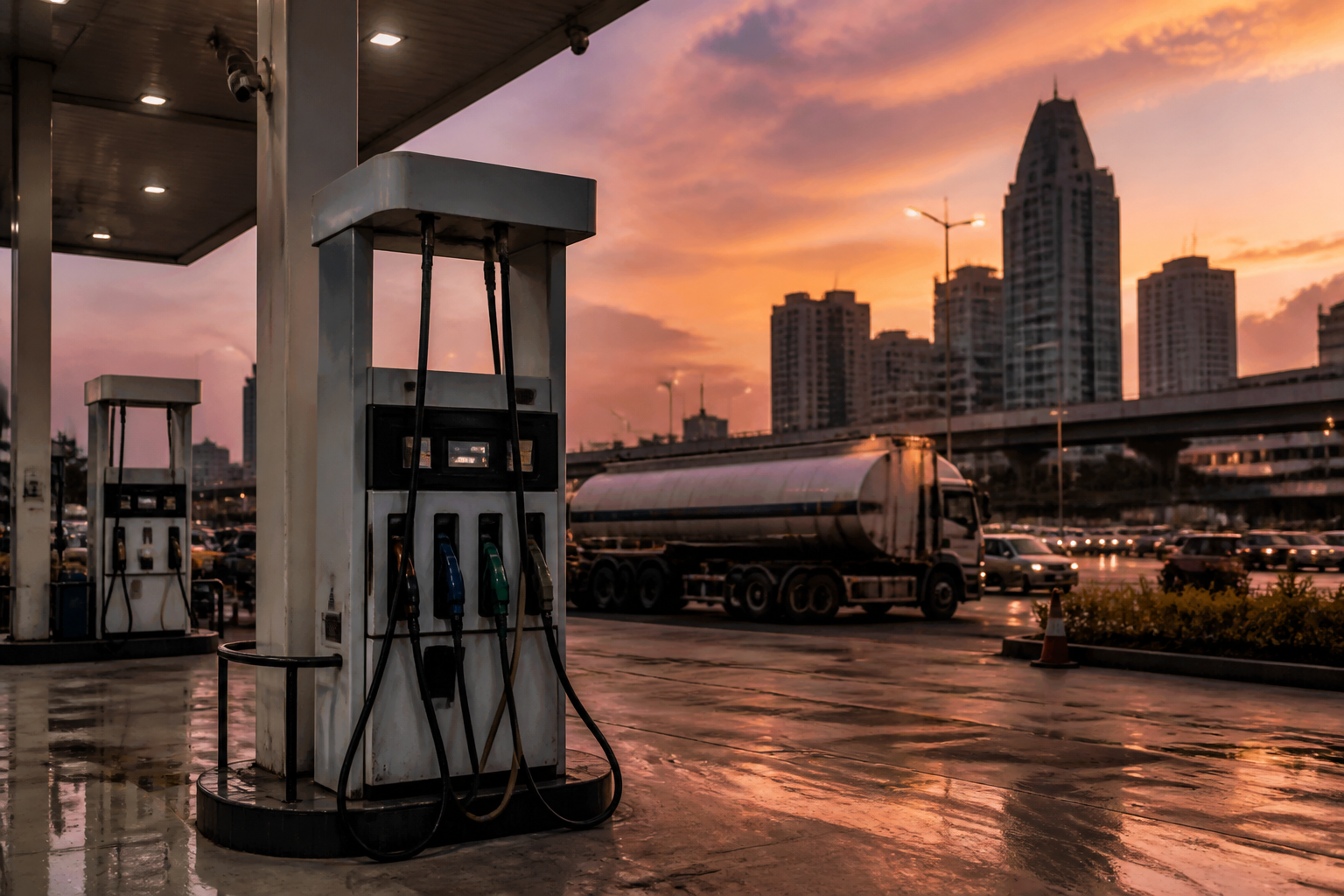
Brent crude moving above USD 100 a barrel has brought a familiar vulnerability back into view for India: the country remains heavily dependent on imported oil while domestic petrol and diesel prices can remain politically and administratively insulated from international market movements. The immediate trigger is a fresh escalation in West Asia, which has pushed up supply-risk premiums. The larger issue is how quickly a temporary geopolitical shock can move through fuel retailers, the import bill, the rupee, inflation and the wider urban economy.
According to a report by Economic Times citing PTI, state-owned oil marketing companies are facing negative marketing margins of about Rs 5 per litre on petrol and Rs 23 per litre on diesel. Retail prices have remained unchanged for more than three months, while Brent crude rose above USD 100 a barrel and the Indian crude basket reached an average of USD 108.91 on September 8. The report says the companies are absorbing the gap between higher international costs and unchanged pump prices.
The immediate contrast is between a floating global commodity price and a largely managed domestic retail regime. Petrol and diesel prices were last revised on May 25, when petrol increased by Rs 2.61 a litre and diesel by Rs 2.71. Those increases followed a broader set of revisions in the second half of May. Across four instalments, petrol prices rose by Rs 7.35 a litre and diesel by Rs 7.53, according to the supplied report. Since then, international prices have moved higher, but retail rates have remained frozen.
That freeze does not eliminate the cost of crude. It changes where the cost appears first. Instead of being immediately reflected at fuel stations, the pressure is recorded in the marketing margins of oil companies and in the national import bill. The extent to which the burden is later distributed among consumers, companies, government revenues or the balance sheets of state-owned firms depends on how long the divergence persists. The supplied material establishes the current margin pressure but does not establish any final compensation or pricing decision.
India’s exposure begins with its import dependence. The country imports more than 88% of its crude oil requirements and is the world’s third-largest oil importer and consumer, according to the report. Import volumes were broadly unchanged at 81.9 million tonnes during the first five months of the current fiscal year, compared with 81.5 million tonnes a year earlier. This is important because the latest increase in the import bill is not being driven primarily by a large rise in the volume of crude purchased.
The crude oil import bill rose by more than 56% in April-July to USD 63.4 billion, from USD 40.5 billion in the corresponding period last year, the report said, citing data from the Oil Ministry’s Petroleum Planning and Analysis Cell. With volumes broadly stable, the increase points to the effect of higher prices on the value of each shipment. Every sustained rise in the international benchmark therefore increases the amount India must pay in dollars for an essential input that the domestic economy cannot quickly substitute.
The Indian crude basket illustrates the speed of the change. It averaged USD 82.04 a barrel in July and USD 90.19 in August, while its September average stood at USD 102.11 at the time of the report. The basket reached USD 108.91 on September 8. It includes low-sulphur Brent crude and sour grades, including Oman and Dubai, in a ratio of 77.81 to 22.19. The movement in the basket matters more directly to Indian refiners than the Brent benchmark alone because it reflects the composition of crude India buys.
For cities, the transmission begins with mobility and logistics. Petrol and diesel are used directly by private vehicles, buses, commercial fleets, delivery networks, construction equipment and goods vehicles. Fuel is also an input into the movement of food, building materials and manufactured goods. The supplied report does not quantify the effect on individual fares or freight rates, but it identifies logistics, aviation, tyres, paints, chemicals and parts of the fast-moving consumer goods sector as oil-sensitive industries whose margins could be squeezed by dearer crude.
This creates a distinction between the price visible to a vehicle owner and the cost faced by the broader urban economy. A frozen pump price can limit an immediate increase in household fuel expenditure, but it cannot prevent higher costs from appearing in aviation, freight, industrial production or supply chains if crude prices remain elevated. The pressure can also reach construction through fuel-intensive transport and equipment, although the supplied material does not provide a sector-specific estimate.
The macroeconomic channel is equally significant. A higher oil import bill increases demand for dollars and can widen pressure on the trade balance. Analysts cited in the report said sustained crude prices could weigh on the rupee and add to domestic inflation. Rajeev Sharan, head of research at Brickwork Ratings, attributed the latest Brent move primarily to US-Iran tensions and supply concerns around the Strait of Hormuz rather than stronger demand. He said higher crude could limit the Reserve Bank of India’s room for further rate cuts at its October 7 review.
These effects are connected. A weaker rupee can make dollar-priced crude more expensive in domestic currency. Higher fuel and energy costs can then feed into the prices of transport and manufactured goods. If inflation broadens, monetary policy faces a more difficult trade-off between supporting growth and containing price pressures. Sharan said he expected the RBI to hold the repo rate at 5.25% and remain watchful, while adding that a tightening bias could not be ruled out if Brent stayed above USD 100 and fed into broader inflation.
The current episode also shows the institutional tension built into fuel pricing. Oil marketing companies operate within a market shaped by international crude prices, exchange rates, refining and distribution costs, taxes and domestic retail decisions. The report focuses on marketing margins, which are the difference between the revenue realised from selling fuel and the cost of acquiring or producing it before other expenses. Negative margins indicate that the retail price is below the relevant market-linked cost used in the assessment cited by ICRA.
Prashant Vasisht, senior vice-president and co-group head at ICRA, said September’s average prices implied negative marketing margins of Rs 5 per litre on petrol and Rs 23 per litre on diesel. He also said under-recoveries on domestic LPG had reached Rs 200 per cylinder. The LPG figure adds another layer to the energy-pricing problem, although the supplied material does not detail how that under-recovery is being financed or allocated.
The policy landscape is therefore not limited to the question of whether petrol and diesel prices should rise. It includes the management of oil company margins, household energy costs, inflation risks, foreign-exchange exposure and the fiscal consequences of absorbing or passing through higher prices. It also includes the longer-term question of reducing vulnerability to imported crude. The report notes that India’s shift to biofuels is being presented by a senior Prime Minister’s adviser as a route towards greater energy security, but it provides no further programme details or quantified impact.
The available data show why that longer-term question remains unresolved. India’s crude import volumes changed little between the comparable periods cited, while the dollar value of imports increased sharply. That combination means that demand-side changes, alternative fuels or efficiency gains would have to be large and sustained to materially alter exposure. The supplied report does not establish whether such a shift is already reducing crude demand, so the effect of biofuels cannot be assumed from the policy reference alone.
The geopolitical trigger also makes the episode different from a straightforward demand-led price cycle. The report says Brent gained 2.5% to move above USD 100, while West Texas Intermediate rose nearly 2% to around USD 95. Vasisht said the escalation between Iran and the United States had pushed up prices, while Sharan pointed to supply concerns involving the Strait of Hormuz. Both accounts place restricted or threatened supply at the centre of the current movement.
That distinction matters for urban and economic planning because supply shocks can arrive faster than consumers, firms or public agencies can adjust. Oil-sensitive businesses may face higher input costs before they can revise contracts or operating plans. Public authorities may also have to weigh the immediate relief provided by stable pump prices against the financial and inflationary pressure that accumulates elsewhere. The report confirms the pressure but does not establish how long the geopolitical disruption will last or how institutions will respond.
What the evidence confirms is narrower but substantial. India is paying more for broadly similar crude import volumes; Brent has crossed USD 100 a barrel; the Indian crude basket has risen sharply from its July and August averages; oil marketing companies are reporting negative margins in the assessment cited; and analysts see risks for the import bill, rupee, inflation and interest rates. What remains uncertain is the duration of the price shock, the eventual treatment of the retailers’ losses and whether domestic fuel prices will be revised.
The developments to monitor are therefore the direction of Brent and the Indian crude basket, the next movement in petrol, diesel and LPG pricing, the import bill, the rupee, inflation indicators and the RBI’s October 7 policy review. Together, these will show whether the current episode remains a short-lived geopolitical shock or becomes a broader test of India’s energy-pricing and economic resilience.
