


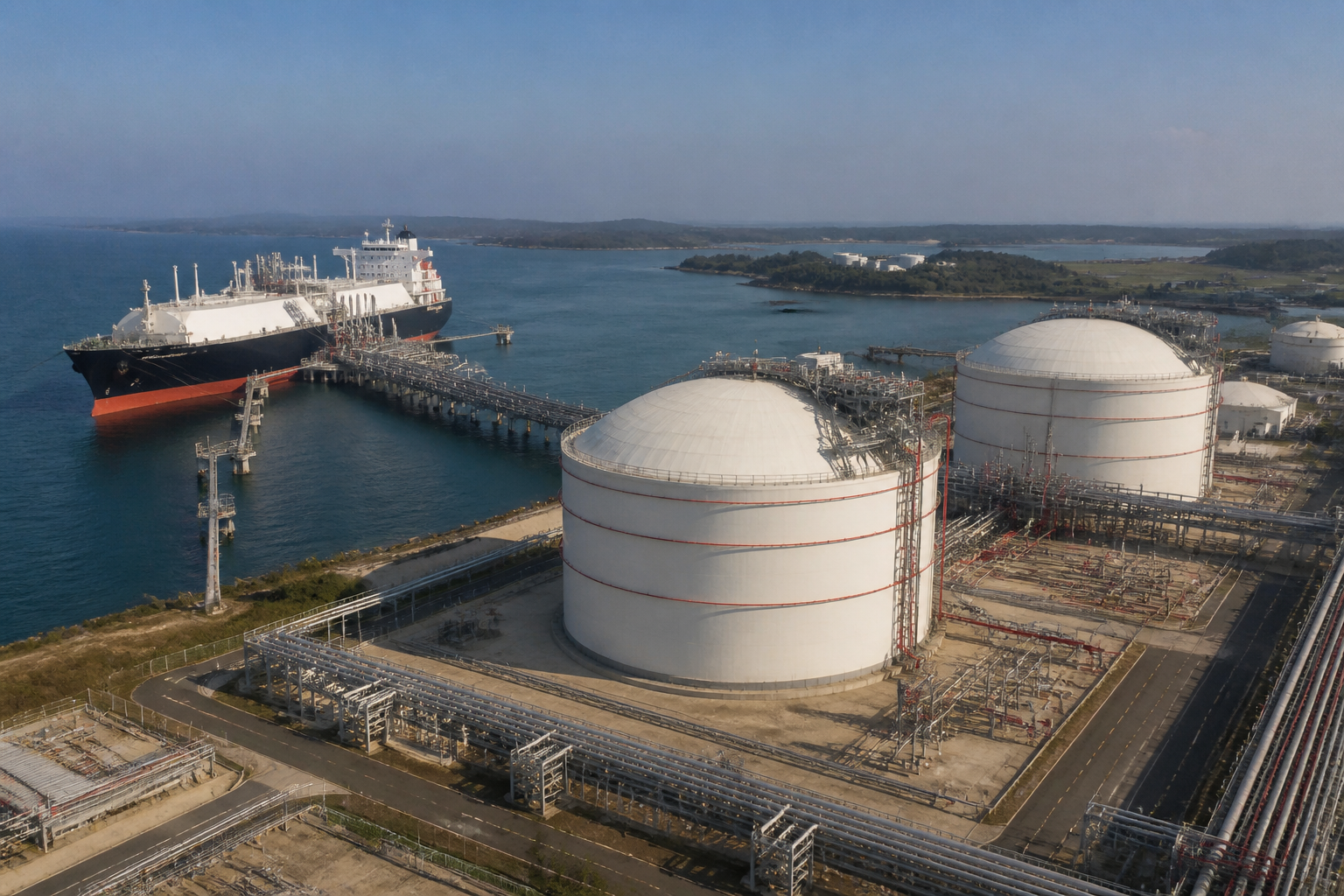
India’s LPG import mix is undergoing a sharp geographical shift. The United States supplied 55.4% of India’s LPG imports in August, after its share rose from about 12% in January and crossed 50% in May, according to Kpler data cited by The Times of India. The change has been driven by disruption to Middle East shipments, but it also reflects a larger question: whether supply security, new contracts and trade considerations can make distant US cargoes a lasting part of India’s cooking-fuel system.
The immediate event is a supply substitution. India had traditionally relied heavily on nearby Gulf producers, with Middle Eastern countries accounting for around 85–90% of LPG imports before the crisis described in the report. When supplies through the Strait of Hormuz were disrupted, Indian buyers turned to the US, the world’s largest LPG exporter, even though the route to India is substantially longer and more expensive in transport terms.
The shift matters because LPG has become an increasingly important household fuel in India. The country imported 21.85 million tonnes of LPG in 2025, while imports met around 66% of domestic LPG consumption, according to the supplied report. That combination of large demand and significant import dependence makes the geography of supply a matter of public infrastructure and energy security, not simply a question of commodity trading.
The new import pattern is also taking shape while overall LPG demand has weakened. Pankaj Srivastava, senior vice-president for commodity markets and oil at Rystad Energy, said average demand stood at 1,042 thousand barrels per day between March 2025 and February 2026. From March to August 2026, the monthly average fell to 862 thousand barrels per day, a decline of almost 20%.
The fall was linked in the report to higher LPG prices and government measures intended to minimise LPG use in alternative industries while protecting cooking-gas availability. This demand reduction, described as demand destruction, has eased some pressure on the import system. At the same time, higher refinery production has reduced the proportion of demand being met through imports.
## How the import mix changed
The numbers show a rapid movement away from the Gulf. The US share of India’s LPG imports rose from around 12% in January to 36.9% in March and more than 50% in May. It reached 73% in July. Over the same period, the UAE’s share fell from 36% to 7.6%, Qatar’s from 19% to 1.4%, and Saudi Arabia’s from 14.6% to zero, according to the Kpler data cited in the report.
August brought some diversification back into the supply basket. The US remained the largest supplier at 55.4%, but the UAE accounted for 15.2%, Algeria for 11.9% and Kuwait for 8.8%. The figures indicate that the US has become the dominant source during the disruption, while Indian buyers have continued to seek cargoes from several origins rather than replacing one concentrated dependency with another overnight.
The underlying reason for the US increase is availability. Natalia Katona, a commodity analyst quoted by The Times of India, said the US already had supply available when Gulf cargoes became difficult to obtain. US propane was also cheaper than Asian alternatives before the conflict, although transporting it to India requires a much longer voyage.
Before the disruption, LPG cargoes from Gulf countries could reach India in three to four days. Some US cargoes loaded at Houston travel to India’s west coast through the Panama Canal, with journeys taking about 30–45 days depending on canal traffic. This makes US procurement more dependent on advance planning, vessel availability and the ability of Indian buyers to manage inventory over a longer supply cycle.
The transport disadvantage has not disappeared. Freight from Houston to India’s west coast rose from about $135 per tonne in early March to around $290 per tonne, according to Katona. Freight from Saudi Arabia’s Ras Tanura increased from approximately $70 per tonne before the crisis to about $235 per tonne. The Saudi comparison is indicative because Saudi LPG loadings stopped in May, while more recent Gulf cargoes have mainly been loaded in the UAE and Kuwait.
## A different pricing and risk structure
The choice between US and Middle Eastern LPG is not determined by freight alone. Srivastava said Middle Eastern supplies use Saudi Aramco’s announced contract prices, which are set at the beginning of the month and closely linked to global crude benchmarks. US LPG is priced through Mont Belvieu’s daily spot mechanism, influenced by North American shale production and export capacity.
That difference changes how Indian oil marketing companies manage price exposure. A monthly contract-price system can create sudden price changes when benchmark assumptions shift. Daily spot pricing, by contrast, provides more frequent visibility around loading dates. The report says this can allow buyers to use average prices and create a degree of operational flexibility, although it does not eliminate market or freight risk.
The longer US voyage is therefore a trade-off. American cargoes take more time to reach India, but their lower free-on-board prices can offset part of the additional freight expense. During a regional supply disruption, the value of a cargo is also determined by whether it can be obtained at all. A cheaper nearby shipment that is unavailable cannot replace a more expensive cargo that can be scheduled and delivered.
This explains why Indian buyers accepted higher logistics costs during the crisis. Cooking-gas availability was treated as the priority, and the lack of short-haul alternatives reduced the importance of freight as a constraint. But that calculation could change if Gulf supply becomes dependable again. Katona said August showed an improvement in Gulf deliveries, which rose to about 44% of India’s LPG imports, while US shipments fell 20% month-on-month.
## The policy and trade dimension
The shift is not only a response to shipping disruption. The supplied report identifies several factors supporting higher US imports: discussions around an India-US trade agreement, the unavailability of nearby supply, upcoming gas-based petrochemical plants seeking reliable feedstock, a reported US-India LPG agreement for 2.2 million tonnes per annum in 2026, and rising US propane production.
The report also says the Indian government has asked Indian Oil, Bharat Petroleum and Hindustan Petroleum to source at least 15% of their 2027 LPG imports through annual agreements with US suppliers. It notes that no decisions had been finalised at the time of reporting. Reuters was also cited as reporting in July that India planned to source up to 25% of its LPG imports from the US in 2027.
These proposed commitments would give the US a more established position in India’s procurement system even if Middle Eastern shipments recover. They would also connect energy sourcing with wider bilateral trade negotiations. US President Donald Trump has said India pledged to increase US energy purchases from $10 billion to $25 billion, while the two countries have set a target of $500 billion in bilateral trade by 2030, according to the report.
The policy question is how much of this shift reflects temporary crisis management and how much represents a deliberate diversification strategy. Annual agreements can provide supply visibility, but they can also reduce the flexibility to return quickly to cheaper nearby cargoes if regional conditions normalise. The balance will depend on prices, freight, refinery output, demand and the reliability of Gulf supply.
## What the demand data reveals
India’s import requirements have fallen alongside demand. Srivastava said average LPG imports were about 785 thousand barrels per day between March 2025 and February 2026, representing almost 70% of demand volume. After the disruption, imports averaged around 440 thousand barrels per day, or approximately half of demand.
The report says LPG consumption fell about 8% to 14.7 million tonnes during January–June 2026, while imports dropped 28% to around 7.5 million tonnes. Full-year consumption is expected to fall to 30 million tonnes in 2026 because of supply constraints, before potentially recovering to around 31 million tonnes in 2027. Imports could rise to about 20 million tonnes next year if demand recovers.
These figures complicate the headline shift toward American supply. The US share is increasing, but the total import requirement has declined. A higher percentage from the US does not necessarily mean that India is importing more LPG from the US in absolute terms. It may instead reflect a smaller overall import basket in which American cargoes have become more prominent because Middle Eastern availability has weakened.
The same data also shows why future demand will matter. If consumption recovers in 2027, India may require more imports even if refinery production continues to rise. That could support long-term US contracts. If demand remains suppressed and Gulf availability improves, buyers may have less reason to pay the additional cost of distant American cargoes.
## The bigger urban energy question
For Indian households, the immediate issue is continuity of cooking-gas supply. For the energy system, the deeper issue is how to manage dependence on imported LPG when a large share of supply passes through a strategically vulnerable maritime route. The recent disruption has demonstrated that physical distance, freight rates and regional security can quickly alter the composition of a fuel basket.
The US cannot automatically replace the Gulf as India’s dominant supplier. Its cargoes require longer planning, longer voyages and exposure to canal and shipping conditions. At the same time, Middle Eastern supply is not risk-free when access through the Strait of Hormuz is uncertain. India’s procurement strategy is therefore moving toward a combination of sources, contracts and inventory planning rather than a simple switch from one supplier to another.
The evidence supplied in the report confirms that American LPG has become a major part of India’s import mix during the current disruption. It also shows that Gulf supplies began recovering in August, while US shipments declined from their July peak. Whether the US share remains above 50% cannot be established from the current data. The decisive variables will be the durability of Hormuz-related disruption, the finalisation of 2027 contracts, the cost of long-distance freight, domestic refinery output and the recovery of LPG demand.
For now, India’s LPG system is not abandoning the Gulf. It is paying for additional optionality. The next stage will reveal whether that optionality becomes a permanent procurement strategy or recedes once nearby supplies become reliably available again.
