


Subheadline: New national accounts data show household units gaining share in manufacturing value added, but the shift also exposes India’s dependence on low-scale production and informal employment.
Standfirst: Household manufacturing in India grew much faster than corporate manufacturing between FY23 and FY25, according to an analysis of current and constant-price data from the recently released National Accounts Statistics 2026. Household units’ share of total manufacturing gross value added rose from 14.8% to 19.4%, while the corporate share fell from 85.2% to 80.6%. The numbers point to a stronger contribution from small businesses, self-employment and unincorporated enterprises. They also raise a more complicated question: does the expansion represent a broad-based strengthening of India’s industrial economy, or does it partly reflect improved measurement of informal activity and continued dependence on small, lower-productivity units?
The latest national accounts data place household manufacturing at the centre of a significant change in the composition of India’s industrial economy. Between FY23 and FY25, the gross value added of household manufacturing units grew at a compound annual growth rate of 25.2% at current prices, compared with 6.7% for corporate manufacturing. At constant prices, the difference remained substantial: household manufacturing grew at a 23.4% CAGR, while corporate manufacturing grew at 7.9%.
That performance increased the household sector’s contribution to total manufacturing GVA from 14.8% in FY23 to 19.4% in FY25. The corporate share declined from 85.2% to 80.6%. Manufacturing as a whole accounted for around 15% of India’s total GVA, making the shift relevant not only to industrial output but also to the structure of economic activity and livelihoods across towns and cities.
The figures do not mean that household manufacturing has overtaken corporate production. Corporate units continue to account for the larger share of manufacturing value added, and their operating surplus reached ₹15.3 lakh crore in FY25. Household manufacturing’s operating surplus was ₹4.6 lakh crore, although it rose 24.5% annually compared with 7% growth for corporate units.
The most important point is the speed and direction of change. Household manufacturing is growing from a much smaller base, which makes a high growth rate easier to achieve. Gaura Sengupta, chief economist at IDFC First Bank, said the faster growth reflects the low base of the household sector compared with the much larger corporate sector. She also linked the expansion to the large role of self-employment and improved capture of informal-sector activity.
That qualification matters because the data are not simply a record of new factories appearing in the formal economy. The latest national accounts series incorporates changes in methods and data sources. The Ministry of Statistics and Programme Implementation has described the new GDP series as reflecting better data and methods. Vivek Kumar, economist at Quant Eco Research, said the movement could partly be a statistical artefact resulting from the transition from the NSS 73rd round of 2015-16 to the Annual Survey of Unincorporated Sector Enterprises benchmark.
In other words, the increase in measured household manufacturing reflects at least two processes operating together. Small and unincorporated businesses may genuinely be expanding, while statistical improvements may also be bringing more of their activity into the national accounts. The supplied data do not establish the precise contribution of each factor. They do, however, show that the household and unincorporated segments can no longer be treated as marginal to the industrial picture.
Data from the Annual Survey of Unincorporated Sector Enterprises point to a parallel expansion in the number of manufacturing units. The number of such units rose to 21.5 million in 2025 from 20.1 million in 2023-24. Employment in these units increased from 33.7 million to 34.9 million over the same period.
These figures connect manufacturing growth to the everyday economic geography of Indian cities and towns. Unincorporated production is often distributed across smaller establishments rather than concentrated in large industrial facilities. The data supplied do not provide a location-wise breakdown, so they cannot show how much of the increase is urban, rural or concentrated in particular states. They do show, however, that manufacturing livelihoods are being generated across a wide base of small enterprises and self-employed workers.
The employment trend is significant but needs to be read alongside the structure of these enterprises. A report by BofA Global Research cited in the source material said India’s manufacturing sector remains heavily concentrated in micro units, with very few medium-sized firms. The report linked that structure to lower productivity and weaker job creation. The rise in household manufacturing therefore presents a mixed picture: it indicates economic activity and income generation, but it does not by itself demonstrate a transition towards larger, more productive or more secure forms of employment.
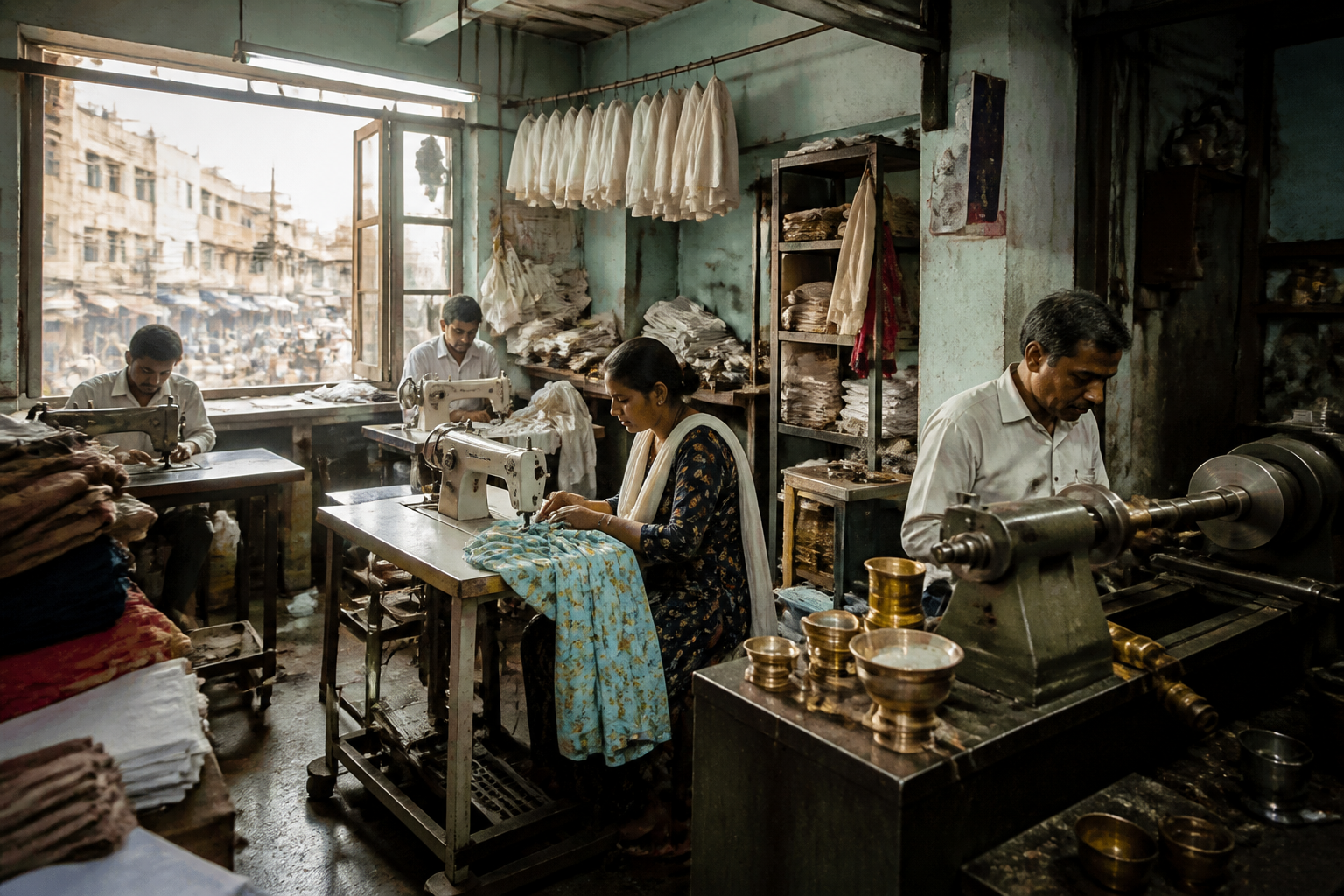
The composition of household manufacturing also provides clues about where the expansion is occurring. Textiles, apparel and leather products accounted for the largest share of household manufacturing value added in FY25, at 20%. The segment grew at a 16.1% CAGR between FY23 and FY25. Metal products accounted for 17.3% of household manufacturing value added and grew at a 33.6% CAGR. Food, beverages and tobacco contributed 16.1% and grew at 22.9%.
Corporate manufacturing has a different profile. Coke, petroleum, rubber, chemicals and related products accounted for the largest corporate share, at 31%, but grew at 2.9%. Machinery and equipment accounted for 30.5% and grew at 16.4%. The contrast suggests that the household and corporate sectors are not merely competing within the same product mix. Their growth is distributed across different activities, scales and production arrangements.
For cities, that distinction affects how industrial activity is understood and planned. A manufacturing economy built around household and micro units does not necessarily resemble a conventional industrial corridor dominated by large factories. Production can be spread through mixed-use areas, small workshops, home-based units and local commercial clusters. The supplied data do not identify the physical locations of these businesses or their infrastructure needs, but the scale of the enterprise base indicates that industrial policy cannot be assessed only through large corporate investments and formal factory employment.
The data also complicate the usual relationship between manufacturing growth and job creation. Household manufacturing’s operating surplus grew rapidly, and employment in unincorporated manufacturing units increased by 1.2 million between 2023-24 and 2025. Yet the structural concern identified by BofA Global Research remains: an economy dominated by very small units may have difficulty generating productivity gains and sustained employment growth at the scale required by India’s expanding workforce.
This is where measurement and policy meet. Better informal-sector data are essential because activity that is not measured cannot be properly incorporated into economic planning. Improved coverage can make the manufacturing sector appear to grow faster even when part of the change reflects more complete measurement rather than a comparable increase in physical output. At the same time, recognising informal production is necessary for understanding how households earn, how enterprises operate and where economic support is reaching—or failing to reach—them.
The new data series and the ASUSE benchmark therefore perform two different functions. The national accounts estimate the value added generated by different parts of the economy. The enterprise survey provides information on the number of unincorporated units and their employment. Read together, they indicate that the small-scale segment is expanding in both measured value and enterprise presence. They do not, on the basis of the supplied material, establish whether productivity, wages, working conditions or business survival rates have improved.
The policy landscape is consequently broader than a choice between formal and informal manufacturing. The evidence points to a sector in which household businesses, unincorporated enterprises and corporate manufacturers occupy different positions. Corporate profitability has been under pressure, according to Madan Sabnavis, chief economist at Bank of Baroda. That pressure is reflected in the slower growth of corporate operating surplus compared with the household segment, although the corporate base remains much larger.
For urban administrations, the issue is also one of institutional visibility. If manufacturing activity is spread across small and household enterprises, its requirements may not be captured by policies designed around formal industrial estates or large employers. The source material does not provide details of specific government schemes, financing programmes, zoning rules or municipal interventions, so the precise policy response cannot be assessed here. What the numbers establish is the scale of the segment that such frameworks would need to recognise.
The strongest conclusion from the data is not that household manufacturing has replaced corporate manufacturing. It is that India’s industrial base is more dependent on small-scale and informal production than the corporate share alone suggests. Household units still contribute less total manufacturing GVA than corporates, but their share has risen sharply and their measured value added has grown much faster over the period examined.
What remains uncertain is how much of that shift represents underlying expansion and how much reflects improved statistical coverage and changes in benchmarking. It is also unclear from the supplied data whether the growth is translating into higher productivity, stronger job quality or a durable movement of firms from household and micro scale into larger enterprises. Those questions will determine whether the latest numbers signal a structural transformation or a better accounting of an existing economic reality.
For now, the evidence supports a more detailed view of Indian manufacturing—one that includes the millions of small units and workers operating outside the corporate centre. The next developments to monitor are revisions to the national accounts, further ASUSE results and evidence on productivity, enterprise scale and employment conditions within the expanding household manufacturing base.
