


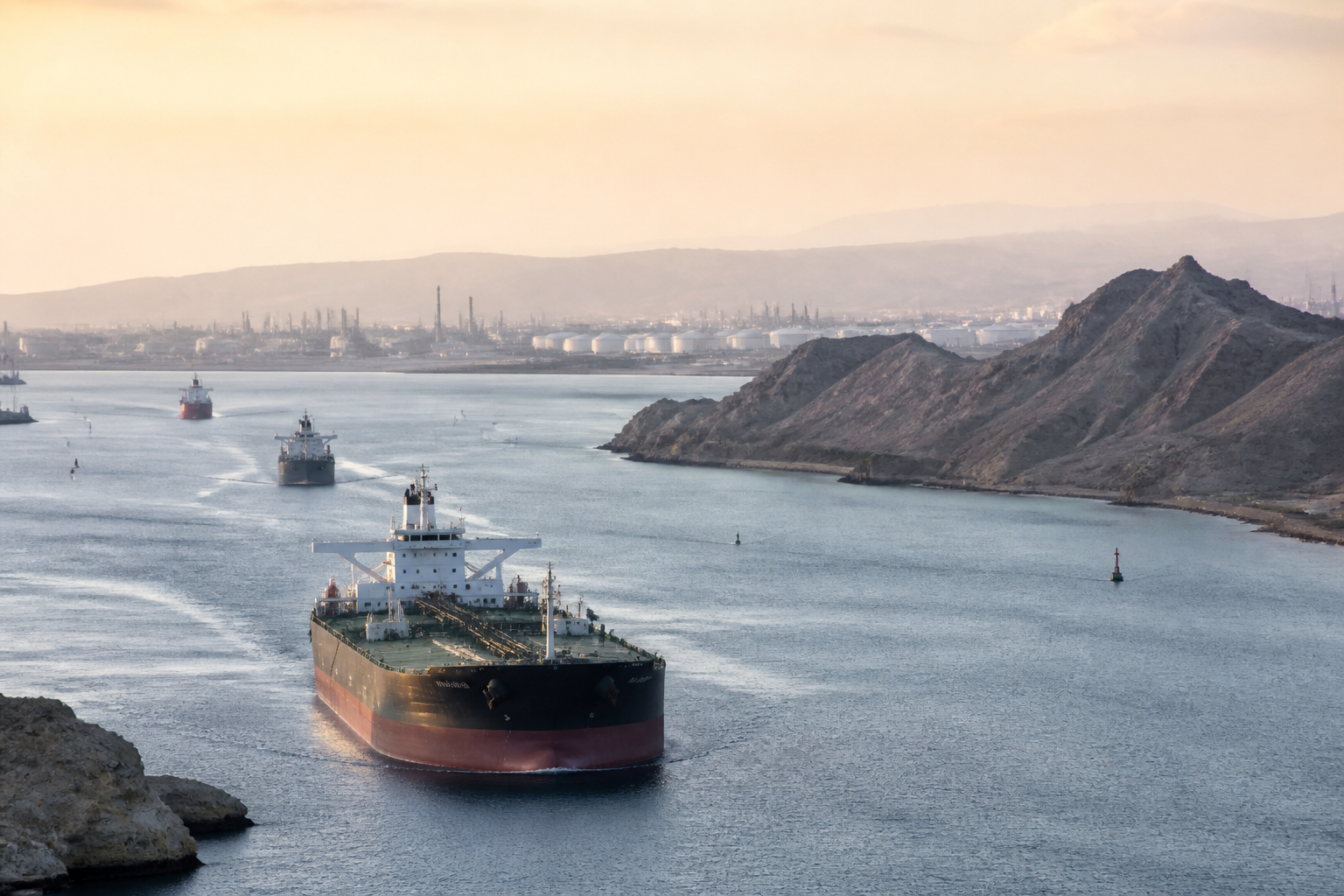
The latest attacks on Saudi Arabia have changed the oil-market question from whether prices will fall back to normal levels to whether the global system can keep enough supply routes open at the same time. Houthi missile and drone strikes on southern Saudi Arabia wounded 73 people, caused fires at energy and utility facilities and temporarily disrupted operations at sites linked to Saudi Aramco, according to the report. The attacks also placed renewed pressure on Bab al-Mandeb, the Red Sea chokepoint, while traffic through the Strait of Hormuz remains severely impaired.
That combination matters because the world’s oil trade depends not only on production but also on the ability to move crude through a limited number of maritime and pipeline routes. Saudi Arabia, the world’s leading crude exporter and the second-largest oil producer after the United States, has historically provided the market with flexibility. Its production capacity, storage network, pipelines and multiple export routes have helped absorb isolated disruptions. The current crisis is testing whether that flexibility remains usable when more than one route is under pressure.
The immediate market response was sharp. Brent crude briefly rose above $99 a barrel on Tuesday, reaching its highest level since July 24, while West Texas Intermediate approached $95. The move reflected both concerns about physical supply and the additional premium traders attach to geopolitical risk. The attacks do not necessarily mean that Saudi production has suffered a lasting loss. Their importance lies in the possibility that repeated strikes could make an alternative export route too dangerous or expensive to use.
The Strait of Hormuz is central to that concern. Before the war, more than 20 million barrels a day moved through the passage, according to the supplied report. The US Energy Information Administration estimates that average flows fell to 4.9 million barrels per day in the second quarter, compared with 21.6 million barrels per day in the final quarter of 2025. Even with traffic reduced to a fraction of its earlier level, the strait remains one of the most consequential links in the global energy system.
Saudi Arabia responded to the disruption by diverting more crude towards its Red Sea port of Yanbu. That raised estimated flows through Bab al-Mandeb to 8.1 million barrels a day in the second quarter, from 5.4 million in the previous quarter. The route therefore became more important precisely as the Houthi threat to shipping intensified. The group declared a blockade of Saudi shipping in July and has attacked Saudi tankers. Tuesday’s strikes show that the danger is no longer limited to vessels at sea; facilities supporting energy operations are also exposed.
The market has alternative routes, but none is frictionless. Shipments can travel around the Cape of Good Hope, while the Suez Canal and the SUMED pipeline offer other options. These alternatives are slower, more expensive and limited by capacity. A diversion around Africa lengthens voyages, ties up tankers for longer periods and raises fuel, freight and insurance costs. The result can be a tighter market even when the number of barrels physically removed from production remains relatively small.
The experience of 2024 illustrates the effect. EIA historical data cited in the report show that oil flows through Bab al-Mandeb more than halved during the first eight months of that year after Houthi attacks on commercial vessels began. Flows fell to about 4 million barrels a day from 8.7 million in 2023, with tankers choosing the longer route around the Cape of Good Hope. The current situation is more difficult because the Red Sea route is being threatened while Hormuz is already operating below its earlier capacity.
This is why the direct damage reported at Saudi facilities may not be the most important measure of risk. Saudi Arabia can absorb isolated attacks if repairs are rapid and shipping remains possible. The more serious problem is sustained uncertainty. If insurers raise premiums sharply, if tanker operators avoid Bab al-Mandeb or if vessels face longer waits for Saudi cargoes, the market loses part of its ability to compensate for disruptions elsewhere. The Financial Times, as cited in the report, said Asian refiners could face longer waits for Saudi crude as tankers abandon the route.
The change in market expectations is also significant. Earlier hopes for lower oil prices were based on a return to normalisation. The assumption was that Hormuz traffic would recover, shut-in production would return and diplomacy between Washington and Tehran could reduce the geopolitical premium. Those conditions have not materialised. The report says Brent was below $70 in early July after a US-Iran understanding but later reached $105 on July 23 as tanker attacks resumed and the Houthi blockade threat emerged.
That price movement shows how quickly expectations can change. Investors had briefly become more optimistic when Hormuz traffic recovered to approximately 8 million to 9 million barrels a day in August, according to Jorge León of Rystad Energy, as quoted by the New York Times. The expectation that diplomacy would produce a durable reduction in risk has since weakened. Hamad Hussain of Capital Economics told the New York Times that oil-market participants were pricing in a longer disruption to shipping flows. Capital Economics consequently moved towards an assumption of oil prices around $100 a barrel for the rest of 2026.
The range of possible outcomes remains wide. Goldman Sachs sees a scenario in which oil rises as high as $120 a barrel if attacks on Middle Eastern vessels escalate. It also sees prices falling towards $80 if exports return to normal. Those estimates are not forecasts of a certain outcome; they demonstrate how asymmetric the market has become. De-escalation could release supply and reduce the risk premium quickly, but further attacks could raise freight costs, restrict exports or damage infrastructure before a large volume of crude is formally taken offline.
Several factors are still limiting the immediate price shock. Hormuz continues to carry substantial volumes, alternative export routes remain available, production outside OPEC is rising and weaker demand is cushioning the disruption. China has also accumulated unusually large oil inventories. These factors can delay a supply crisis, but they do not remove the underlying vulnerability. Inventories provide time, while alternative routes provide partial relief; neither restores the capacity and efficiency of the normal trading system.
The conflict’s origins make a rapid resolution difficult to assume. The Houthis emerged as a major force in Yemen’s civil war, taking control of large parts of northern Yemen, including Sanaa. Saudi Arabia intervened in 2015 at the head of an Arab coalition supporting Yemen’s internationally recognised government. A UN-backed truce in 2022 reduced large-scale fighting but did not produce a permanent political settlement. The current escalation began building again in July, when the Houthis declared a blockade against Saudi shipping and expanded military activity along Yemen’s western coast.
The confrontation is also linked to the wider regional conflict involving Iran and its adversaries. The report says the US-Israeli war against Iran that began on February 28 transformed Yemen’s conflict from a largely contained war into another front. Ahmed Nagi of the International Crisis Group said the Houthi movement’s push towards Yemen’s western coast had a maritime dimension because control of territory near the Red Sea could provide greater depth to pressure shipping. That connection means developments on land can affect maritime insurance, tanker movements and crude availability far beyond Yemen.
For Saudi Arabia, the policy dilemma is difficult. Riyadh has signalled that it will respond to attacks while its foreign minister has said the door to diplomacy remains open. A military response may seek to restore deterrence, but a broader escalation could further endanger the routes Saudi Arabia needs to export oil. Restraint, meanwhile, could leave the Houthis with greater influence over the timing and geography of disruption. The competing objectives—protecting sovereignty, avoiding a return to full-scale war and maintaining export capacity—are now closely linked.
For India, the immediate economic exposure is through imported crude. Higher oil prices raise the cost of imports and can place pressure on fuel markets, transport expenses and the wider economy. The supplied report also notes that India’s fuel demand fell 2.8% year on year in August, although it does not establish how much of that change was caused by the current geopolitical disruption. The country’s vulnerability therefore depends on both international prices and the duration of shipping constraints.
The evidence does not establish that oil prices will certainly remain above $100 or reach the $120 scenario described by Goldman Sachs. Demand weakness, non-OPEC supply, inventories and alternative routes remain important counterweights. What it does establish is that the assumption of a quick return to cheaper crude has become harder to defend. Hormuz remains impaired, Bab al-Mandeb is increasingly risky and the cost of moving oil is rising.
The central issue for the market is therefore not whether one facility can be repaired quickly. It is whether enough shipping lanes can remain reliably open for the global system to compensate for disrupted production and delayed cargoes. Until the conflict recedes or the two key routes become dependable again, the geopolitical premium in oil prices is likely to remain a central feature of the market. The developments requiring close monitoring are the restoration of Hormuz traffic, the safety of Bab al-Mandeb, the direction of Saudi export flows and whether further attacks turn a shipping risk into a sustained physical supply shortage.
