


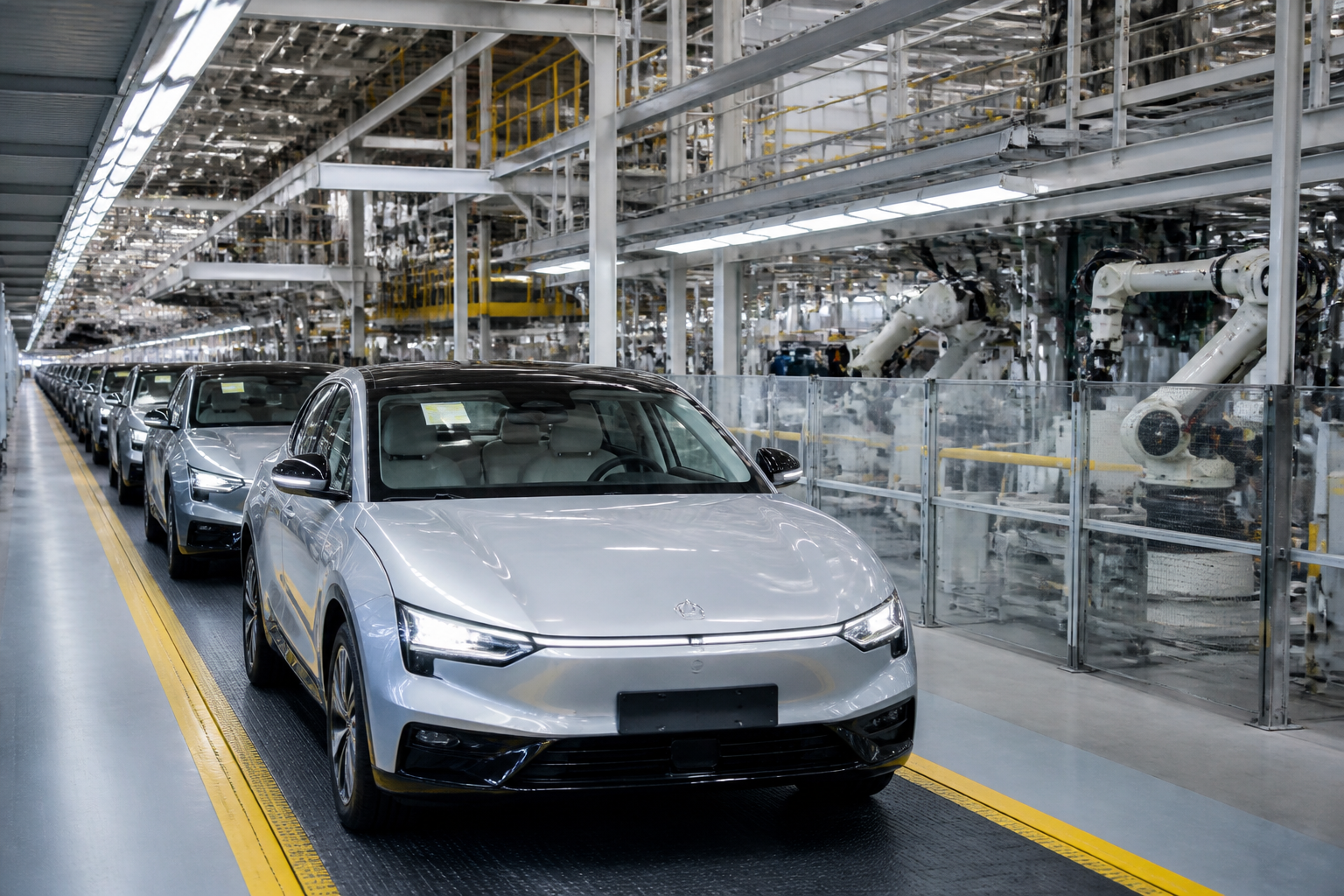
Chinese carmakers are moving from exporting vehicles to exporting production capacity. That shift is reshaping the geography of automotive manufacturing, putting pressure on established producers and creating a new competition among countries to attract factories, jobs and supply chains.
The change follows a period of rapid expansion by China’s vehicle industry. Chinese manufacturers now produce around a quarter of the world’s cars, while exports from the country have risen seven-fold. Chinese brands account for roughly four-fifths of those exports. Alix Partners expects Chinese vehicle exports to reach 10 million in 2026, more than 40% above the previous year.
The immediate pressure comes from China’s domestic market. Competition among manufacturers has intensified, and the market is forecast to shrink by 10% this year. A prolonged price war has encouraged companies to look overseas for growth. At the same time, foreign brands have lost ground inside China: their share of the domestic market has approximately halved over five years.
This is not simply an export story. Chinese carmakers are increasingly placing factories closer to the customers they want to serve. The reasons are familiar to any global manufacturer: avoiding the cost of shipping complete vehicles, reducing exposure to tariffs, adapting products to local tastes and regulations, and gaining access to government subsidies or other incentives linked to local production.
The result is a new phase in the globalisation of the car industry. Chinese companies are already assembling vehicles, or planning to do so, in countries including Indonesia, Kazakhstan, South Africa, Egypt, Brazil and Mexico. Europe, however, is the largest and most contested prize.
Chinese manufacturers captured 11% of vehicle sales in western Europe in the second quarter of this year, according to Schmidt Automotive Research, overtaking Japanese rivals. Their progress has continued despite tariffs imposed by the European Union in 2024. European policymakers are now considering additional measures that would tie purchase subsidies and corporate-fleet tax benefits to local-content thresholds and other requirements favouring production within the region.
The proposed rules are still moving through the European policymaking process and could be changed or weakened. But the possibility of tighter local-content requirements is already influencing corporate decisions. Chinese carmakers are accelerating their plans to establish a production presence inside Europe rather than relying only on imported vehicles.
BYD, the largest of the Chinese manufacturers, is close to opening a plant in Hungary that could eventually produce 300,000 cars a year. The company has put another factory planned for Turkey on hold while it looks for an existing site in Spain or France. That choice highlights an important feature of the current transition: speed and flexibility may matter as much as building entirely new capacity.
A new factory can take about three years to become operational. Buying and retrofitting an existing plant is faster and less expensive. The number of available sites could grow as established European manufacturers restructure their operations. Volkswagen, for example, received approval for a plan to phase out production at four German sites.
Underused capacity offers another route into the market. Alix Partners estimates that European factories have spare capacity equivalent to 2.5 million cars a year. Chinese companies are beginning to use that space. Chery has agreed to borrow part of Nissan’s Sunderland factory in Britain, while Geely has received permission to build electric vehicles at a Ford plant in Valencia.
These arrangements provide a rapid entry point, but they are unlikely to be the final form of Chinese expansion. Pedro Pacheco of Gartner describes such agreements as temporary measures that allow companies to reach the market quickly. The next stage, he argues, will be independent production. SAIC has confirmed plans for a new factory in Spain, while Xpeng is reported to be searching for a permanent European base.
For European cities and industrial regions, this creates a competition that extends beyond car sales. A vehicle plant brings demand for industrial land, power, logistics, supplier facilities, transport links and skilled labour. The location of a factory can influence the use of existing industrial sites and determine whether underused manufacturing land is redeveloped or remains vacant.
It can also change the position of a city within a wider supply chain. Automotive production depends on a network of component makers, warehouses, ports, roads and energy systems. A factory is therefore not an isolated building. It is an anchor for an industrial ecosystem whose reach extends across municipalities and national borders.
The relocation of production also changes the calculation for policymakers. Governments may attract factories with subsidies and other incentives, but the long-term value of those investments depends on the durability of employment, the strength of local suppliers and the extent to which production is integrated into the regional economy. The supplied evidence does not establish the terms of individual incentives, but it shows that such inducements are part of the global competition for manufacturing.
Chinese manufacturers’ advantage is not limited to lower wages or cheaper exports. European executives may hope that local production will eliminate the current cost gap, estimated at around 30%. But much of the advantage comes from the organisation of the industry itself: leaner corporate structures, streamlined manufacturing, vertical integration and economies of scale.
The difference can be seen in the number of components used in vehicles. Fabian Brandt of Oliver Wyman estimates that Chinese cars typically contain between 1,000 and 2,000 different parts, while European competitors are still dealing with between 3,000 and 10,000. Fewer components can simplify production and reduce the number of interfaces that manufacturers must manage.
Chinese companies have also developed what the industry calls the software-defined vehicle. Instead of relying on dozens of separate microcontrollers, these vehicles are built around a centralised computer that controls multiple functions. This approach is linked to lower costs and faster product development.
The difference in development cycles is significant. Chinese carmakers typically take about two years to develop a new vehicle, compared with at least twice as long for foreign competitors. That speed is a competitive advantage because it allows companies to respond more rapidly to changes in consumer demand, technology and regulation.
Moving factories abroad will add costs. Chinese companies will need to build sophisticated retail and after-sales networks in roughly 30 markets. They will also have to use many of the same suppliers as their competitors, particularly if European policymakers require greater local content. Labour and energy costs will apply to Chinese-owned factories just as they do to European-owned ones.
However, overseas production does not erase the systems that created China’s advantage. Research and development is expected to remain in China, while manufacturing methods developed there can be replicated in new plants. Companies can also choose locations with lower operating costs. Eastern European manufacturing centres such as Hungary and Slovakia are more expensive than China, but the gap is described as relatively narrow compared with higher-cost locations such as Germany.
Automation could further reduce the importance of labour costs. Chinese manufacturers are working on highly automated “dark factories” that require few human workers and potentially no lighting during production. If these systems can be transferred successfully to overseas sites, the conventional relationship between factory location and labour availability could change.
The scale of the possible expansion remains uncertain. Alix Partners estimates that Chinese carmakers could have overseas production capacity of 3.4 million vehicles by 2030, compared with 1.2 million last year. Other estimates reach as high as 6 million. Mobility Global expects Chinese brands to manufacture 90,000 cars in Europe this year, rising to as many as 1 million by 2030.
Those estimates describe capacity, not necessarily actual production or sales. They also depend on decisions that are still being made by companies and regulators. European content rules may be amended, factory plans may be delayed, and the availability of existing sites may change as established manufacturers restructure.
Even with those uncertainties, the direction of travel is clear. Chinese carmakers are no longer relying on a single model of global expansion based on shipping finished vehicles from China. They are combining exports with local assembly, factory acquisitions, temporary use of existing plants and plans for independent production.
The larger urban question is how cities and industrial regions respond when manufacturing power shifts through a combination of technology, logistics and corporate organisation. The competition is not only for factories. It is for the infrastructure, land, skills and supplier networks that make factories viable.
What the evidence confirms is that localising production will not necessarily remove the advantages of Chinese manufacturers. Their competitiveness is embedded in development speed, vertical integration, component simplification and production methods that can travel across borders. What remains uncertain is how quickly overseas capacity will be built, how European policy will evolve and whether established manufacturers can match the pace of change.
