


India’s Dedicated Freight Corridors are now moving from construction milestone to economic test. With the Western Dedicated Freight Corridor fully operational, the Eastern and Western corridors together form a 2,843-km freight-only railway network across two of the country’s most important economic axes. Their promise is not limited to faster trains. The network could reduce logistics uncertainty, release capacity on passenger railways, alter the location of factories and make inland access to ports more reliable.
That shift matters because India’s transport system has long required passenger and freight trains to share the same railway routes. As passenger demand and goods movement increased, freight services were frequently delayed by the priority given to passenger trains. The conventional network also constrained train length, axle loads and operating speeds. The DFC programme was designed to separate these competing demands on routes where congestion had become a structural economic cost.
The Western corridor runs 1,506 km from Dadri in Uttar Pradesh to Jawaharlal Nehru Port near Mumbai. The Eastern corridor covers 1,337 km from Ludhiana in Punjab to Sonnagar in Bihar. Together, they cross manufacturing, agricultural, mineral and consumption belts. The network was carrying 443 freight trains a day when the final Western sections were inaugurated, while Indian Railways estimates that the corridors can handle more than 120 trains in each direction.
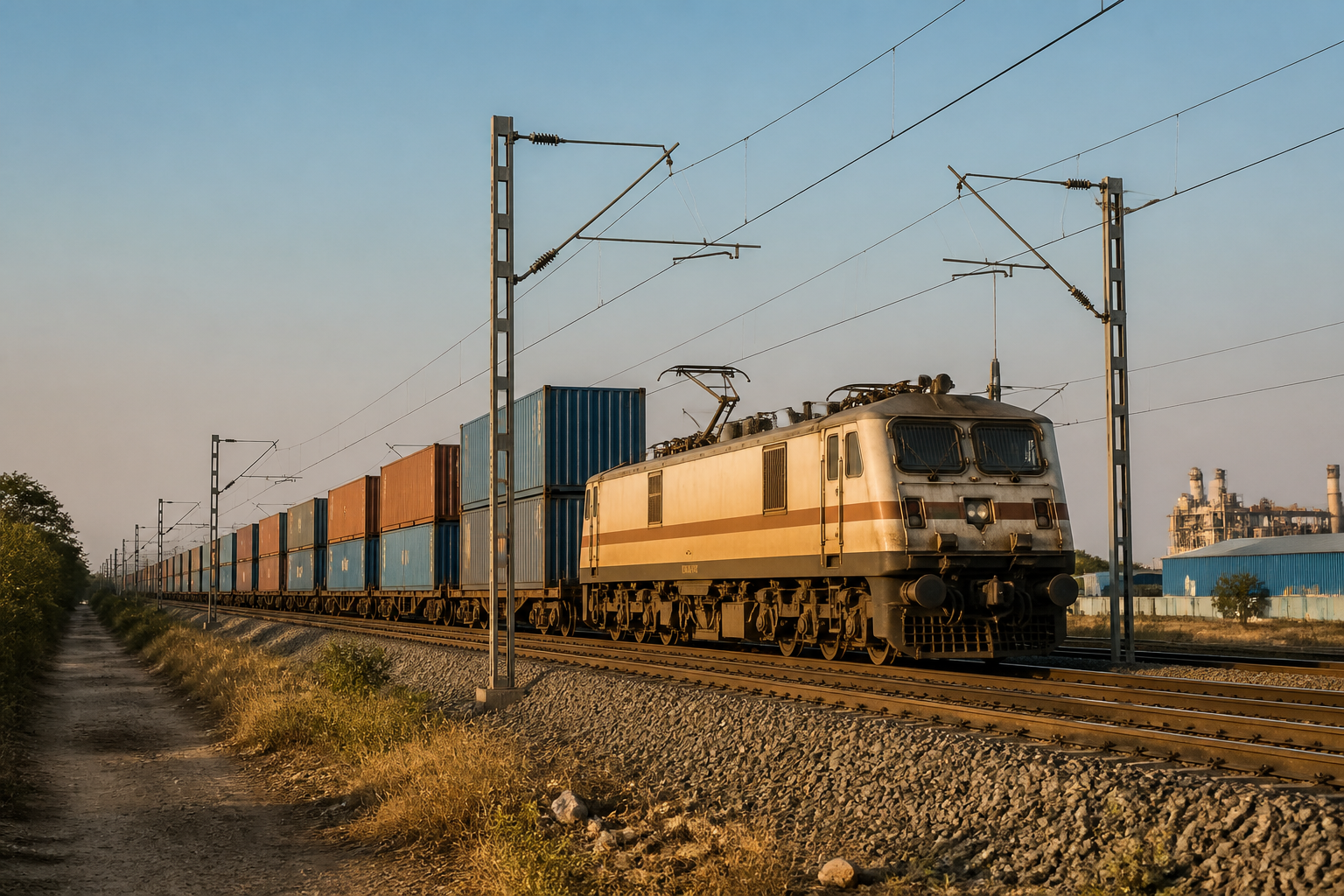
This is not simply a conventional railway line reserved for goods trains. The corridors have double tracks, automatic signalling, stronger infrastructure and higher axle-load capability. The Western DFC also has high-clearance overhead electrification, allowing double-stack container trains. By carrying two layers of containers in a single movement, the system can increase the volume moved without requiring a proportional increase in train paths.
The most important economic change may be predictability rather than speed alone. The supplied figures show that container trains take an average of 2.44 hours per 100 km on the DFCs, compared with 5.25 hours on the conventional network. For coal trains, the corresponding figures are about 3.15 hours and 6.48 hours. A faster and more reliable journey allows businesses to plan inventories, warehouse replenishment and port delivery windows with greater confidence.
That affects the cost of working capital. Manufacturers often hold additional inventory because uncertain deliveries can interrupt production. Retailers maintain safety stock when replenishment times are difficult to predict. Exporters may move containers to ports several days before a vessel’s departure to protect against delays. If dedicated rail services provide a dependable window, part of this precautionary cost can fall even when the freight charge itself is not the only saving.
The wider logistics picture gives the DFCs their national significance. A 2025 DPIIT-NCAER assessment cited in the report estimated India’s logistics costs at 7.97% of GDP in 2023-24. It placed rail’s logistics cost at about Rs 1.96 per tonne-km, compared with Rs 11.03 for road. The DFCs cannot serve every type of cargo: high-value, small consignments will continue to depend on roads and air transport. But for heavy and long-distance freight, a stronger rail option can change the cost structure of entire supply chains.
The Western DFC has a particularly direct relationship with India’s export ambitions. It connects the northern manufacturing belt to Jawaharlal Nehru Port and the port system in Gujarat. Dadri, an inland logistics centre, handled more than 1.7 lakh TEUs of exports in 2025-26, including garments, food products, tractor parts, tyres, auto components and furniture. It also handled more than 1.5 lakh TEUs of imports.
This connection changes the geography of export manufacturing. A factory does not need to be located beside a seaport if it has a dependable, high-capacity rail connection to one. For industrial clusters in northern India, the corridor can reduce the disadvantage created by distance from the coast. The value for exporters lies not only in a lower freight bill but also in the ability to provide international buyers with more reliable delivery schedules.
The possible industrial effect extends beyond existing manufacturing centres. Industrialisation has often concentrated around ports and large metropolitan markets because long-distance movement of raw materials and finished products was expensive or uncertain. The DFCs weaken part of that constraint by connecting inland locations to ports, markets and mineral-producing regions. Logistics parks, freight terminals and industrial corridors along the routes could reinforce this change, although the supplied material does not establish the scale or timing of that development.
The Eastern DFC serves a different but complementary economic geography. Its connection to the mineral and energy belt makes it important for coal, steel, cement, fertiliser and other bulk commodities. These sectors depend heavily on rail and are sensitive to the cost of moving inputs over hundreds of kilometres. A dedicated heavy-haul network can allow larger loads to travel without being held behind passenger services.
The effect can extend through several layers of the economy. Lower coal transport costs can influence power generation. Cheaper movement of inputs can affect steel and cement production. Those changes may eventually feed into the cost structure of construction and infrastructure. The relevant measure is therefore not only the revenue earned by the freight railway but also the industrial costs that the network can reduce for businesses using it.
Agriculture is another important use case. Food grains, fertilisers and other agricultural commodities already move by rail between production and consumption regions. Faster and more predictable freight can reduce one layer of friction in these supply chains. It cannot resolve food inflation, which is also shaped by weather, crop yields, storage capacity and global commodity prices. Its potential benefit depends on integration with warehouses, cold chains, agricultural markets and road-based first- and last-mile transport.
The DFCs may also create capacity outside the freight corridors themselves. When goods trains shift to dedicated tracks, space can be released on the conventional railway network for additional passenger services and for freight that does not require the DFC. This makes the project a capacity intervention across two railway systems rather than only a new freight route. A similar logic applies to highways: if rail becomes competitive for long-distance bulk and container traffic, some truck movements could shift away from roads, potentially easing congestion and reducing pressure on road infrastructure.
The environmental case in the supplied material is linked to both electrification and modal shift. An official Indian Railways assessment estimates that the two DFCs could save about 457 million tonnes of carbon dioxide emissions over 30 years. The corridors are electrified, reducing the freight system’s dependence on diesel. The scale of the eventual reduction, however, will depend on how much cargo moves from road to rail and how effectively the corridors are used.
That makes the current phase different from the construction phase. The tracks and systems now provide capacity, but economic gains will depend on connections to ports, inland container depots, warehouses, industrial parks and ordinary railway lines. A freight corridor cannot generate its full value if cargo loses time at terminals or requires inefficient road transfers at either end. The distinction between infrastructure potential and actual productivity will be determined by the wider logistics network around the railway.
There are early indications that businesses are beginning to use the network in this way. Amazon began a daily service on the Western DFC in August, linking its logistics network across Delhi, Ahmedabad and Surat with onward connections towards Pune, Mumbai and Goa. The example is limited, but it illustrates the change required from the new infrastructure: businesses must design supply chains around dedicated rail rather than treat it only as an occasional alternative.
The DFCs therefore represent more than an addition to India’s railway asset base. They address a long-standing institutional conflict between passenger mobility and freight movement on shared routes, while creating a high-capacity spine through major production and consumption regions. Their strongest effect may be indirect: fewer hours spent moving containers, less capital tied up in inventory, improved access for inland factories, lower costs for bulk commodities and additional capacity for passenger rail.
What the evidence confirms is that India now has a dedicated freight system on two economically significant corridors, with measurable differences in transit time, a lower rail cost structure than road for heavy freight and a potential to support exports, manufacturing and bulk supply chains. What remains uncertain is the scale of cargo diversion, the quality of terminal and last-mile connections and the extent to which new industrial activity follows the routes. Those utilisation questions will determine whether the DFCs become merely faster railway lines or a broader reorganisation of India’s industrial geography.
