


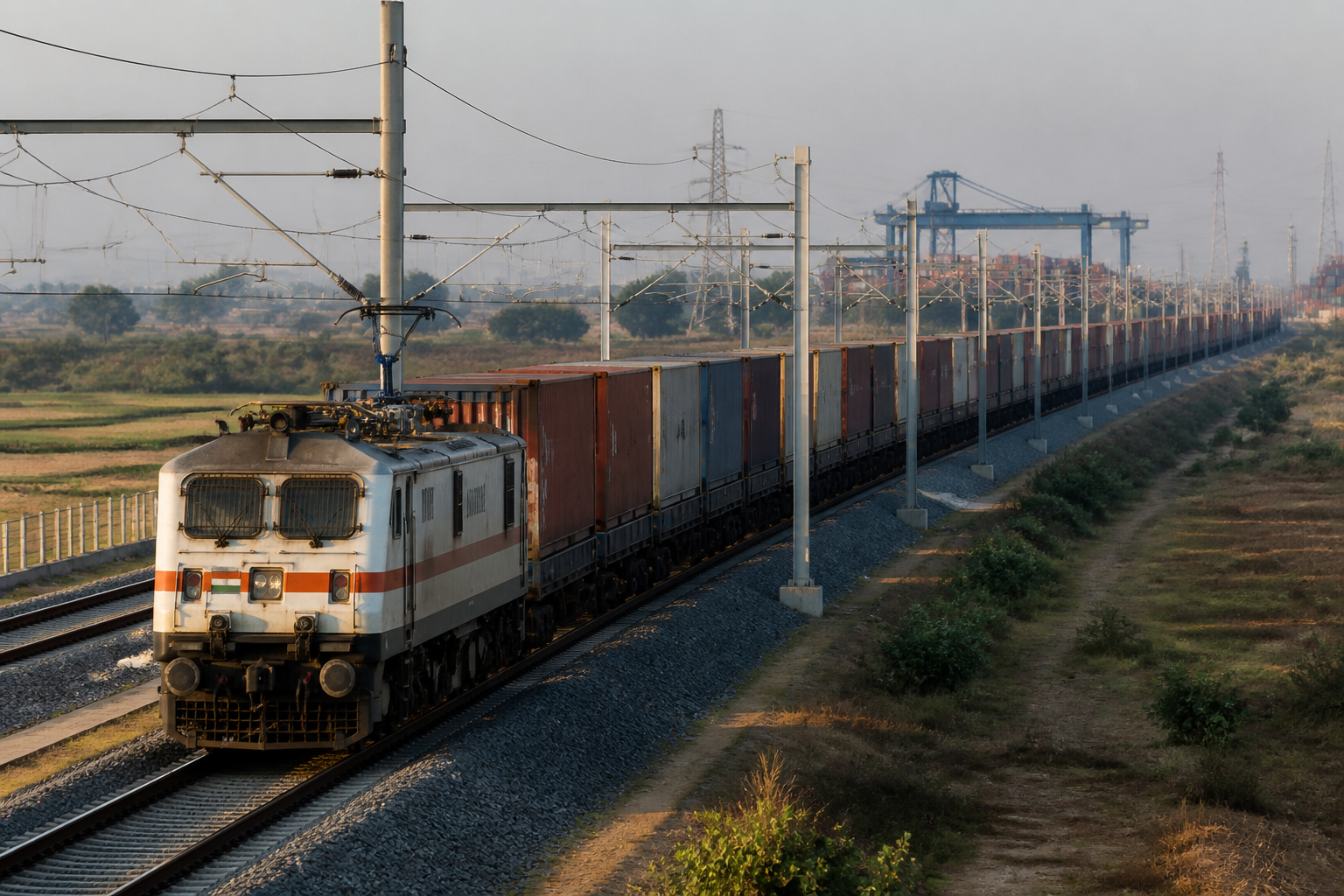
India’s 2,843-km Dedicated Freight Corridor network is now fully operational, creating a freight-only railway spine across two of the country’s most important economic axes. Its significance lies less in the completion of the tracks than in the possibility that manufacturers, exporters, ports and bulk industries can begin organising their supply chains around a more reliable national freight system.
The Western Dedicated Freight Corridor runs 1,506 km from Dadri in Uttar Pradesh to Jawaharlal Nehru Port near Mumbai. The Eastern Dedicated Freight Corridor covers 1,337 km from Ludhiana in Punjab to Sonnagar in Bihar. Together, the corridors pass through manufacturing, agricultural, mineral and consumption belts that have historically depended on railway routes shared by passenger and freight services.
The network was carrying 443 freight trains a day when the final Western sections were inaugurated. Indian Railways estimates that the dedicated corridors can handle more than 120 trains in each direction. Their infrastructure includes double tracks, automatic signalling, higher axle-load capability and electrification designed to support double-stack container trains on the Western corridor.
That combination addresses a long-standing constraint in the Indian railway system. On conventional routes, passenger and freight trains compete for track capacity. Freight services can be held up by passenger operations, while the railways have limited scope to operate longer and heavier trains at higher speeds. The dedicated corridors separate the two functions on routes where freight demand is particularly important.
The immediate gain is time and predictability. Container trains on the DFCs take about 2.44 hours to cover 100 km, compared with 5.25 hours on the conventional network, according to the supplied report. For coal trains, the corresponding figures are approximately 3.15 hours and 6.48 hours. These are not merely railway performance statistics. They determine how businesses plan inventories, warehouse operations, port deliveries and production schedules.
A company often holds additional inventory because it cannot be certain when components or raw materials will arrive. A more predictable freight journey can reduce that need for safety stock and release working capital. Retailers can replenish warehouses more frequently, while exporters may be able to move containers closer to a vessel’s sailing schedule instead of sending them to ports several days early to protect against delays.
This is why the economic value of the corridors cannot be measured only through freight charges. The benefit also appears in the cost of time, inventory and uncertainty. A faster train may reduce the direct cost of transport, but a more dependable train can change the way an entire supply chain is designed.
The broader logistics context is significant. A 2025 DPIIT-NCAER assessment estimated India’s logistics costs at 7.97% of GDP in 2023-24. The assessment put rail’s logistics cost at about Rs 1.96 per tonne-km, compared with Rs 11.03 for road. The DFCs will not replace road transport for every shipment: high-value, small consignments and first- and last-mile movements will continue to depend heavily on roads. But for heavy, long-distance cargo, a stronger rail option can alter the economics of the complete route.
The Western corridor has a particularly direct connection with India’s export ambitions. It links the northern manufacturing belt with Jawaharlal Nehru Port and the western port system. Dadri, an important inland logistics centre, handled more than 1.7 lakh TEUs of exports in 2025-26, including garments, food products, tractor parts, tyres, auto components and furniture. It also handled more than 1.5 lakh TEUs of imports.
The implication is a change in the geography of access to global markets. A factory in northern India does not necessarily need to be located beside a seaport if it can reach one through a dependable high-capacity rail connection. For exporters, reliability can be as important as the freight rate because delivery schedules must be coordinated with international production systems and shipping services.
This could also affect the location of future manufacturing activity. Industrial development in India has often concentrated around ports, major metropolitan markets and established transport corridors because long-distance movement of inputs and finished products was expensive or uncertain. The Western DFC connects the northern hinterland with industrial centres and ports in Gujarat and Maharashtra. The Eastern DFC links the industrial north with coal and mineral-producing regions.
The infrastructure therefore creates the conditions for factories and logistics facilities to locate farther from the coast while retaining access to national and international markets. The supplied report identifies logistics parks, freight terminals and industrial corridors as important parts of this possible shift. The DFC alone cannot create an industrial cluster, but it can remove one of the structural disadvantages faced by inland locations.
The Eastern corridor has a different economic role. Its connection with the mineral and energy economy makes coal a central use case. Indian Railways moves large quantities of coal from eastern and central India to power plants and industrial centres. Steel, cement, fertiliser and other bulk commodities also depend heavily on rail. A dedicated heavy-haul network can move larger loads without the same level of interference from passenger traffic.
Lower transport costs for coal and minerals can work through several industrial sectors. Cheaper coal movement affects the cost structure of power generation. More affordable movement of inputs can affect steel and cement production, with possible consequences for construction costs. The value of the freight corridor is consequently distributed across the industries that use the railway, rather than being confined to railway revenue.
Agriculture presents another potential use. Food grains, fertilisers and other agricultural commodities already move by rail across long distances. Higher capacity and more predictable journeys can reduce one layer of friction between surplus-producing regions and deficit markets. Transport infrastructure will not resolve food inflation, which is also shaped by weather, crop yields, storage capacity and global prices, but it can influence the cost and timing of movement.
That benefit will depend on connections beyond the main railway line. The effectiveness of agricultural freight requires warehouses, cold chains, market infrastructure and road-based first- and last-mile links. The same principle applies to containers and industrial cargo. A freight corridor can provide the trunk route, but the economic benefit depends on whether cargo can enter and leave the network efficiently.
The DFCs also create capacity indirectly. When freight trains move onto dedicated lines, space is released on conventional railway routes. Indian Railways can use that capacity for additional passenger services or for freight that is not suited to the dedicated corridors. The network therefore adds capacity to the freight system while also relieving pressure on parts of the passenger railway system.
A similar effect could occur on highways if rail becomes competitive enough to attract long-distance bulk and container traffic. Fewer heavy trucks on selected routes could reduce congestion and the pressure imposed on road infrastructure. The environmental case is linked to this modal shift. The supplied report cites an official Indian Railways assessment that the two DFCs could save about 457 million tonnes of carbon dioxide emissions over 30 years. Electrification also reduces the freight system’s dependence on diesel, although the final environmental outcome will depend on actual utilisation and the wider power system.
The completion of the network marks the start of its utilisation phase rather than the end of the project’s economic test. The corridors must be connected effectively with ports, inland container depots, warehouses, industrial parks and conventional railway lines. If these interfaces remain weak, the high capacity of the main route will not automatically translate into lower end-to-end logistics costs.
There are early indications that private logistics users are beginning to design services around the new network. Amazon began operating a daily service on the Western DFC in August, linking its logistics network across Delhi, Ahmedabad and Surat with onward connections towards Pune, Mumbai and Goa, according to the supplied report. Such services are still individual examples, but they illustrate the shift from treating rail as an occasional alternative to using it as a planned part of a supply chain.
The larger question is whether the DFCs can change the structure of India’s freight economy beyond the corridors themselves. Their physical length is limited compared with the national road and railway network, but their influence could extend through the connections they make between inland production, ports, power plants, warehouses and markets.
The evidence confirms that the corridors have already created a faster and more specialised freight route, with measurable differences in operating time and the capacity to carry heavier and longer trains. What remains to be established is how quickly businesses shift cargo to the network, whether terminals and last-mile links keep pace, and how much of the potential capacity becomes regular commercial use. Those utilisation and integration milestones will determine whether India’s freight-only railway becomes merely a major project or a lasting change in the country’s industrial geography.
