


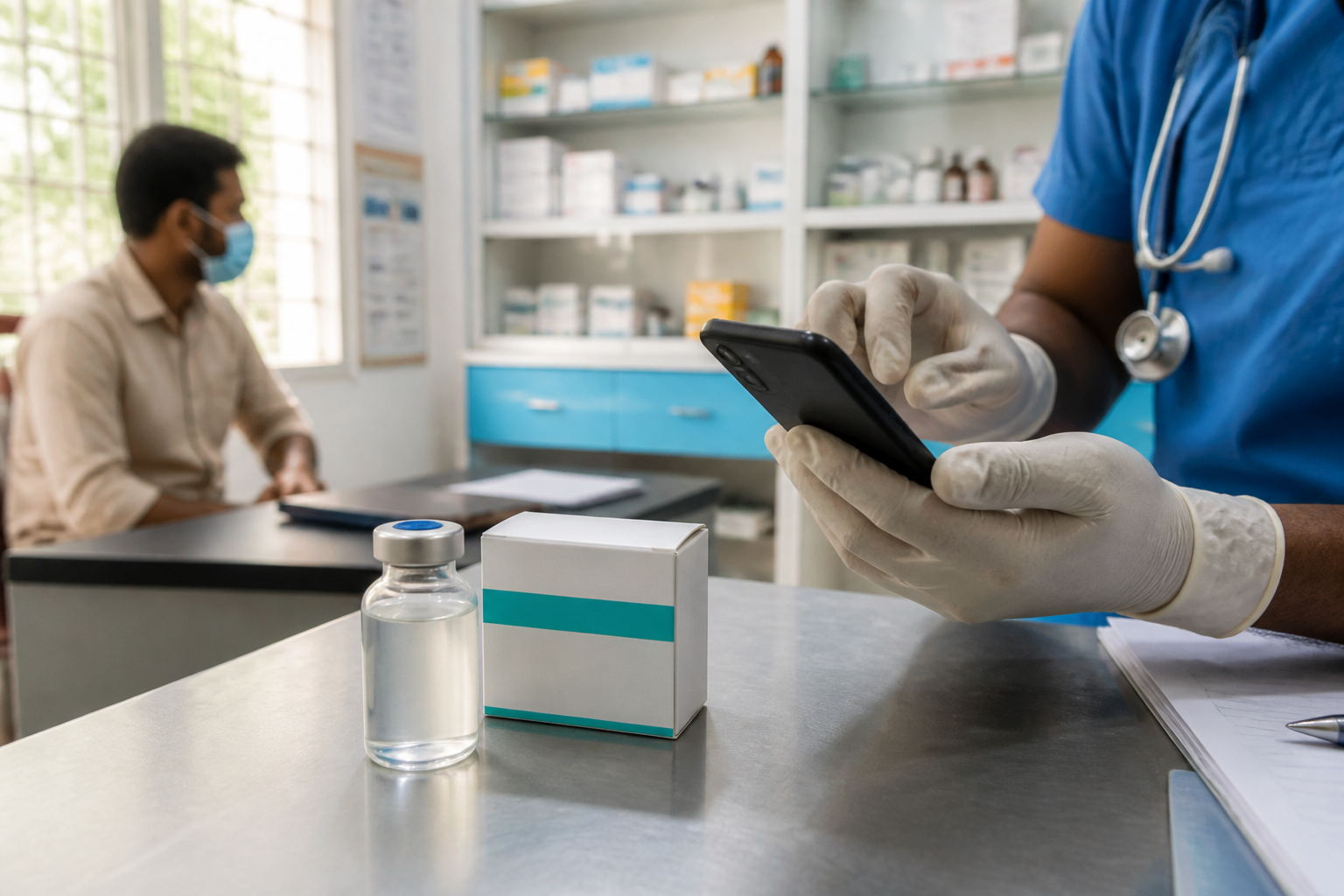
The discovery of counterfeit Abhayrab rabies vaccine batch KE25012 has exposed a serious weakness in how patients, clinics and regulators verify one of the country’s most time-sensitive medicines. The latest warning follows a Delhi Police and Central Drugs Standard Control Organisation (CDSCO) raid at an unlicensed residential premise in New Delhi, with laboratory tests later declaring seized samples “Not of Standard Quality” and misbranded.
The immediate concern is patient safety. Rabies is preventable when post-exposure treatment is genuine, correctly administered and taken within the appropriate medical protocol. But once clinical symptoms appear, the disease is generally fatal. That makes the integrity of every vaccine dose, and the ability to trace it back through the supply chain, more than a routine quality-control issue.
The case also has a wider significance because it is reportedly the second major counterfeit Abhayrab scare in India in recent months. An earlier batch, KA24014, had prompted alerts from international immunisation bodies, including Australia’s Australian Technical Advisory Group on Immunisation. The recurrence suggests that the problem is not limited to a single suspect consignment. It raises questions about how counterfeit products enter circulation, how quickly they are detected and what information remains available to patients after vaccination.
The latest enforcement action began with a raid on an unlicensed residential premises in New Delhi. Samples of batch KE25012 were sent for laboratory examination to the Central Drugs Laboratory in Kasauli. The laboratory classified them as “Not of Standard Quality” and misbranded. Indian Immunologicals Limited (IIL), through its Human Biologicals Institute division in Hyderabad, said the testing identified 17 discrepancies in packaging and labelling and confirmed that the vials were spurious.
Authorities and the manufacturer have distinguished the suspect material from legitimate stock. According to the report, genuine stocks released under Certificate CDL/2025/8392 on November 7, 2025, were safe and had been distributed through authorised medical channels. That distinction is important, but it does not by itself resolve the problem for patients who may no longer possess their vial, carton or receipt.
This is where the counterfeiting issue becomes a traceability problem. Patients frequently leave a clinic after vaccination without retaining the packaging. In many cases, the record they have is limited to a prescription, an entry in a clinic register or a handwritten note. If the packaging is later found to be suspect, the patient may not know the batch number, the source of the dose or whether the clinic obtained it through an authorised channel.
The supplied report identifies batch KE25012 as the centre of the current alert and advises people who received Abhayrab on or after November 7, 2025, to verify their vaccination history with a healthcare professional. It also states that patients can scan the vial’s QR code and check whether product information appears immediately. However, a QR-code check is only useful when the patient still has access to the vial and when the verification system itself is reliable. It cannot fully address cases in which packaging has been discarded or records are incomplete.
That gap places a disproportionate burden on patients. A person who has been bitten by a dog, cat or another mammal is already dealing with an emergency decision. Asking that person to reconstruct a past vaccination trail months later assumes that the health system has preserved accurate records and that the patient knows where to seek verification. The report indicates that many may instead have to depend on clinics and healthcare providers to audit their records.
The issue is therefore not only whether a counterfeit vial can be identified at the point of sale. It is also whether the system can establish, after administration, which patient received which batch, at which facility, on what date and through which distributor. The supplied material does not establish that such a nationwide, interoperable patient-level tracking system exists. It does show the consequences of its absence: patients may be unable to verify an important medical history precisely when certainty is most necessary.
Administration of the vaccine is another part of the safety chain. The report states that anti-rabies vaccines must not be injected into the buttocks and should be administered intramuscularly or intradermally in the thighs or shoulders, depending on the medical protocol. A dose given in the buttocks is described as invalid and requiring repetition. This means that product authenticity is only one condition of effective protection. The vaccine must also be stored, documented and administered correctly.
The report further notes that, in dog or cat exposure cases, an animal that remains alive for 10 days after the bite is considered non-rabid under the stated guidance, and a booster may not be required. It cautions that this 10-day rule does not apply to bites or saliva exposure from other mammal species. These are clinical matters that require professional assessment, particularly because exposure type, wound severity, prior vaccination and the animal’s status can alter the treatment protocol.
The recurrence of counterfeit versions of the same brand brings attention to the responsibilities distributed across the medicine supply chain. CDSCO and state drug-control authorities are responsible for regulatory surveillance and enforcement. Police agencies investigate the manufacture and distribution of spurious products. Laboratories establish whether seized samples meet quality and labelling requirements. Manufacturers must protect packaging and communicate clearly when a counterfeit version is identified. Clinics and pharmacies are the final visible link for patients, and their procurement and record-keeping practices determine how easily a dose can be traced.
A raid and laboratory test can remove a suspect batch from circulation, but they address only the part of the problem that becomes visible. The harder question is how many points in the chain allow a counterfeit product to appear credible. The report does not establish where KE25012 was sold, how widely it circulated or how many patients may have received it. Those unanswered questions are precisely why verification and recall communication matter.
The case also exposes the limitations of relying on packaging as the primary defence against counterfeit medicines. Packaging discrepancies may help investigators and professionals identify a fake vial, but ordinary patients may not recognise 17 technical differences. They may also assume that a product purchased from a clinic is genuine. A system that depends mainly on consumer inspection therefore offers uneven protection, especially to patients who do not retain packaging or who receive treatment in fragmented healthcare settings.
The report’s reference to authorised medical channels points to another institutional distinction: legitimacy of the distribution route and authenticity of the individual product are closely related but not identical questions. Patients need to know not only that a clinic is operating, but also that the vaccine was sourced through an authorised distributor and that its batch details can be verified. The material supplied does not provide a public list of affected facilities, distributors or geographic areas, so the scale of exposure remains uncertain.
For Hyderabad and Telangana, the warning has a practical local dimension even though the enforcement action occurred in Delhi. The manufacturer’s Human Biologicals Institute division is based in Hyderabad, and the report says medical experts in the city have urged caution. But the available information does not establish that Telangana has received counterfeit KE25012 stock or that any local patient was affected. The appropriate conclusion is narrower: residents who are concerned about a dose should verify their records with a healthcare professional rather than assume that the location of purchase or the appearance of the vial is sufficient proof.
The episode ultimately shows that vaccine safety depends on more than manufacturing standards. It depends on a chain linking regulators, laboratories, police investigators, manufacturers, distributors, healthcare facilities and patients. A failure at any point can make it difficult to determine whether a person has received effective protection. The current evidence confirms that counterfeit KE25012 samples were identified, tested and classified as misbranded and not of standard quality. It also confirms that legitimate stocks released under the cited certificate were described as safe. What remains unclear is the distribution footprint of the counterfeit batch, the number of patients who may have received it and the extent to which clinics can reconstruct individual vaccination histories.
Those are the next facts that matter. Patients with concerns need accessible verification and clinical advice; healthcare providers need accurate records; and authorities need to clarify the affected distribution chain and recall reach. Until that information is publicly established, the counterfeit Abhayrab episode remains both a medicine-quality alert and a warning about the weaknesses of traceability after a critical healthcare intervention.
