


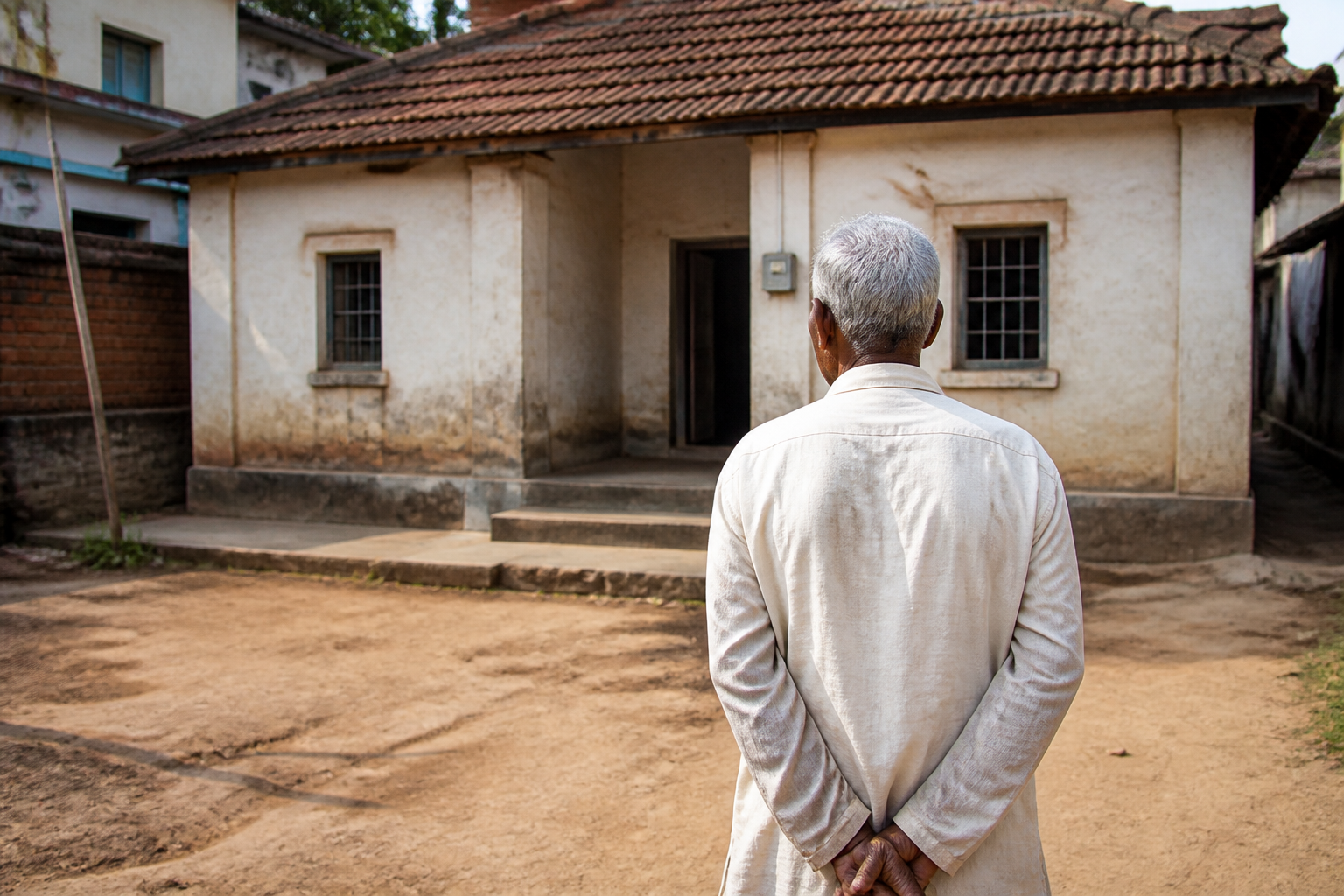
The Orissa High Court’s March 17, 2026 ruling in a dispute between an 86-year-old father and his youngest son does not decide who owns several parcels of land purchased in the son’s name. It does something narrower and, for senior citizens facing unsafe or coercive living conditions, potentially more immediate: it protects the father’s ability to live safely and with dignity in the ancestral home while the ownership dispute continues before the appropriate forum.
That distinction is the central importance of the case. The judgment treats residential security and legal ownership as related but separate questions. The first was addressed through the protective framework of the Maintenance and Welfare of Parents and Senior Citizens Act, 2007. The second was left to the pending civil proceedings. In doing so, the court accepted that an elderly person’s immediate need for a safe place to live cannot necessarily wait for a final determination of property title.
The case arose from a family arrangement that later deteriorated. According to the account before the court, the father, a retired government serviceman, had three sons. His elder and middle sons had moved out of the ancestral property in Odisha with their families, while the youngest son continued to live with him. The father said that the relationship had initially been cordial, and that he had purchased multiple parcels of land in the youngest son’s name.
The father later alleged that repeated torture and humiliation made it impossible for him to remain in the ancestral house. He left and first stayed with his eldest son before moving to the residence of his middle son, where he continued to live. He also alleged that, after his departure, the youngest son took exclusive possession of the ancestral home.
The dispute then developed along two legal tracks. The father sought the youngest son’s eviction from the ancestral house before the Sub-Collector, Bhubaneswar, acting as the Sub-Divisional Tribunal under the senior citizens law. Separately, he approached the civil court over the parcels of land that had been purchased in the youngest son’s name, seeking revocation of the son’s name from those properties.
The distinction between these proceedings became decisive. The Sub-Collector’s order directed the father and son to live peacefully, required the son to refrain from abusing or threatening his father, and directed him to vacate the ground floor of the house at Baramunda village. The ground floor was to be handed over to the father so that he could live there safely. The order also recorded that the dispute concerning the property was civil in nature and that an appeal was pending.
Both the father and the youngest son challenged the order before the Orissa High Court. Justice Ananda Chandra Behera, in W.P.(C) No. 24893 of 2025, partly allowed the father’s case on March 17, 2026. The High Court declined to interfere with the protective order requiring the son to vacate the house and preserve the father’s ability to reside there. At the same time, it refused to direct that the son’s name be removed from the disputed land parcels.
The result is therefore not a ruling that the father owns all the disputed properties. Nor does it establish that property transferred or purchased in a child’s name can automatically be recovered through proceedings under the senior citizens law. The court’s order, as described in the supplied material, is focused on residence, safety and dignity rather than title.
This approach follows the welfare purpose of the Maintenance and Welfare of Parents and Senior Citizens Act, 2007. The High Court referred to the Act as beneficial legislation intended to provide social justice to parents and senior citizens. It also considered Rule 19 of the Orissa Maintenance of Parents and Senior Citizens Rules, 2009, which requires orders under the law to enable senior citizens to live with security and dignity.
The court’s reasoning reflects a broader principle in welfare legislation: statutory provisions should be interpreted in a way that advances their protective purpose. The judgment referred to earlier decisions, including Philomina v. The Appellate Tribunal, Thiruvananthapuram and Mrs. Rajani B. Somkuwar v. Ms. Sarita Somkuwar and Another. It also relied on the Supreme Court’s 2025 decision in Urmila Dixit v. Sunil Sharan Dixit and Others, which held that the senior citizens law and its rules should receive a liberal, purpose-oriented interpretation.
The significance of that interpretation lies in the difference between a technical property dispute and a welfare emergency. A civil court may ultimately determine who has legal rights over land, whether a transfer should be reversed and whether a person’s name should remain on a title document. But those questions may take time. The senior citizen’s need for a secure place to live is immediate and may be assessed separately under the protective jurisdiction created by the 2007 Act.
The judgment therefore recognises two kinds of legal injury that can arise in the same family dispute. The first concerns physical safety, dignity and access to a home. The second concerns ownership, title and the validity of property transactions. The first can attract protective directions from the tribunal or court exercising powers under the senior citizens framework. The second remains within the jurisdiction of the forum competent to decide civil property rights.
The legal distinction also limits the ruling’s reach. The father’s attempt to reopen the land-related issue before the High Court did not succeed because the question was already pending before the civil court and the statutory appellate route had not been pursued in the manner required. The judgment thus protects the father’s living arrangement without bypassing the procedures governing the underlying property dispute.
The supplied legal analysis describes this as a two-part outcome. Shrusti Shah, Associate Partner at King Stubb & Kasiva, said the father succeeded because the High Court preserved the tribunal’s protective order, safeguarding his right to live in his own home with dignity. She also emphasised that the ownership issue remained separate and had to be resolved through the pending proceedings.
That separation is important for families dealing with property, care and ageing. A parent may have contributed money to a property, purchased land in a child’s name or allowed a child to occupy a family home. If the relationship later breaks down, the parent may face both a residential problem and a title dispute. The ruling indicates that the first problem need not automatically be postponed until the second is resolved.
At the same time, the judgment does not remove the importance of formal property records or proper legal procedure. The fact that a parent financed a purchase, trusted a child or lived in an ancestral home does not by itself settle the question of ownership. Those claims must be examined by the civil court or another legally competent forum. The High Court’s refusal to decide the land issue reinforces that institutional boundary.
The case also illustrates how the senior citizens law operates within a wider administrative structure. The initial protective directions came from the Sub-Collector, Bhubaneswar, acting as the Sub-Divisional Tribunal. The High Court then reviewed that order. The civil court separately considered the land dispute. Each forum had a different function: immediate welfare protection, judicial review and determination of civil property rights.
For citizens, the practical lesson supported by the ruling is not that every family property dispute can be converted into an eviction proceeding. It is that allegations of abuse, threats or forced displacement involving an elderly parent may be considered through a welfare framework even when ownership questions remain unresolved. Conversely, parties seeking changes to title or recovery of property must use the forum and appeal mechanism prescribed for those issues.
The ruling also places dignity at the centre of the senior citizens framework. The High Court considered the father’s age, the fact that he had lost his wife and his account that he had effectively been forced from the family home. Those circumstances influenced the court’s decision to preserve the protective order. The legal protection was not framed as a final declaration of title, but as a means of allowing an extremely aged person to live with security while other proceedings continue.
What the judgment confirms is limited but significant. A senior citizen’s immediate right to safe and dignified residence can be protected independently of a contested ownership claim. What remains unresolved is whether the land parcels purchased in the youngest son’s name should ultimately be transferred, cancelled or otherwise dealt with. That question belongs to the pending civil proceedings and any applicable appellate process.
The case will therefore be relevant less as a ruling on family inheritance than as an example of how Indian courts may separate welfare protection from property adjudication. Its continuing importance will depend on how the pending land dispute proceeds and how tribunals apply the senior citizens law in cases where an elderly parent seeks both shelter and control over disputed assets.
