


The Maharashtra government is positioning the India-European Union free trade agreement as more than a tariff and market-access arrangement. At a high-level India-Belgium dialogue held against the backdrop of the agreement, Chief Minister Devendra Fadnavis called for greater Belgian investment in Maharashtra and proposed an economic partnership between Mumbai and Antwerp. The proposal brings together trade, ports, logistics, advanced manufacturing, technology and clean industry—sectors that are central to the state’s attempt to strengthen its position in the global economy.
The immediate event was a government-led effort to connect a prospective trade agreement with specific state-level investment opportunities. Belgium’s Prime Minister Bart De Wever and Union Commerce and Industry Minister Piyush Goyal were present at the dialogue, along with representatives from industry, ports, trade and investment. Fadnavis said Maharashtra should become a major partner in the success of the India-EU economic relationship. The state government also said it would appoint a dedicated team to coordinate with Belgian companies and create a mechanism to accelerate selected investment projects.
That administrative commitment is significant because trade agreements do not automatically produce factories, logistics facilities, research partnerships or jobs in a particular state. The benefits depend on whether local governments can identify projects, provide approvals, connect them to infrastructure and maintain coordination across departments. The Maharashtra announcement therefore points to an implementation question: can the state turn a broad international economic opportunity into a functioning investment pipeline?
The areas identified by the chief minister cover five broad clusters: advanced manufacturing and green industries; semiconductors and electronics; clean energy; pharmaceuticals and biotechnology; and ports, logistics and communications. These sectors are not separate from the urban system. They depend on industrial land, reliable power, freight connections, skilled workers, research institutions, housing and transport links. Their expansion would place additional demands on the metropolitan and regional infrastructure around Mumbai, Pune, Navi Mumbai and the state’s port-led industrial corridors.
The report presents Maharashtra as an unusually strong platform for this strategy. Fadnavis said the state accounts for about 15 per cent of India’s gross domestic product and receives nearly one-third of the country’s foreign direct investment. He also said Maharashtra has around 66 per cent of the country’s data-centre capacity. These figures were presented as part of the state’s investment pitch and were not independently examined in the supplied material. They nevertheless show the logic of the government’s argument: Maharashtra is seeking to combine market size, industrial capability, skilled labour and existing economic concentration to attract higher-value global investment.
Mumbai and Pune occupy different positions in that pitch. Mumbai is presented as the country’s financial centre, while Pune is described as a hub for engineering, automobiles and technology. The planned Navi Mumbai International Airport is expected by the chief minister to provide an additional boost to the state’s economic capacity. Together, these locations form a connected but uneven economic geography, in which finance, manufacturing, technology, aviation and logistics must operate across metropolitan boundaries.
The proposed Mumbai-Antwerp relationship adds a city-to-city dimension to the investment strategy. Antwerp is a major port and a global diamond-trading centre, while Mumbai’s Bharat Diamond Bourse is an important centre for India’s diamond trade. Fadnavis proposed that cooperation should extend beyond diamonds to finance, technology, ports, logistics and sustainable development. This expands the idea of a sister-city or commercial partnership from a symbolic relationship into a potential network linking trade services, maritime infrastructure and industrial innovation.
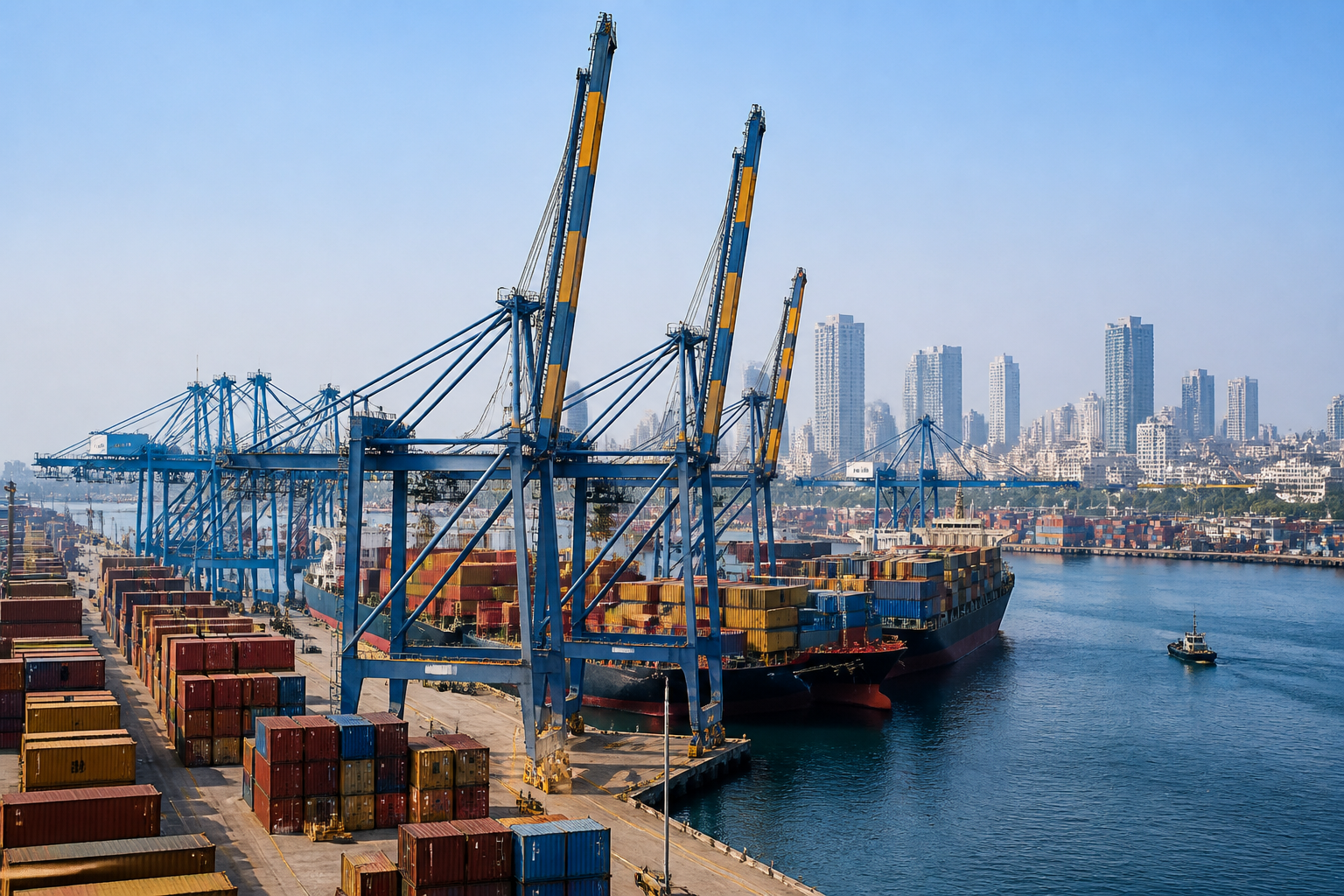
Ports are particularly important to the proposal. The chief minister referred to the Jawaharlal Nehru Port and the proposed deep-sea port at Vadhavan as elements strengthening Maharashtra’s maritime capacity. He also suggested cooperation between the ports of Antwerp and Bruges and Maharashtra’s port system in digitalisation, green shipping, hydrogen, logistics and skills development. These priorities reflect the changing requirements of international trade. Port competitiveness increasingly depends not only on cargo handling, but also on digital systems, hinterland connectivity, energy efficiency, customs processes and the availability of trained workers.
The urban consequences of such a strategy would be distributed across the wider Mumbai region rather than limited to the city centre. Ports and airports generate demand for roads, rail links, warehousing, industrial services and worker mobility. New logistics activity can improve market access, but it can also intensify pressure on land, transport networks and local utilities. The supplied report does not provide project-level investment amounts, land requirements, employment estimates or timelines. Those omissions mean that the scale of the potential urban impact remains uncertain.
The clean-technology component of the proposal is similarly broad. Fadnavis referred to green hydrogen, industrial carbon reduction, the circular economy, medical devices and biotechnology as areas for possible joint projects. These priorities connect the investment discussion with the transition facing industrial cities. Green production requires new energy systems, technical capacity and industrial processes, while circular-economy models require collection, sorting, processing and manufacturing networks. The report records these as areas of potential cooperation, not as confirmed projects.
One proposed research link involves Belgium’s semiconductor research organisation imec and universities and research institutions in Maharashtra. If developed, such a partnership would connect the state’s industrial ambitions with research and skills development. It would also test whether investment promotion can move beyond land and incentives towards technology transfer, institutional collaboration and specialised human capital. The supplied material does not specify the participating Maharashtra institutions, the structure of the proposed partnership or a delivery schedule, so its status remains at the level of an expressed expectation.
The India-EU agreement provides the wider economic frame. De Wever said the agreement would connect a market of approximately two billion consumers and represent around one-quarter of the global economy. Goyal said Indian textiles, footwear, machinery, automobile components, agriculture and food processing could gain greater opportunities in European markets. He also described the combination of Belgian technology, capital and innovation with India’s skills, young workforce and large market as a potential source of mutual benefit.
For Maharashtra, the challenge is to ensure that export opportunities are matched by productive capacity and dependable infrastructure. Market access alone cannot resolve bottlenecks in land approvals, freight movement, power supply, research capability or worker training. The government’s proposed coordination team and fast-track mechanism are therefore important institutional details, although the report does not explain how the mechanism will operate, which departments will participate or how progress will be measured.
The state’s stated goal of becoming a one-trillion-dollar economy by 2030 gives the Belgium initiative a larger policy context. The target places investment attraction alongside infrastructure development, industrial expansion and global economic integration. But the report does not establish how much Belgian investment is currently under discussion, how many projects have been identified or how the bilateral proposals would contribute to the 2030 goal. Those questions will need to be answered through subsequent government releases, agreements and project disclosures.
What the announcement confirms is a strategic direction. Maharashtra is trying to use international economic partnerships to reinforce its existing advantages in finance, manufacturing, ports, technology and urban markets, while adding newer priorities such as semiconductors, green hydrogen and industrial decarbonisation. What remains unconfirmed is the conversion of that strategy into signed commitments, funded projects and measurable outcomes.
The next stage will be the state government’s engagement with Belgian companies and the operation of the proposed investment facilitation mechanism. The progress of the Mumbai-Antwerp proposal, cooperation involving Antwerp and Bruges ports, the possible imec research partnership and any project-level commitments will indicate whether the dialogue becomes an investment programme or remains a broad diplomatic and economic statement.
