


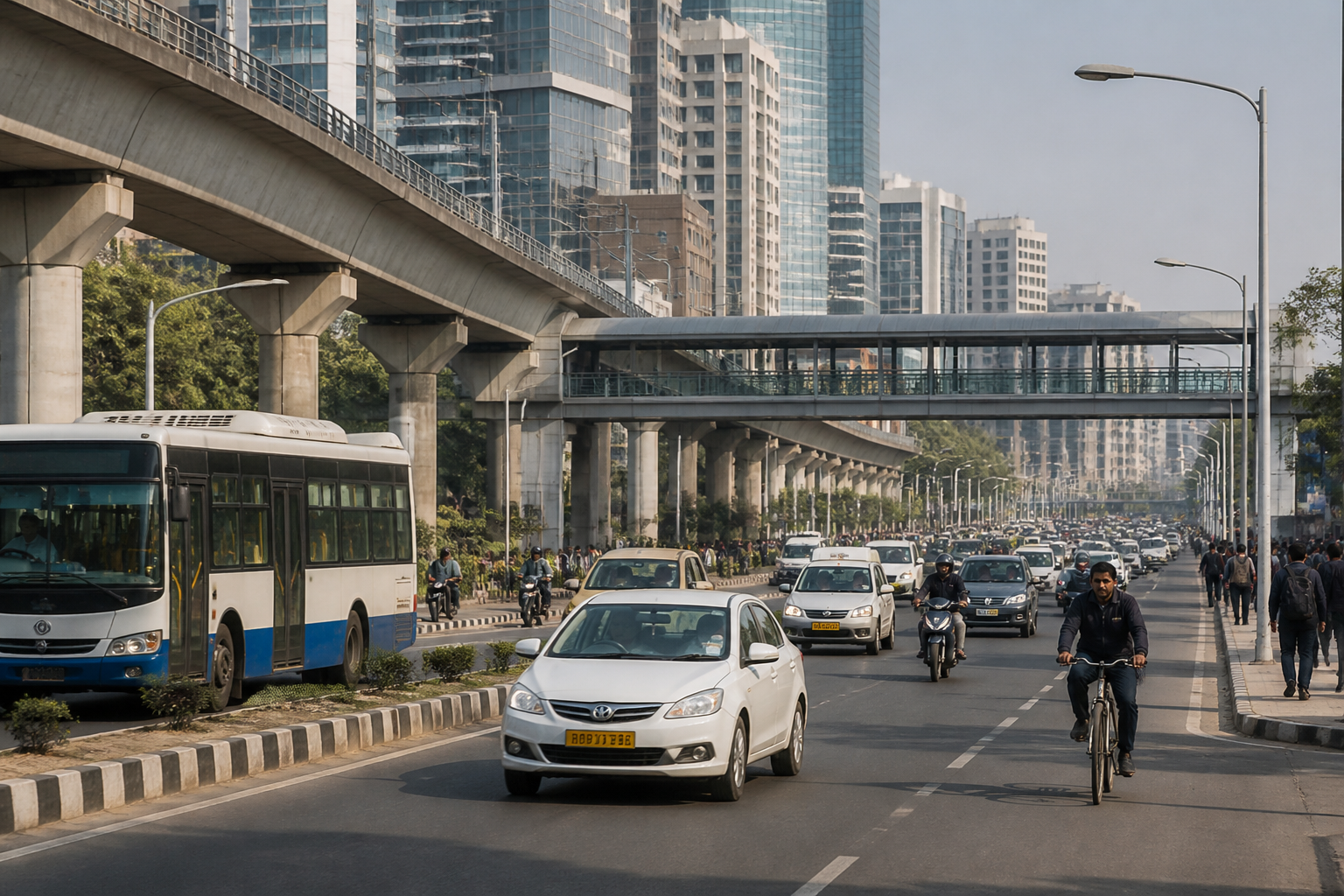
G20 transport emissions could fall sharply by 2050 if countries change how people commute and travel, according to a new study by the Council on Energy, Environment and Water (CEEW). The study models three interventions—hybrid work, shared mobility or carpooling, and higher bus ridership—and estimates that together they could reduce annual passenger-transport emissions by 15-20 per cent under a higher-impact scenario.
The finding shifts part of the climate conversation away from vehicles and fuels alone and towards the systems that shape daily movement. The CEEW study, titled “Mitigation Potential of Behavioural Change in Passenger Transport in G20 Countries”, estimates that the three interventions could save about 538 million tonnes of carbon dioxide every year by 2050. That would equal roughly one-fifth of G20 passenger-transport emissions under a business-as-usual scenario.
The cumulative figure is larger still. Between 2025 and 2050, the behavioural changes modelled by CEEW could avoid 5.7-8 gigatonnes of carbon dioxide emissions across the G20. The study places that amount at around 5-6 per cent of the remaining carbon budget associated with keeping global warming within 1.5 degrees Celsius.
The central message is not that individual behaviour can substitute for infrastructure, regulation or cleaner vehicles. Rather, it is that the design of urban mobility systems determines how much travel is required, how many people share each vehicle and whether public transport can absorb a larger share of trips. The three interventions therefore expose different parts of the relationship between urban form, work patterns and transport demand.
Carpooling has the largest standalone potential in the study. If average car occupancy rises by 50 per cent from current baseline levels, annual emissions savings could reach about 237 million tonnes of carbon dioxide in 2050. If countries converge towards the same average car occupancy, the savings could rise to around 411 million tonnes.
That potential is concentrated in places where private cars are already central to mobility. Developed countries and China account for around 90-92 per cent of the carpooling-related savings because they have higher car ownership and lower average occupancy. In these economies, increasing the number of people travelling in each car can reduce the emissions associated with the existing vehicle fleet without requiring every trip to shift immediately to another mode.
CEEW Senior Fellow Vaibhav Chaturvedi told NDTV that the findings provide global evidence for the idea behind India’s Mission LiFE, which seeks to connect climate action with consumption choices. He described the wider requirement as one involving smarter cities, better workplaces, cleaner mobility and lower oil dependence.
The geography of the findings is important. In 2024, developed nations and China represented 34 per cent of the world’s population but accounted for more than 60 per cent of global road-transport emissions, according to the study as reported by NDTV. Their higher emissions are linked to mobility systems that are more dependent on private vehicles, creating a larger immediate opportunity for savings through shared travel and reduced car use.
Hybrid work represents a second pathway. CEEW estimates that it could reduce G20 passenger-transport emissions by 322 million tonnes of carbon dioxide in 2050, or about 12 per cent compared with the business-as-usual scenario. The model does not assume that all office workers work remotely every day. Instead, it considers sustained reductions in commuting intensity, meaning that working from home for part of the week can reduce travel demand.
More than 65 per cent of the hybrid-work savings come from developed countries and China in the study’s estimates. China accounts for about 96 million tonnes of the reduction, followed by the United States at around 45 million tonnes and the EU-15 at roughly 32 million tonnes. These figures reflect the scale of commuting and the emissions intensity of existing passenger-transport systems in those economies.
The hybrid-work finding also illustrates why transport planning cannot be separated from workplace organisation. A change in the number of days people travel to offices affects peak-hour demand, road congestion and public-transport use. However, the supplied study findings do not establish how such changes would affect commercial real estate, neighbourhood retail or transit finances. Those outcomes would depend on how widely hybrid work is adopted and how urban institutions respond.
Buses provide a third intervention, but the study presents them as part of a combined strategy rather than a complete solution. In a high-bus scenario, increased preference for buses produces emissions reductions ranging from 0.4 per cent to 6.7 per cent, depending on the country. Across the G20, the maximum annual savings are estimated at about 54 million tonnes of carbon dioxide.
The relatively smaller bus figure compared with carpooling and hybrid work does not make bus systems unimportant. It indicates that simply shifting some passengers to buses, without considering the wider structure of travel demand, has a more limited emissions effect in the model. The result also underlines the need to distinguish between the number of people using public transport, the occupancy of vehicles and the emissions associated with the services provided.
India occupies a different position in this comparison. The study cites vehicle ownership of around 33 vehicles per 1,000 people in India, compared with 860 in the United States, 704 in France and 223 in China. India therefore has less scope for reducing emissions by changing already car-heavy lifestyles because private-vehicle ownership remains much lower.
That lower starting point creates a different urban policy challenge: avoiding future dependence on private vehicles as incomes rise and cities expand. Rohini Dikshit, a Programme Associate at CEEW, told NDTV that India and other developing countries have an opportunity to avoid a lock-in to private-vehicle dependence, while richer car-dependent economies need to treat behavioural change as a near-term climate-mitigation measure.
The distinction between absolute and per-capita potential is central to interpreting the Indian numbers. CEEW estimates India’s hybrid-work potential at roughly 71 million tonnes of carbon dioxide in 2050, largely because of the country’s large population. Yet India’s per-capita savings potential remains much lower than that of richer economies with greater car dependence.
This means that India’s transport transition cannot be assessed only by comparing total tonnes of emissions avoided. The more immediate question is whether cities can expand mobility without reproducing the patterns that generated high emissions elsewhere. The study’s numbers point towards the importance of bus use, shared mobility and work arrangements that reduce unnecessary commuting, while also showing that the largest absolute savings are currently concentrated in developed countries and China.
The combined scenarios reinforce this imbalance. The United States and EU-15 account for 61-63 per cent of total savings in the study’s estimates, while developed countries and China together account for 80-88 per cent. These shares do not mean that lower-emitting countries lack responsibility or opportunity. They show that the size of the available reduction depends heavily on the existing mobility baseline.
For urban governments, the evidence connects climate policy with decisions about transport supply, land use and employment patterns. A city that offers reliable buses but continues to expand in ways that lengthen commutes may not capture the full benefit of public transport. A city that promotes hybrid work without maintaining accessible neighbourhood services may also produce outcomes not measured by the study. The source material does not quantify these institutional or spatial effects, but it establishes that transport behaviour is shaped by more than personal preference.
The CEEW analysis therefore presents behavioural change as a differentiated urban strategy. In car-dependent economies, carpooling and reduced commuting can deliver large near-term reductions. In India, the priority suggested by the evidence is to prevent the growth of private-vehicle dependence while strengthening shared and public mobility before car ownership rises further.
What the study confirms is the scale of the opportunity: up to 538 million tonnes of annual G20 passenger-transport savings by 2050 under the higher-impact scenario, with cumulative savings of 5.7-8 gigatonnes between 2025 and 2050. What remains uncertain from the supplied material is how governments, employers and transport agencies would implement these changes, and how the interventions would interact. The next question for cities is not whether behaviour matters, but whether urban systems make lower-emission choices practical at scale.
