


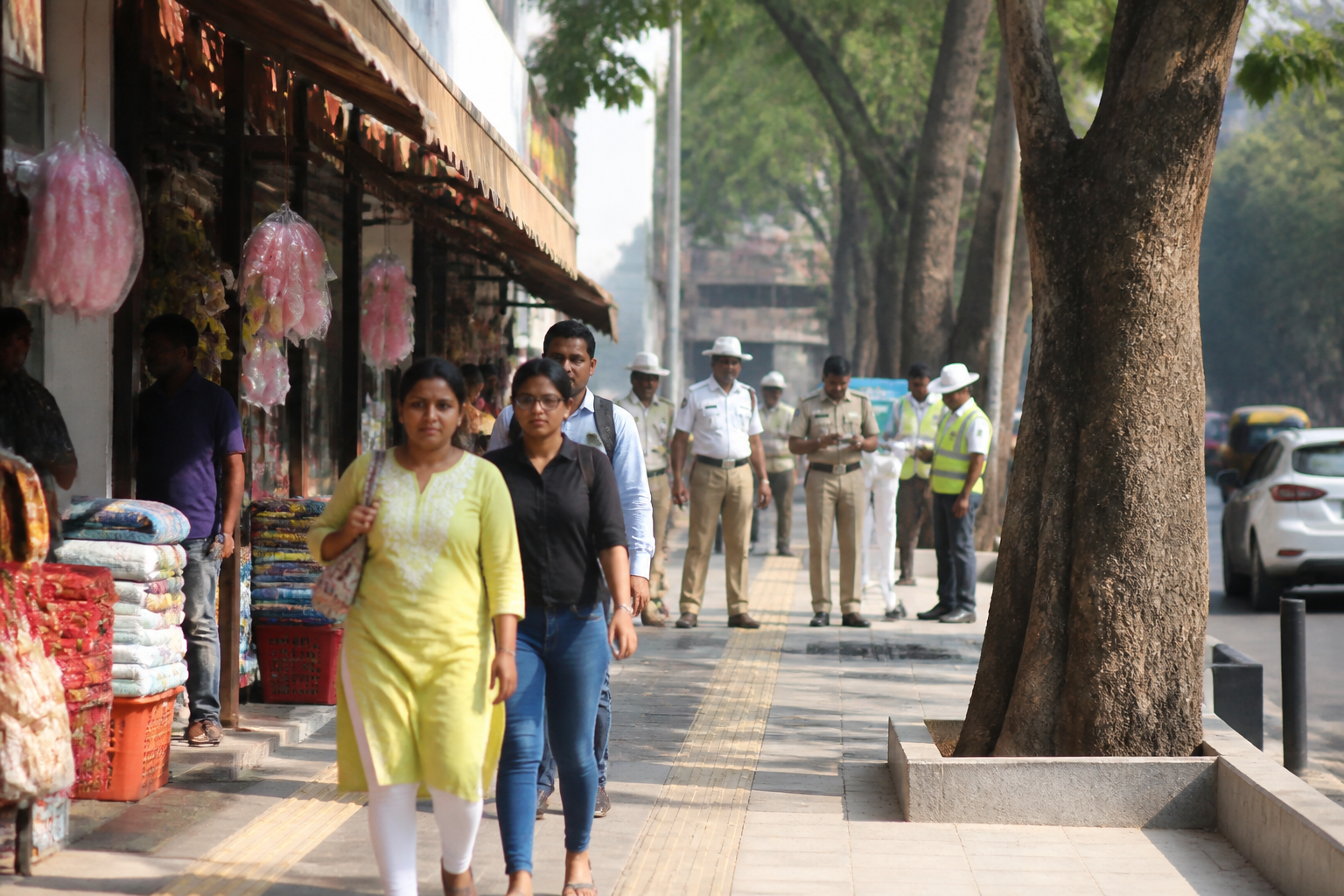
Bengaluru footpath encroachment has moved from a clearance exercise to a question of sustained civic enforcement after Greater Bengaluru Development Minister Krishna Byre Gowda directed authorities to create joint police and civic task forces in each municipal jurisdiction. The proposed arrangement is intended to monitor cleared footpaths, identify repeat encroachment and initiate action against violators.
The directive, reported by Vijay Karnataka after a virtual meeting on footpath encroachment, places the emphasis on what happens after a clearance operation. Officials were told that removing an obstruction once would not be sufficient if the same location is occupied again. The proposed response combines municipal officers, police personnel, marshals and beat staff in regular and surprise inspections.
That shift is significant because it identifies recurrence, rather than removal alone, as the administrative problem. A footpath can be cleared on one day and become inaccessible again if responsibility for monitoring is unclear, inspections are irregular or follow-up action is not recorded. The minister’s instructions seek to address those gaps by assigning responsibility to specific officers and requiring periodic reviews of action taken.
The report does not provide a citywide inventory of encroached footpaths, the number already cleared, the number of repeat violations or a timeline for forming the task forces. It also does not establish how many municipal jurisdictions will be covered or what resources will be assigned to the proposed system. Those omissions matter because the effectiveness of the arrangement will depend on its operational design, not only on the announcement.
The proposed task forces are expected to operate within each city corporation jurisdiction and to coordinate police and civic officials. Their stated functions include routine and surprise inspections of cleared footpaths, immediate action when re-encroachment is detected, and the submission of reports supported by photographs and geotagged information. This would create a record of the location, condition and follow-up status of individual sites.
A geotagged reporting system could make enforcement more traceable, at least in principle. It could allow officials to identify whether a location has been inspected, when a violation was detected and what action followed. However, the supplied report does not specify whether the records will be publicly accessible, which agency will maintain them, how frequently they will be updated or whether missed inspections will attract accountability. Without those details, the reporting requirement remains an administrative instruction rather than a measurable public system.
The directive also calls for stronger action against repeat violators. The minister instructed officials to register first information reports, seize materials and impose higher penalties according to law in cases of repeated encroachment. The report does not identify the specific legal provisions, penalty amounts or procedure that would govern these actions. It therefore confirms the intended enforcement approach but not the precise legal pathway.
This distinction is important in a city where footpaths serve more than one function. They are intended to provide space for walking, but they also intersect with commercial activity and street vending. The report’s treatment of vendors recognises that enforcement cannot be separated from the question of where vending is permitted, restricted or regulated. Officials were asked to clarify roads where street vending is prohibited and formally communicate that information to the relevant police and civic authorities.
The instruction to identify restricted roads on a street-by-street basis suggests that enforcement is expected to become more geographically specific. A general direction to remove encroachments does not answer which activities are prohibited on a particular road, which spaces may be used by vendors or how pedestrian movement should be protected in areas with heavy traffic. Road-level guidance could provide officials with a clearer basis for action, provided that the guidance is formally issued and consistently applied.
At the same time, the report says that a new comprehensive survey of street vendors should be conducted. Officials were instructed to complete the survey quickly and take subsequent action based on eligibility and legal criteria. Pending processes, including the formation of Town Vending Committees, were also to be completed in accordance with the law.
The combination of enforcement and surveying is central to the policy challenge. Footpath obstruction is a public-access issue, but street vending is also an urban livelihood issue. The report does not provide the number of vendors, the status of existing surveys, the proposed vending zones or the criteria that will determine eligibility. It therefore does not establish how the city will reconcile pedestrian access with the legal and administrative framework for street vending. It does show that the government intends to address both matters together rather than treating every vendor as an enforcement problem without classification.
Institutionally, the plan assigns responsibilities across agencies that operate with different roles. Municipal authorities control civic enforcement and local infrastructure, while police personnel are responsible for public order and criminal-law action where applicable. Marshals and beat police are expected to undertake joint inspections. The minister also called for a joint order at the chief commissioner level, with the area of operation and responsibility of each official clearly defined.
That proposed order could become the main test of whether the task force is a standing mechanism or a temporary campaign. The report does not state whether the groups will have permanent staff, dedicated budgets, fixed inspection schedules or escalation procedures. It also does not say who will review complaints from pedestrians, vendors or local residents. These are not peripheral details: they determine whether enforcement is continuous and accountable or dependent on periodic instructions from senior officials.
The available evidence is administrative rather than statistical. No baseline data is supplied on the extent of footpath encroachment, the proportion of footpaths accessible to pedestrians, the frequency of repeat violations or the outcomes of earlier clearance drives. As a result, the announcement cannot yet demonstrate that the proposed model will improve pedestrian access. It establishes a new set of directions and enforcement expectations, but not performance results.
The absence of a baseline also limits how the city’s progress can be assessed. If the authorities publish the locations covered, the number of inspections, repeat violations detected, materials seized, cases registered and footpaths restored, future reviews could distinguish activity from outcome. At present, the report only says that progress should be reviewed regularly. It does not define the indicators or the public reporting format.
The larger urban question is whether Bengaluru can protect pedestrian infrastructure through routine administration rather than periodic clearance. The minister’s instructions recognise that physical removal is only one stage of the process. Continued monitoring, clear jurisdiction, documented action and legal follow-through are being presented as necessary parts of the same system.
The plan also raises a question about coordination. A joint task force may reduce the gap between civic and police action, but coordination alone will not resolve unclear rules, insufficient pedestrian space or the absence of legally completed vending arrangements. The proposed vendor survey and Town Vending Committee process will be important because enforcement decisions are likely to affect both public movement and livelihoods.
For now, the evidence confirms that the government has directed municipal and police authorities to create joint task forces, monitor cleared footpaths, use photographic and geotagged reports, act against repeat encroachment, clarify restricted vending roads and complete a new vendor survey. It does not yet confirm that the task forces have been formally constituted, that inspections have begun or that pedestrian access has improved. The next developments to monitor are the chief commissioner-level joint order, the jurisdiction-wise task-force structure, the vendor survey, the status of Town Vending Committees and the publication of measurable enforcement results.
