


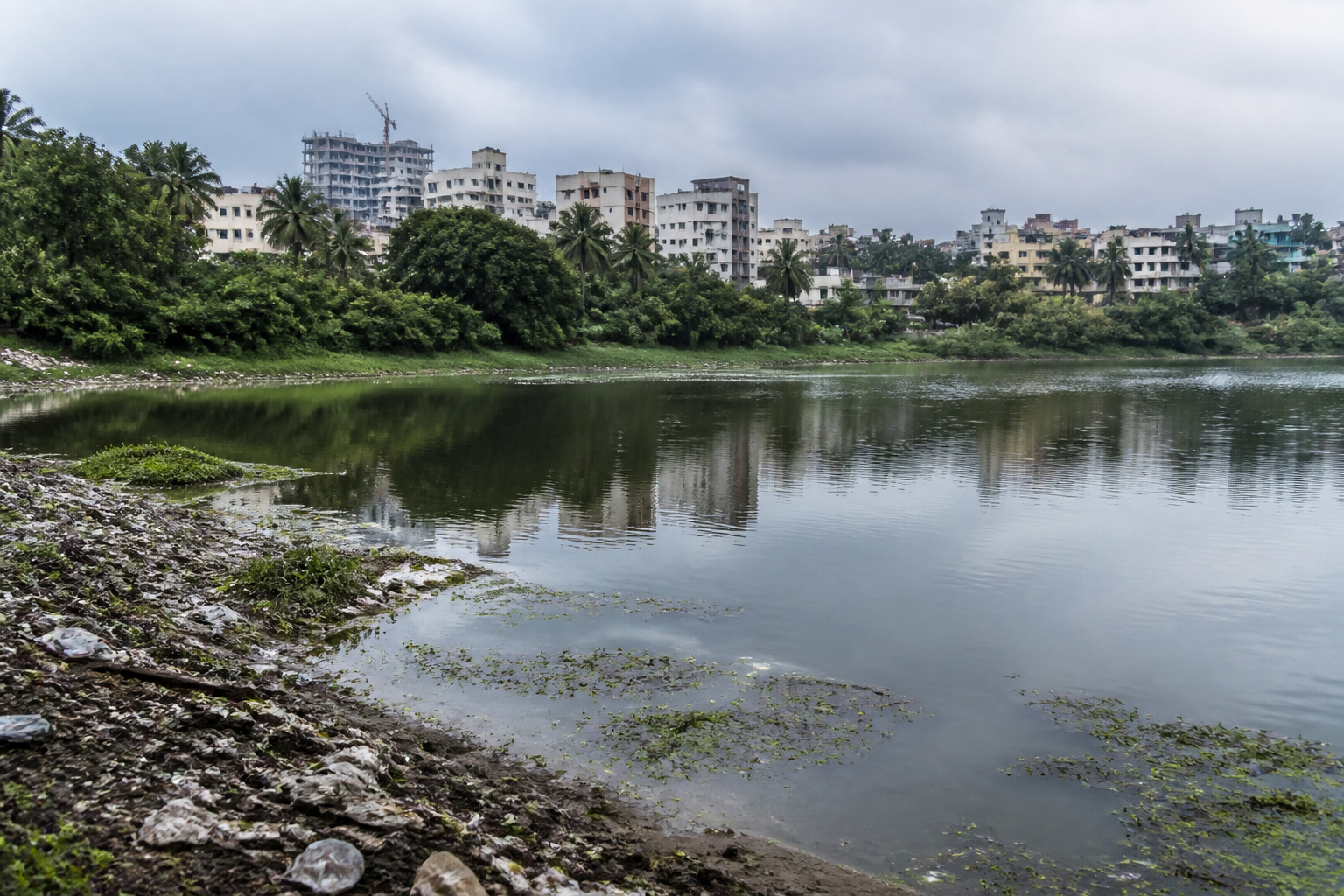
North Bengaluru’s lakes are showing different symptoms of the same urban failure: polluted water is being allowed to move through a rapidly urbanising landscape without adequate sewage and waste-management systems. A Bangalore University analysis of Dasarahalli, Madavara and Chikkabanavara lakes, conducted during April and May 2026, found elevated levels of several indicators of declining water quality. The findings matter beyond the condition of three water bodies because their outlet water joins the Arkavathi River, which eventually reaches the Tippagondanahalli Reservoir, a source of drinking water for parts of Bengaluru.
The study examined pH, turbidity, electrical conductivity, total dissolved solids, hardness, nutrients, dissolved oxygen, biochemical oxygen demand and chemical oxygen demand. Several parameters, including pH, electrical conductivity, chloride, fluoride and nitrate, were within permissible limits. But elevated total dissolved solids, turbidity, hardness, phosphate, biochemical oxygen demand and chemical oxygen demand were recorded at some locations. Together, these indicators point to deteriorating water quality linked to urban runoff, solid-waste dumping and nutrient enrichment.
The differences between the lakes are important. Madavara recorded the highest nutrient overload, including phosphate, sulphate and nitrate, as well as the highest chemical oxygen demand. In practical terms, the lake showed the strongest signs of severe organic pollution among the three sites assessed. Dasarahalli recorded the highest electrical conductivity, total dissolved solids, hardness, turbidity, chloride, fluoride, sodium and biochemical oxygen demand. The researchers associated this combination with a high inflow of domestic sewage.
Chikkabanavara recorded relatively better water quality than the other two lakes, but that does not place it outside the urban risk zone. The lake is facing encroachment and waste accumulation. Its comparatively better readings therefore describe a relative position within the study, not a clean bill of health. The three lakes are under pressure from human activity, pollution and climate change, according to the researchers.
The larger pattern is one in which lake pollution is treated as a problem at the receiving end rather than as a failure across the drainage system. When wastewater and solid waste enter a lake, the visible damage appears at the shoreline or on the water surface. The sources, however, may lie across a wider catchment: unconnected households, expanding settlements, roadside activity, construction, storm-water flows and waste-disposal practices. Cleaning the lake without controlling those flows can address the symptom while leaving the supply of pollution intact.
That source-to-lake relationship is especially significant in north Bengaluru, where the researchers describe large parts of the area as peri-urban and undergoing rapid urbanisation. Peri-urban areas often grow faster than public infrastructure. New buildings and settlements can appear before underground drainage, reliable wastewater treatment and organised waste collection are extended to them. In such circumstances, a lake can become an informal receiving system for the surrounding urban area.
Dr Raghavendra M of Bangalore University’s Department of Environmental Science said the lack of an underground drainage system in parts of north Bengaluru was leading to much of the waste generated in these areas entering water bodies. The researchers selected the three lakes partly because their outlet water joins the Arkavathi River and ultimately reaches Tippagondanahalli Reservoir. This makes the issue a question of connected water systems, not only local lake maintenance.
The study’s findings also show why a single water-quality number is not enough to describe an urban lake. Madavara’s nutrient and chemical oxygen demand levels indicate one type of stress. Dasarahalli’s readings point more strongly towards domestic sewage inflow. Chikkabanavara’s comparatively better water quality sits alongside encroachment and accumulated waste. Each lake therefore requires attention to its specific pollution pathways, even though all three are affected by the same broader pressures of urban expansion and weak source-level management.
The parameters measured help distinguish those pressures. Turbidity indicates suspended material in water, while total dissolved solids and electrical conductivity reflect the presence of dissolved substances. Biochemical oxygen demand and chemical oxygen demand indicate the amount of oxygen-consuming organic and chemical material in the water. Nutrient enrichment, particularly involving compounds such as phosphate and nitrate, can alter aquatic conditions. The supplied study does not establish a single cause for every reading, but its overall conclusion links the deterioration to urban runoff, solid-waste dumping and nutrient enrichment.
This is also why the researchers’ call for stricter source-level controls is more consequential than a conventional lake-cleaning exercise. Their recommendations include strengthening sewage treatment, preventing direct discharge of wastewater, controlling encroachment, removing solid waste and invasive weeds, conducting regular water-quality monitoring and promoting community participation. These measures span several responsibilities rather than belonging to one agency or one project. Sewage management, land-use enforcement, waste collection, lake protection and environmental monitoring must work together if the pressure on the lakes is to decline.
The policy and administrative challenge is coordination. A lake may be managed as a public asset, while sewage networks, local roads, solid waste and new construction fall under different institutional processes. If these systems do not operate across the same catchment, pollution can continue even after the lake itself is cleaned. The study does not identify the responsible agencies for each intervention, but it establishes that the problem is distributed across the urban system.
Regular monitoring is central to that system. The analysis provides a snapshot based on samples assessed during April and May 2026. That is useful for identifying present conditions and comparing the three lakes, but it does not by itself establish how water quality changes through the year. Continued monitoring would be needed to determine whether the recorded pollution is persistent, seasonal or associated with particular flows. The researchers specifically call for sustained monitoring as part of ecological restoration.
The route to the Arkavathi River and Tippagondanahalli Reservoir gives the issue a wider urban dimension. The supplied material does not quantify how much pollution reaches the reservoir or establish a direct impact on drinking-water quality. It does, however, identify a connected pathway from local lakes to a downstream water source. That pathway means local failures in sewage and waste management deserve attention before they are transferred downstream.
The study also places encroachment within the same frame as water quality. Encroachment reduces the space available for a lake and can interfere with inflows, outlets and natural buffering areas. Waste accumulation adds another pressure. Protecting a water body therefore requires more than removing material from the water; it requires maintaining the physical boundaries and drainage relationships that allow the lake to function.
What the evidence confirms is a pattern of uneven but significant ecological stress across three north Bengaluru lakes. Madavara shows the strongest nutrient and organic-pollution signals in the study, Dasarahalli shows indicators associated with high domestic sewage inflow, and Chikkabanavara remains comparatively better while facing encroachment and waste accumulation. What remains uncertain is the precise contribution of each pollution source, the seasonal variation in readings and the effectiveness of existing enforcement or treatment systems.
The next test is whether the response moves upstream. The researchers’ central warning is that treating pollution only after it reaches lakes is temporary. For Bengaluru’s lakes to retain ecological and downstream value, the city will need reliable sewage management, protection from direct discharge, control of encroachment, organised waste removal and monitoring that continues beyond a single assessment. The condition of these three lakes is therefore not only an environmental report card; it is evidence of how the expanding city is managing the water systems beneath it.
