


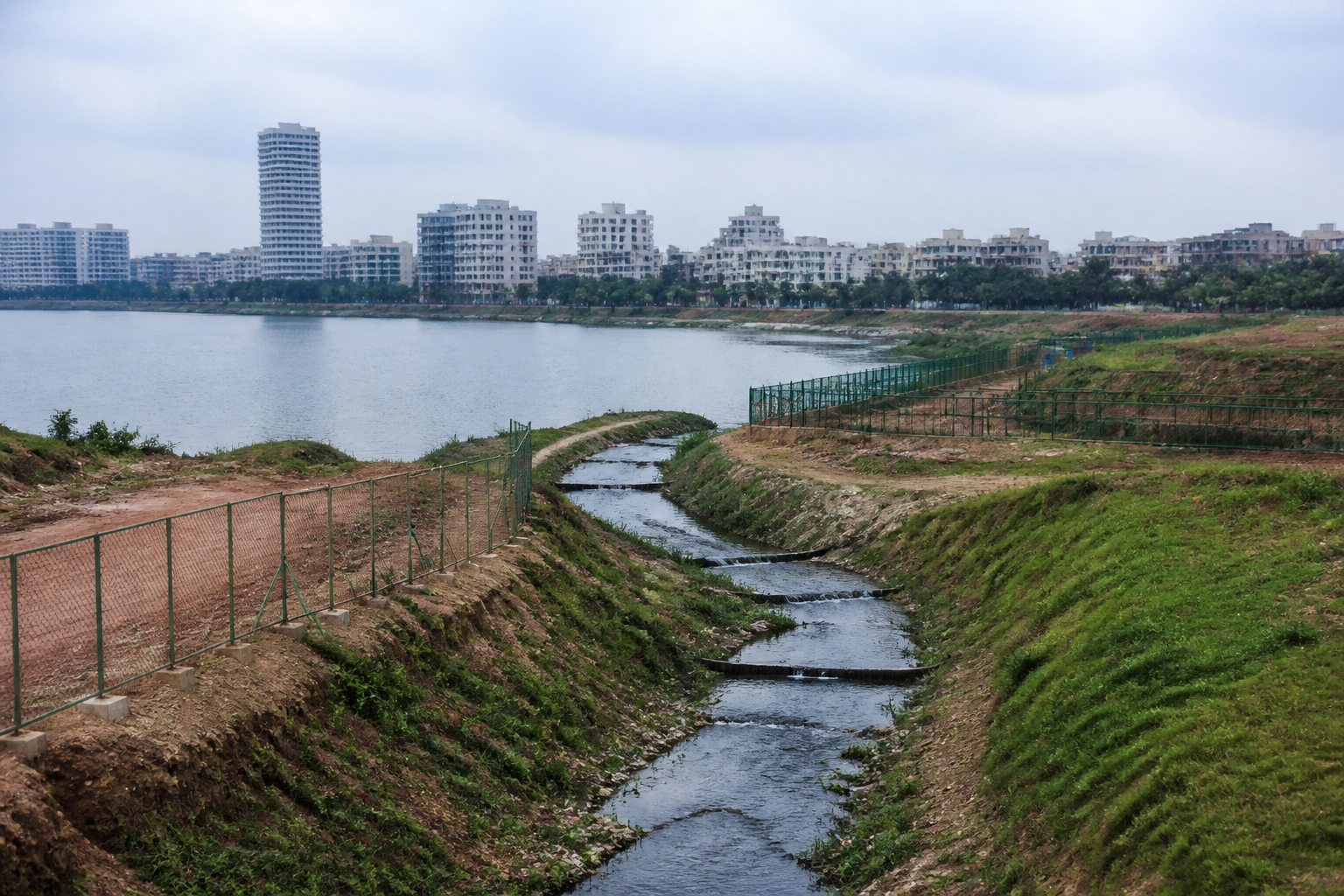
The latest compliance report on Bellandur Lake says wetland construction at the main inlet and HAL inlet is 100 per cent complete. Citizen stakeholders dispute that conclusion, arguing that an excavated area and inlet structures do not automatically constitute a functioning wetland capable of treating polluted water. The disagreement exposes a larger problem in urban lake restoration: how should completion be measured when a project is expected to perform an ecological function rather than simply deliver a built asset?
The Karnataka Tank Conservation and Development Authority’s report, covering work between January 1 and August 15, 2026, records the completion of wetland construction at the two inlets. It also reports progress on fencing, flood-regulation structures, diversion canals and desilting. But the Bangalore Development Authority says work to enhance the wetland’s retention capacity is still under way. That distinction is central to the dispute because the wetland’s reported physical completion and its intended treatment performance are not necessarily the same thing.
Citizen stakeholders say the National Green Tribunal Monitoring Committee and the Indian Institute of Science have previously maintained that Bellandur Lake requires wetlands of adequate capacity to perform functions such as sedimentation, nutrient removal and improving water quality before inflows enter the lake. Their objection is therefore not limited to terminology. It concerns whether the intervention can operate as a treatment ecosystem while sewage continues to enter the lake.
Sonali Singh of Change Maker – Bellandur Lake said that if the submission to the tribunal treats only inlet construction and excavation in Zone 1 as 100 per cent wetland completion, it does not reflect the complete wetland envisaged in the scientific restoration plan. She called for independent technical verification by IISc or the Expert Committee before the reported progress is accepted.
The dispute illustrates the difficulty of applying conventional construction milestones to ecological infrastructure. A road, boundary wall or sluice gate can generally be assessed through physical completion. A wetland intended to filter incoming water has an additional requirement: it must have sufficient capacity, retention time and operating conditions to perform its function. The available report does not establish that the two sides agree on the technical criteria for making that assessment.
The BDA’s account suggests that the treatment function has not yet reached its intended operating condition. A senior official said the wetland’s water retention capacity is currently one day and is being enhanced to seven days so that water can be properly filtered. The official also said sewage continues to enter the lake from illegal buildings and surrounding areas. On that account, the wetland construction may have reached one project milestone while capacity enhancement and the wider sewage-control problem remain unresolved.
Retention time matters to the logic of the intervention described by the authority. If water passes through the wetland too quickly, the system may not provide the duration required for sedimentation, nutrient removal and other treatment processes. The seven-day target cited by the BDA is therefore not a cosmetic addition to the project. It is presented as a condition for the wetland to perform the role assigned to it. At the same time, the report does not provide independent measurements showing how the current one-day capacity performs against water-quality objectives.
This leaves two different definitions of completion in circulation. The KTCDA report appears to use a construction-based definition, recording the completion of the wetland works at the main and HAL inlets. Citizen stakeholders and the BDA’s capacity-enhancement statement point towards a performance-based definition, under which completion would require the wetland to retain and treat inflowing water at the intended scale. Until those definitions are reconciled, a percentage figure can convey physical progress without settling whether the ecological objective has been achieved.
The distinction is particularly important because the project is not operating in a clean inflow environment. The BDA says sewage continues to flow into the lake from illegal buildings and surrounding areas. That means wetland performance cannot be considered separately from the systems that control sewage at source and divert it before it reaches the lake. The KTCDA report records diversion canals on the northern and southern sides, but the supplied material does not establish how much sewage those canals intercept, whether all major inflows are covered or how their performance is being measured.
The other reported works show substantial physical activity around the lake. Fencing has been completed along 11.26 kilometres of the 12.26-kilometre boundary, leaving one kilometre pending at Ambedkar Nagar Slum. The report also says that construction and installation of a sluice gate and waste weir have been completed. These structures are intended to regulate flows and manage waste, but the report’s completion claims do not by themselves answer whether the lake’s water quality or ecological condition has improved.
Desilting provides another example of the difference between activity and outcome. Work is reported as complete across 724 acres and 26 guntas of the lake’s 794 acres and 26 guntas of water-spread area. The remaining area is described as about 70 acres, for which a tender had been invited for desilting and transportation of silt, with August 24, 2026, set as the last date. The figures indicate that desilting was incomplete during the reporting period, even as other components were described as complete.
Together, the reported numbers present a project at different stages of execution. Most of the boundary has been fenced, major flood-regulation structures have been installed, diversion canals have been constructed and a large portion of desilting has been completed. The wetland works are described as complete by KTCDA, while BDA says retention capacity is still being enhanced. The remaining desilting and boundary work further show that the lake restoration programme is not at a single, uniform endpoint.
That matters for institutional accountability. The KTCDA report is a compliance document submitted to the National Green Tribunal, while the BDA is responsible for describing the status of the wetland work and its capacity. Citizen stakeholders are asking for an independent technical assessment before the tribunal accepts the reported completion. The question is therefore not only whether agencies have carried out listed works, but also whether the reporting framework captures the intended environmental result.
The role of the NGT is significant because compliance reporting can shape how restoration progress is evaluated. If the tribunal accepts a construction milestone as proof of wetland completion, the project may be recorded as complete even while capacity enhancement continues. If it requires functional verification, agencies may need to demonstrate the wetland’s retention capacity, treatment performance and relationship with continuing sewage inflows. The supplied material does not indicate which approach the tribunal will adopt or whether an independent verification has been ordered.
The Bellandur dispute also points to a broader challenge in urban infrastructure: ecological systems are often delivered through contracts, tenders and measurable construction packages, but their success depends on ongoing operation and environmental performance. A wetland is not only an excavated space. In the description offered by citizen stakeholders, it is a treatment ecosystem whose value depends on how water moves through it and what pollutants it can remove. That makes the monitoring method as important as the construction record.
The available evidence confirms that restoration work has progressed across several physical components, but it does not establish that the wetland is functioning at the intended capacity. It also confirms that sewage inflow remains a live concern and that BDA is still working to increase retention from one day to seven days. What remains unresolved is whether the reported construction completion corresponds to the scientific and operational standard expected for Bellandur Lake.
The next important step is therefore the one requested by citizen stakeholders: an independent technical verification by IISc or the Expert Committee. Such an assessment would need to clarify the design capacity, retention period, treatment function and relationship between the wetland and the continuing sewage inflows. Until that evidence is placed before the National Green Tribunal, the phrase “100 per cent wetland completion” remains contested not because physical work has not taken place, but because the parties disagree on whether the completed works constitute a functioning treatment system.

