


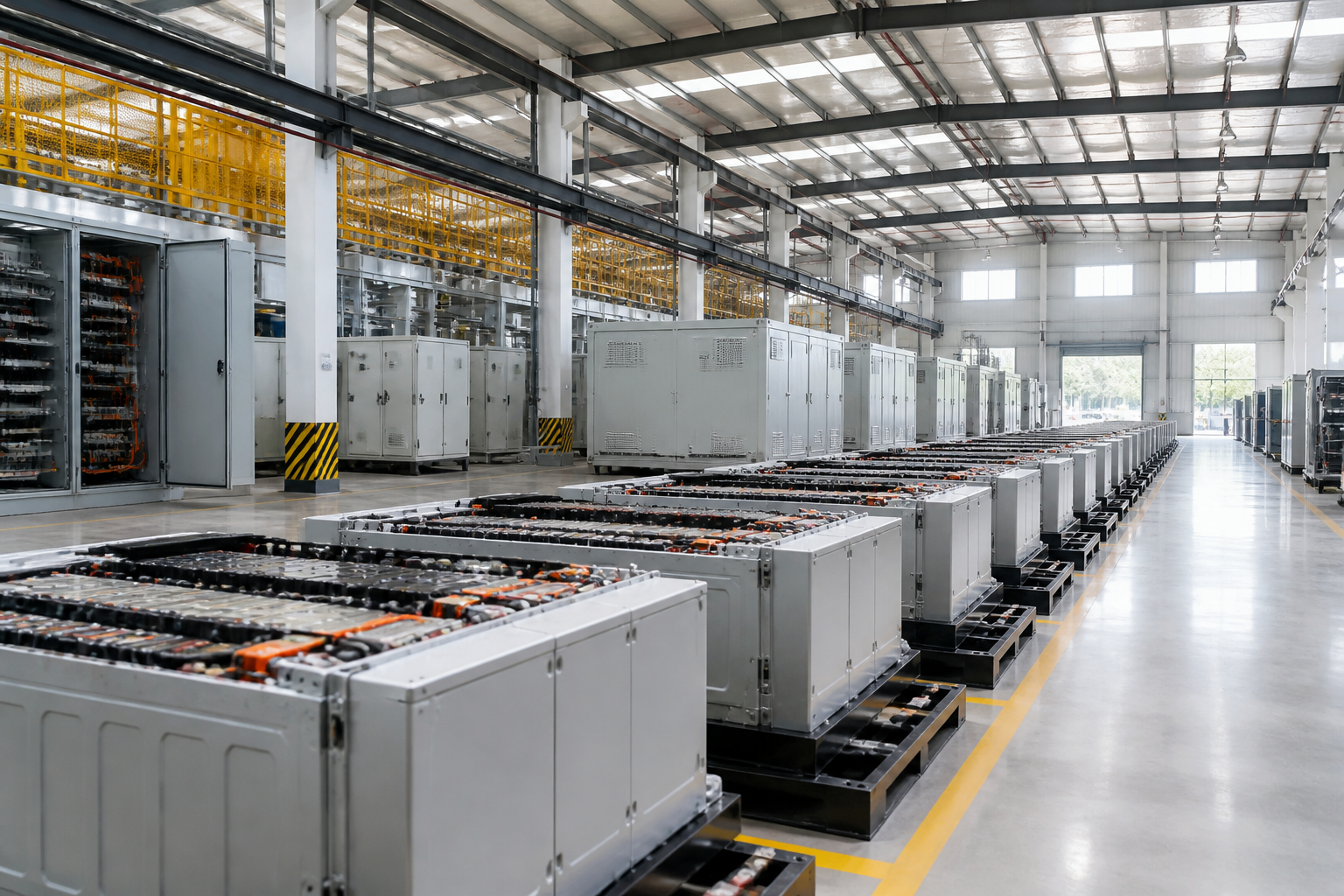
SPML Infra’s announcement that its proprietary 104.4 kWh battery pack has completed international safety, performance and transportation testing is more than a product milestone. It is an indication of how India’s energy-storage market is beginning to move from project execution and imported equipment towards domestic engineering and manufacturing.
The Kolkata-based infrastructure company said in a stock exchange filing on Friday that the battery pack had completed key certification and testing requirements. The product is being developed alongside a Battery Energy Storage System (BESS) manufacturing facility in Pune, which the company says is nearing completion. The facility is planned with an initial production capacity of 2.5 GWh, with a proposed expansion to 5 GWh.
The announcement does not establish that the facility has begun commercial production or that the battery pack has entered large-scale deployment. It does, however, mark a defined stage in the development process: the product has completed testing and certification requirements that address safety, performance and transport. The remaining question is how quickly such validation can be converted into manufacturing output and operating storage projects.
The distinction matters because battery storage is not simply a manufacturing business. It sits at the intersection of electricity generation, transmission, distribution, infrastructure finance, construction and urban growth. As cities expand and power demand becomes more variable, storage systems can form part of the infrastructure required to balance supply and demand. But their value depends on how safely, reliably and economically they are integrated into the grid.
SPML said the certification and testing covered thermal runaway safety, battery performance, system functional safety, electromagnetic compatibility and transportation safety. Each area addresses a different risk. Thermal runaway safety concerns the possibility of uncontrolled heat escalation inside battery systems. Performance testing establishes whether the equipment functions according to its designed specifications. Functional safety examines system-level safeguards, while electromagnetic compatibility and transportation safety relate to operation alongside other electrical equipment and movement of battery units.
The company’s reference to these requirements places product safety at the centre of its manufacturing strategy. For BESS projects, safety is an operational and planning issue as much as an engineering one. Storage installations may be located near substations, industrial areas, renewable-energy projects or other critical infrastructure. Their deployment therefore requires confidence in the equipment, the installation environment and the systems used to monitor and control it.
SPML Managing Director Abhinandan Sethi described the certification of the battery pack as an important milestone in the company’s energy-storage journey. He said the company was developing technology and engineering capabilities internally rather than limiting its role to manufacturing or project execution. That positioning reflects an effort to participate across several parts of the storage value chain.
The company said its strategy combines proprietary product engineering, domestic manufacturing and established engineering, procurement and construction capabilities. In principle, that combination could allow SPML to supply equipment, build associated infrastructure and execute storage projects. The filing, however, does not provide details of specific customer contracts, project locations, commercial production dates or the expected utilisation rate of the Pune facility.
Those omissions are important when assessing the significance of the planned capacity. A proposed 2.5 GWh facility is substantially larger than the energy content of an individual 104.4 kWh battery pack. The figures refer to different scales: the battery pack describes a product unit, while gigawatt-hours describe the annual or installed manufacturing capacity of a facility, depending on how the company defines and reports it. The available announcement does not explain the number of packs that could be produced at the facility or how output would be divided among product formats.
The planned expansion from 2.5 GWh to 5 GWh also represents an intended growth path rather than an achieved production level. The company’s latest annual report describes the manufacturing plant as nearing completion and says the expansion is part of its growth strategy. It also refers to a strong order pipeline and strategic technology partnerships, but the supplied material does not identify the orders, partners or financial value associated with them.
This is where the broader policy and infrastructure context becomes relevant. India’s electricity system is adding renewable generation while cities, industries and transport networks require dependable power at different times of day. Solar and wind output can vary according to weather and daylight conditions. Storage can help shift electricity across time, support grid operations and reduce the mismatch between generation and demand. The announcement does not claim that SPML’s battery pack will perform any specific grid service, so its eventual role cannot yet be determined from the filing.
What can be established is that domestic storage manufacturing is being presented as part of India’s clean-energy and self-reliance agenda. SPML said the battery pack was engineered and developed as part of a strategy to build indigenous technology and manufacturing capabilities for the country’s expanding grid-scale energy-storage market. That statement connects the company’s investment to a larger industrial question: whether India can develop sufficient local capability in the components, systems engineering, testing and project execution required by an electricity sector increasingly dependent on flexible infrastructure.
Domestic manufacturing alone does not resolve the challenges facing energy storage. A storage plant must be connected to the grid, operated under appropriate technical standards and supported by a revenue model that pays for the services it provides. The supplied announcement does not disclose the facility’s planned grid connection, operating model, financing structure or tariff arrangements. It therefore supports a conclusion about capability-building, but not yet about commercial viability or system-wide impact.
The Pune facility’s location is nevertheless relevant to the built environment. Manufacturing infrastructure creates a physical base for energy equipment, while BESS deployments can influence the design of substations, renewable-energy parks, industrial campuses and other electricity-intensive developments. As storage becomes part of infrastructure planning, questions of land, fire safety, electrical connectivity, transport and maintenance will need to be addressed alongside questions of battery chemistry and capacity.
The announcement also highlights the role of engineering, procurement and construction companies in the energy transition. Firms with existing project-execution capabilities can potentially move into equipment manufacturing and systems integration. That shift could reduce the separation between the companies that build infrastructure and those that supply the technology embedded in it. Whether such integration produces faster deployment or better cost control will depend on execution, but the supplied material does not yet offer evidence on either outcome.
For cities, the immediate significance is not that one Pune facility will transform the power system. The stronger signal is that energy storage is becoming an industrial and infrastructure category in its own right. The market is beginning to require certified products, domestic production capacity and companies able to connect equipment with project delivery. Those capabilities will matter if storage is to support a more flexible and resilient electricity system.
At the same time, the evidence remains limited to a company announcement and the status reported in its annual report. The battery pack has completed specified certification and testing requirements; the Pune facility is nearing completion; initial planned capacity is 2.5 GWh; and the company intends to expand that capacity to 5 GWh. The material does not confirm commercial production, completed grid-scale installations or operating performance in the field.
The next meaningful markers will therefore be the facility’s completion, the start of production, disclosure of customer or project orders and evidence of deployment. Until those milestones are reported, SPML Infra’s announcement is best understood as a sign of India’s effort to build domestic battery energy storage capability, rather than proof that the storage market has reached scale.
