


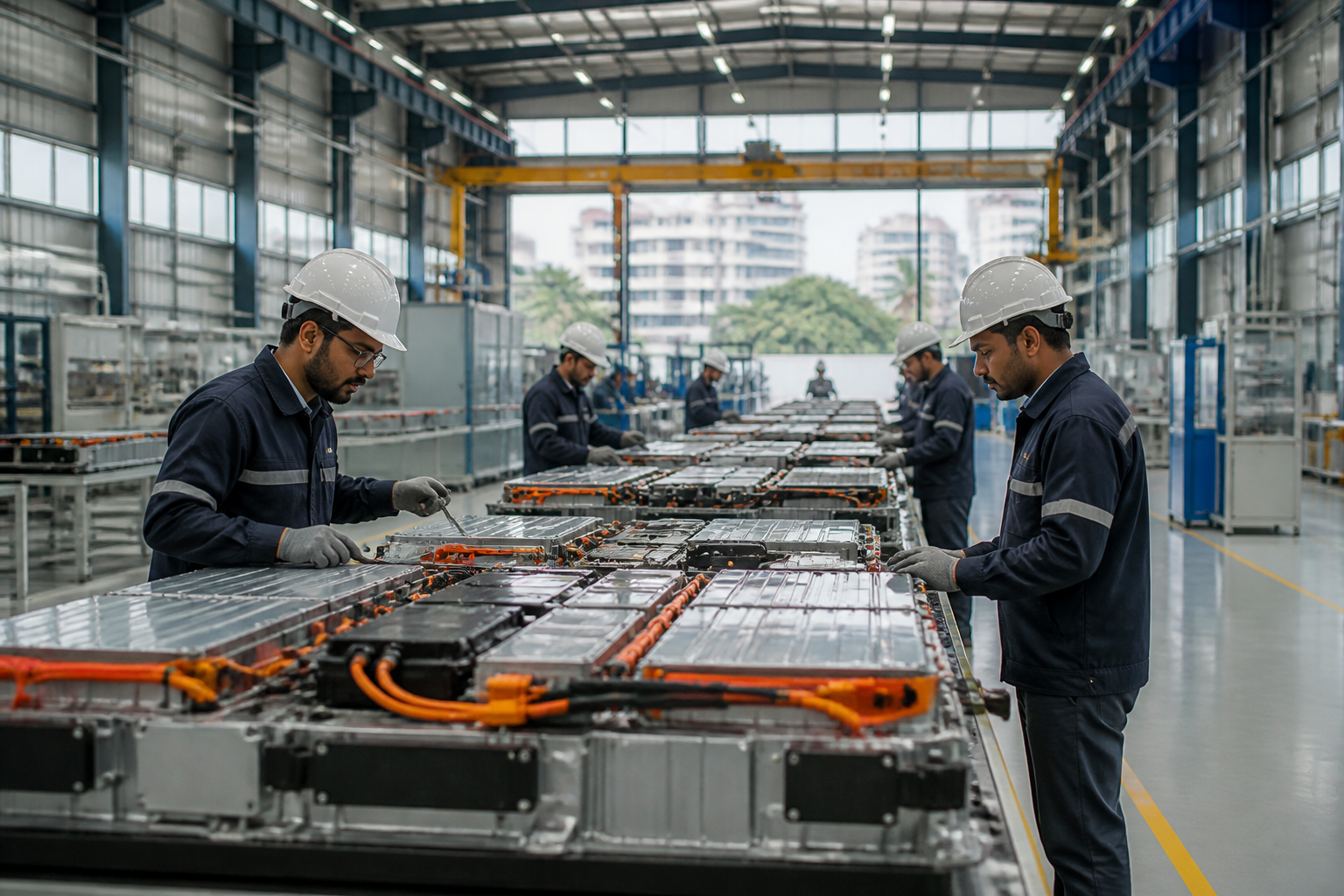
SPML Infra’s announcement that its proprietary 104.4 kWh battery pack has completed international certification and testing requirements is more than a product milestone. It is an early indication of how India’s energy-storage market is being assembled: through a combination of domestic manufacturing, technology development and the engineering capacity required to integrate storage into large infrastructure projects.
The Kolkata-based infrastructure company said on September 4 that it is setting up a Battery Energy Storage System (BESS) manufacturing facility in Pune and that the battery pack had completed certification and testing covering safety, performance and transportation requirements. The company described the development as a step towards commercial deployment. Its annual report says the facility is nearing completion, with an initial production capacity of 2.5 GWh and a planned expansion to 5 GWh.
Those figures place the announcement within a broader infrastructure question. Energy storage is not simply a manufacturing category. It is an enabling layer for electricity systems that must balance generation and demand, manage intermittency and maintain reliability. The supplied material does not establish how much of the facility’s output has been contracted, when commercial production will begin or which projects will use the battery packs. It does, however, show the company attempting to position itself across several parts of the emerging storage chain rather than as only a project contractor.
SPML says the 104.4 kWh pack was engineered and developed as part of a strategy to build indigenous technology and manufacturing capabilities for India’s grid-scale storage market. The company also points to its existing engineering, procurement and construction capabilities as part of the proposed platform. In practical terms, that suggests a business model that links product design with factory production and project execution. Whether that combination becomes a durable advantage will depend on factors not established in the announcement, including manufacturing consistency, procurement economics, project performance and the ability to scale safely.
The certification claim is important because battery storage is an infrastructure system with several distinct risks. According to SPML, the completed compliance and testing work addresses thermal runaway safety, battery performance, system functional safety, electromagnetic compatibility and transportation safety. These are not interchangeable checks. They relate to the behaviour of the battery under different operating conditions, the interaction between electrical and control systems, the impact of electromagnetic interference and the safe movement of the product before installation.
The company has not published the detailed test results in the supplied material, nor has it identified the certifying bodies, testing laboratories or applicable standards. That limits what can be concluded about the product. Certification does not by itself establish the commercial performance of a storage system over its full operating life, nor does it demonstrate how the pack will perform when assembled into larger systems and connected to a particular grid environment. It does provide a stated technical and regulatory foundation for the next stage of deployment.
The distinction between a battery pack and a complete BESS is also significant. A 104.4 kWh pack is a defined storage component, while a grid-scale storage installation typically requires multiple packs, power-conversion equipment, thermal management, controls, fire-safety systems and grid-connection infrastructure. The announcement does not specify the architecture of SPML’s proposed systems, the chemistry used, the duration for which they can deliver power or the operating configuration of the Pune facility. Those details will matter when assessing the technology’s usefulness in actual electricity projects.
The company’s stated production capacity provides the clearest measure of its intended scale. An initial capacity of 2.5 GWh is equivalent to 2,500 MWh of annual manufacturing capacity if the figure refers to yearly output, although the supplied material does not explicitly define the capacity period or expected utilisation. The proposed expansion to 5 GWh would double the stated capacity. The announcement therefore signals an ambition to move beyond pilot-scale development, but capacity on paper is not the same as production achieved, orders delivered or storage deployed.
The facility’s location in Pune is relevant to the manufacturing strategy. The announcement identifies Pune as the site of the BESS unit but does not provide details on land, suppliers, workforce, logistics, power availability or local approvals. It also does not state whether the plant will manufacture cells, assemble battery packs or integrate wider storage systems. Those distinctions affect how much domestic value is created and how dependent the operation remains on imported components. SPML’s language about indigenous technology and manufacturing capabilities points to localisation as a strategic objective, but the extent of localisation is not established.
The company’s stated role in the energy-storage ecosystem is consequently broader than the 104.4 kWh product itself. SPML describes a combination of proprietary product engineering, domestic manufacturing and EPC execution. Its managing director, Abhinandan Sethi, said the company was developing technology and engineering capabilities within SPML rather than limiting its role to manufacturing or project execution. This is a significant claim about organisational capability, but the supplied announcement does not identify completed storage projects, operating assets or performance data that would allow it to be independently assessed.
The policy context is present in the company’s own framing: SPML links the investment to India’s expanding grid-scale energy-storage market and to a drive for self-reliance in clean-energy technologies. The source material does not cite a specific government scheme, tender, subsidy, storage mandate or procurement programme connected to the Pune facility. It is therefore not possible to attribute the project to a particular public policy instrument. What can be established is that the company sees domestic manufacturing as a route into a market where storage is expected to support a lower-carbon and more resilient power system.
That distinction matters for interpreting corporate announcements in infrastructure. A manufacturing plant can be described through its planned capacity, but the public value of the investment will ultimately be determined by how the products enter the electricity system. Storage can serve different functions, including shifting electricity across time, supporting grid stability or improving the reliability of renewable generation. SPML has not specified which applications its battery packs will prioritise. Without that information, the plant’s contribution to grid resilience remains an objective rather than a demonstrated outcome.
The available numbers tell a limited but coherent story. The company has disclosed one proprietary battery-pack rating of 104.4 kWh, an initial facility capacity of 2.5 GWh and a planned capacity of 5 GWh. The relationship between the pack rating and the factory’s stated capacity is not explained, and the source does not provide expected annual pack volumes. It also does not disclose the share of capacity already committed through orders. These omissions prevent a reliable assessment of the plant’s likely utilisation or market share.
The company refers to a strong order pipeline and strategic technology partnerships, but the announcement does not name customers, disclose contract values or identify the projects covered by those claims. Nor does it provide a timeline for completing the Pune facility beyond saying that it is nearing completion. The next evidence will therefore have to come from operational milestones: commencement of production, disclosure of the plant’s actual output, customer or project announcements, and performance data from deployed systems.
For cities and infrastructure planners, the importance of the announcement lies in the connection between industrial capacity and the reliability of urban energy systems. Hospitals, transport networks, water facilities, data infrastructure and housing all depend on predictable electricity. The supplied material does not claim that SPML’s battery packs will serve any of these uses directly. It does show how storage is being presented as an infrastructure capability that could connect manufacturing, electricity management and large project delivery.
The Pune facility also raises a question about how India will measure success in domestic energy-storage manufacturing. Factory capacity is one indicator, but it needs to be considered alongside safety validation, actual production, system integration, operating performance and the durability of commercial demand. The source provides evidence on the first two stages of that sequence: SPML says the product has completed key certification and testing, and it reports that a facility with 2.5 GWh of initial capacity is nearing completion. The later stages remain to be demonstrated.
SPML Infra’s announcement therefore confirms a company-level move into BESS manufacturing, supported by a certified 104.4 kWh battery pack and a planned Pune facility with a stated path from 2.5 GWh to 5 GWh. It does not yet establish commercial deployment, plant commissioning, customer commitments or the wider performance of the technology. The developments that deserve monitoring are the facility’s completion, the start and scale of production, the disclosure of detailed technical standards and the identification of storage projects in which the battery system is deployed.

