


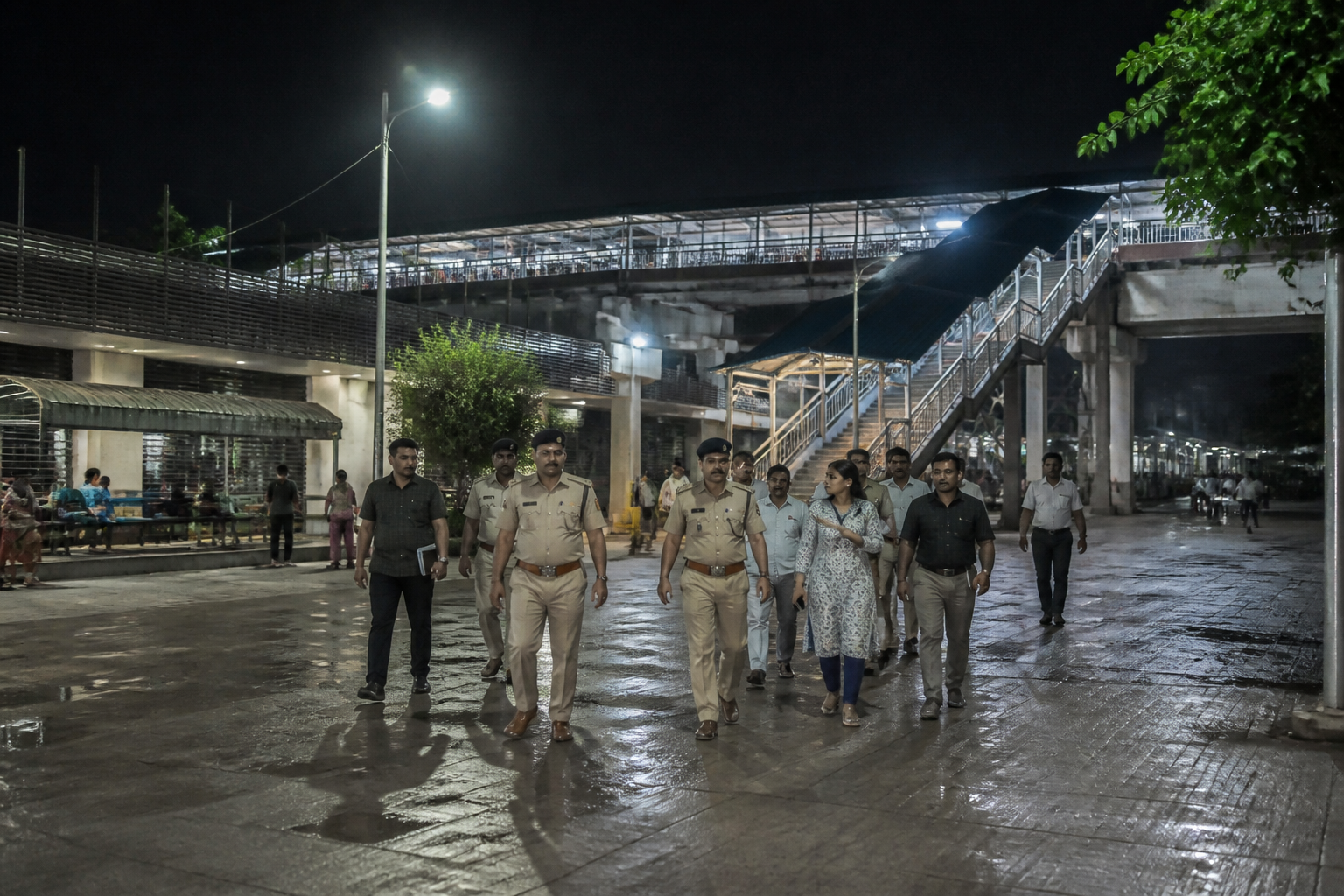
A midnight operation at Nerul railway station has brought back a familiar question for Navi Mumbai: can periodic crackdowns make station-adjacent public spaces safer, or do they merely move a recurring problem from one location to another? The joint action by Navi Mumbai Police, the Navi Mumbai Municipal Corporation and CIDCO followed complaints about disorder, substance use, alleged drug activity, gutkha sales and arguments involving passengers. It also exposed the institutional complexity of managing public spaces around a railway station, where policing, municipal enforcement and land administration overlap.
The operation was conducted from 11.30 pm on September 1 to 1.30 am on September 2 in and around the Nerul station area in Sector 20. Police, with support from the civic body and CIDCO, checked suspected locations on both the eastern and western sides of the station. Homeless people and people described in the source report as drug users were removed from the premises, while action was taken to clear the locations where they were found.
According to the report, the immediate purpose was to prevent inconvenience to passengers at night and stop the station area from being used for illegal activities. Deputy Commissioner of Police Amit Kale said such action is carried out at railway stations from time to time and that the police had taken the initiative by writing to the relevant departments before the joint operation. The account does not specify the number of people removed from Nerul, whether arrests were made, or whether cases were registered during this particular drive. Those omissions matter because eviction, detention, prosecution and rehabilitation are different forms of state action, with different consequences for public safety and vulnerable residents.
The operation followed complaints that the station surroundings had become a venue for drinking, the consumption and sale of narcotics, gutkha sales and disputes with passengers. Loksatta had previously reported on the issue on August 28, according to the supplied material. That sequence suggests the operation was not an isolated response to a single incident but followed public reporting and complaints about a continuing condition around the station.
The distinction between a station and its surrounding spaces is central to understanding the problem. A railway station is primarily a transport facility, but passengers experience it through a wider network of entrances, approaches, open plots, under-bridge areas, dark corners and adjoining roads. These spaces may fall under different agencies or may be managed through overlapping responsibilities. In the Nerul case, police involvement was combined with the NMMC and CIDCO, indicating that enforcement required coordination beyond the police station or railway premises alone.
That coordination is important because the reported problems are not limited to law and order. The source identifies open areas, spaces below bridges and poorly lit corners as locations that can be misused. These are also design, maintenance and management concerns. If such places have weak lighting, limited visibility, irregular cleaning or no consistent presence of staff, a police operation can clear them temporarily without changing the conditions that made them attractive for prohibited activity in the first place. The supplied report does not provide an assessment of lighting, surveillance cameras, access control or the ownership of each location, so it cannot establish which physical deficiencies contributed to the complaints.
The available numbers from the wider enforcement effort show the scale of the administration’s response, but not its long-term outcome. Kale said that about two months earlier, an operation involving approximately 150 police personnel had been carried out at Seawoods, Kille Gaothan and beneath the Belapur flyover. Around 400 people were reportedly acted against during that drive. The statement indicates that station areas and transport-linked public spaces are being treated as recurring enforcement priorities across Navi Mumbai. It does not clarify whether the 400 people were arrested, detained, fined, removed or processed under different laws, nor does it state whether the same individuals later returned.
That missing information limits what can be concluded from the Nerul operation. A crackdown can demonstrate that agencies are responding to complaints and can provide immediate relief to passengers. It can also help authorities identify locations where illegal sales, substance use or harassment are alleged to occur. But the report provides no follow-up data on repeat complaints, reported crime, passenger perceptions, prosecutions or conditions at the cleared sites after the operation. Without such measures, it is not possible to determine whether the action reduced the underlying problem or simply produced a short-term change in visibility.
The treatment of homelessness adds another layer to the public-space question. The operation removed homeless people from the station area, but the supplied report does not say where they were taken, whether their identities and needs were assessed, or whether any shelter or social service was offered. That information is essential for distinguishing between a public-safety intervention and a displacement exercise. The report also uses the category of ‘homeless’ alongside people described as drug users, but it does not establish that the two groups are identical. Combining these categories without further evidence can obscure the different administrative and social responses required for homelessness, addiction, nuisance, trafficking and criminal activity.
The institutional arrangement also remains only partly visible. Police led the initiative and wrote to other departments. NMMC and CIDCO then participated in the operation. This suggests a coordination model in which policing identifies a problem, the municipal authority contributes civic enforcement or removal capacity, and CIDCO participates because it controls or manages some land and spaces in the area. However, the supplied account does not identify the formal division of responsibility, the legal provisions used, or whether Indian Railways or the station operator took part. Those details would be necessary to assess whether the arrangement can be sustained and who is accountable for conditions after the operation ends.
The most significant point in the report is therefore not the removal exercise itself but the expectation of regular monitoring. The account notes that one-time eviction is unlikely to be sufficient if people return to open areas, spaces below bridges and dark corners. It calls for regular surveillance by NMMC and CIDCO, alongside continuous police patrolling and inspection. This is an operational conclusion supported by the reported recurrence of similar actions at other locations, although the material does not provide a formal monitoring schedule or any commitment from the agencies on staffing, frequency or public reporting.
For passengers, the practical test is whether the journey to and from the station becomes safer after the operation. That includes the station entrances, the eastern and western approaches and the public spaces used at night. Safety is not measured only by the number of people removed during a drive. It also depends on whether complaints can be made easily, whether lighting and visibility are maintained, whether illegal sales are investigated, and whether agencies respond consistently when problems recur. None of these outcomes can yet be measured from the Nerul action because the available information covers the operation itself rather than its aftermath.
The Nerul case illustrates a broader governance challenge in urban transport areas: public safety depends on institutions acting together, but responsibility can become fragmented when a problem extends beyond the formal boundary of a transport facility. Police action may be necessary where offences are suspected. Municipal and land-owning agencies may need to address maintenance, access and encroachment conditions. Homelessness and substance dependence may require responses that go beyond enforcement. The supplied report confirms the first stage of coordinated action, but not whether the other parts of that system are in place.
What the evidence confirms is that Navi Mumbai authorities conducted a late-night joint operation at Nerul railway station after complaints about disorder, alleged substance-related activity and passenger inconvenience. It also confirms that police intend to continue similar actions and that earlier operations covered other transport-linked locations. What remains uncertain is the legal outcome of the Nerul drive, the fate of those removed, the role of railway authorities, the condition of the spaces after the operation and whether repeat complaints decline. Those are the developments that will determine whether the crackdown becomes a continuing public-space management system or remains a periodic response to visible disorder.
