


A new Council on Energy, Environment and Water study estimates that three changes in passenger transport behaviour hybrid work, shared mobility and higher bus ridership could reduce annual carbon dioxide emissions across G20 countries by 15-20 per cent by 2050. In its higher-impact scenario, the changes together could save about 538 million tonnes of CO2 a year, roughly one-fifth of the passenger transport emissions expected under a business-as-usual scenario.
The finding is significant not simply because of the size of the number, but because it shifts attention from the technology of transport to the organisation of urban movement. The study, titled “Mitigation Potential of Behavioural Change in Passenger Transport in G20 Countries”, examines what could happen if people shared more car journeys, worked from home for part of the week and chose buses more often. These are not identical interventions. They operate through different parts of the urban system: vehicle occupancy, commuting demand and public transport use.
Together, they point to a central planning question. Can cities reduce transport emissions only by changing vehicles and fuels, or can they also reduce unnecessary trips and use existing road capacity more efficiently? The CEEW analysis suggests that behaviour can be a substantial mitigation lever, although the scale and meaning of that opportunity vary sharply between countries.
The study estimates that the three changes could cumulatively avoid 5.7-8 gigatonnes of CO2 between 2025 and 2050. That is equivalent to about 5-6 per cent of the remaining carbon budget associated with limiting global warming to 1.5 degrees Celsius, according to the findings reported by NDTV. The estimate is modelled rather than an observation of current emissions reductions. Its importance lies in showing how everyday mobility choices could accumulate into a large system-level effect over time.
Carpooling produces the largest standalone reduction in the study. If average car occupancy rises by 50 per cent from current baseline levels, annual savings could reach around 237 million tonnes of CO2 in 2050. If countries move towards the same average car occupancy level, the potential rises to about 411 million tonnes.
That result reflects the structure of car-dependent mobility. A private vehicle carrying one person uses broadly the same road space and consumes similar energy as one carrying several people, but produces more emissions per passenger journey. Increasing occupancy therefore allows existing vehicle trips to serve more travellers without a proportional increase in the number of cars on the road.
The gains, however, are distributed unevenly. Developed countries and China account for about 90-92 per cent of the carpooling savings in the scenarios. Their higher levels of car ownership and lower average occupancy leave more room for improvement. In these economies, shared mobility can act on an already established private-vehicle system.
The implication for India is different. The study cites vehicle ownership of about 33 vehicles per 1,000 people in India, compared with 860 in the United States, 704 in France and 223 in China. India therefore has a smaller existing stock of private vehicles whose occupancy can be increased. Its immediate transport challenge is not only to make car travel more efficient, but also to avoid building cities and commutes around private vehicles in the first place.
This distinction matters for urban planning. A country with low car ownership can record a large absolute saving because of its population, while still having a much lower saving potential per person. The study estimates India’s hybrid-work potential at roughly 71 million tonnes of CO2 in 2050, largely because of the country’s population. That figure does not mean India has the same mobility profile as the United States or Western Europe. It means that changes applied across a very large population can produce a substantial aggregate result.
Hybrid work addresses transport emissions differently from carpooling. Instead of increasing the number of passengers per vehicle, it reduces the number of commuting trips. The CEEW study estimates that hybrid work could reduce G20 passenger transport emissions by 322 million tonnes of CO2 in 2050, or about 12 per cent compared with the business-as-usual scenario.
The model does not assume that every employee works remotely every day. It considers sustained reductions in commuting intensity, meaning that working from home for part of the week could lower travel demand. This makes hybrid work a question of urban movement as much as workplace policy. Fewer regular commutes can change peak-hour demand, the use of roads and transit systems, and the relationship between homes, offices and other daily destinations.
More than 65 per cent of the estimated hybrid-work savings come from developed countries and China. China accounts for about 96 million tonnes of the reduction, followed by the United States at around 45 million tonnes and the EU-15 at roughly 32 million tonnes. These figures again reflect the scale of established commuting systems and the emissions associated with them.
For cities, the evidence does not establish that remote work automatically produces lower emissions in every circumstance. The supplied study findings concern reduced commuting intensity. They do not assess all possible changes in household travel, office energy use or land-use patterns. What they do show is that the commute remains an important point of intervention when a large share of passenger transport is tied to regular workplace travel.
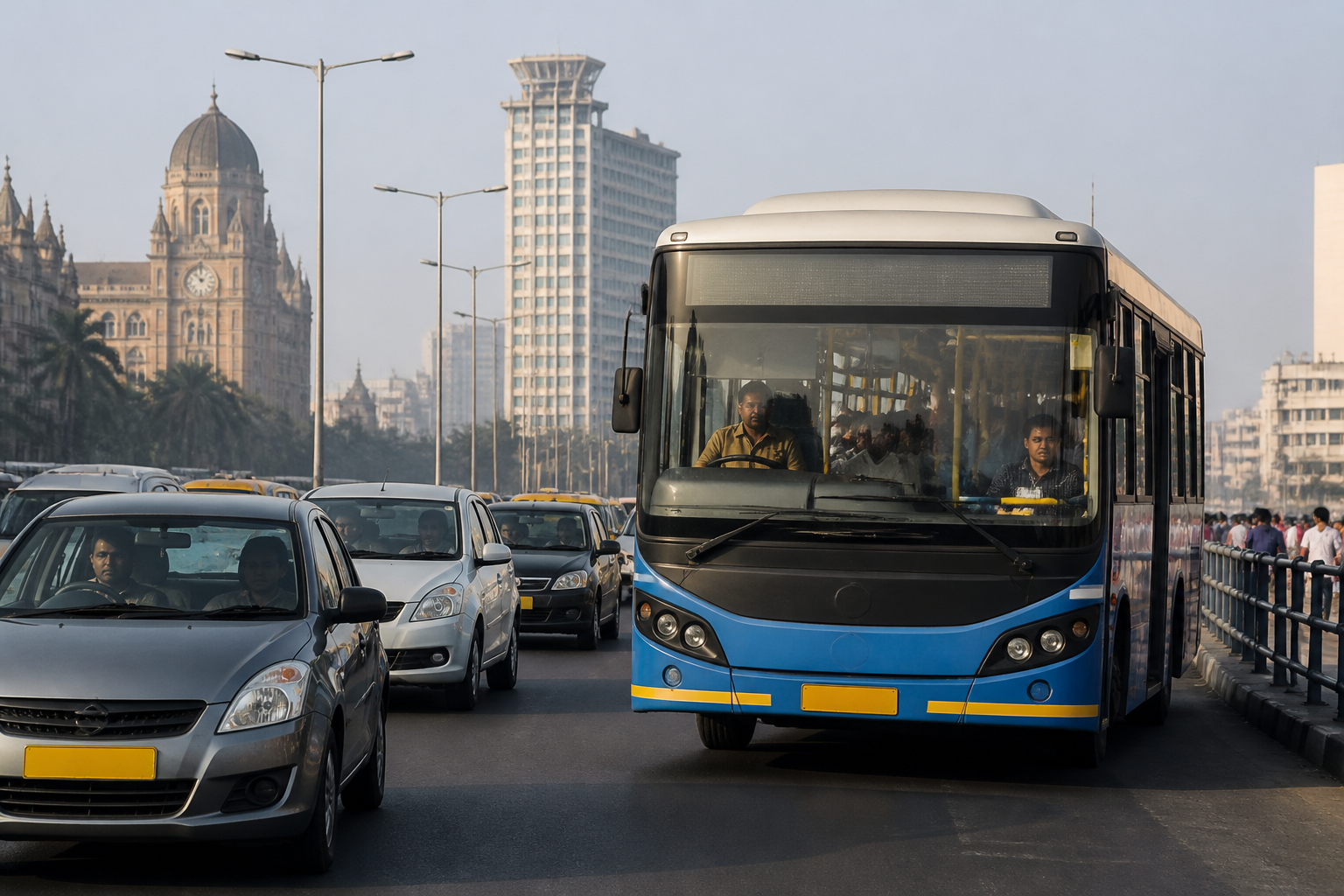
The third intervention is a shift towards buses. In the high-bus scenario, increased preference for buses produces emissions reductions ranging from 0.4 to 6.7 per cent, depending on the country. Across the G20, the study estimates up to 54 million tonnes of annual savings.
The comparatively smaller result is important because it qualifies a common assumption about public transport. More bus passengers can lower emissions, but buses alone are not enough if the wider system remains inefficient or if the shift is too limited. Bus-based reductions depend on the relationship between passenger numbers, vehicle use and the travel modes being replaced. The study therefore places bus ridership alongside shared mobility and reduced commuting rather than treating it as a standalone solution.
The three interventions also expose the difference between absolute and per-capita climate responsibility. In 2024, developed countries and China represented 34 per cent of the world’s population but accounted for more than 60 per cent of global road transport emissions, according to the study’s findings. In the combined scenarios, the United States and EU-15 account for 61-63 per cent of total savings, while developed countries and China together account for 80-88 per cent.
These patterns suggest two different policy priorities. In richer, car-dependent economies, changing travel behaviour can reduce emissions from an already high-emitting mobility system. Carpooling and hybrid work have large near-term potential because the relevant infrastructure, vehicles and commuting patterns are already widespread. In India and other developing economies, the larger opportunity is to prevent future lock-in to private-vehicle dependence while expanding reliable, attractive and lower-emission alternatives.
That is where the study connects transport behaviour to the built environment. Behaviour does not change in isolation. The feasibility of carpooling depends on trip patterns, workplace locations and digital coordination. Hybrid work depends on the nature of employment and the persistence of commuting requirements. Bus use depends on service availability and the ability of public transport to serve daily journeys. The CEEW findings identify the potential of these measures, but they do not claim that potential will materialise without supportive urban systems.
The evidence also places limits on what can be concluded. The study models three interventions through scenarios; it does not report that the G20 has already achieved the stated reductions. It provides estimates for 2050 and cumulative savings from 2025 to 2050, rather than a forecast of a single guaranteed outcome. The figures should therefore be read as estimates of mitigation potential under specified behavioural changes.
What is established is that passenger transport emissions can be influenced not only through cleaner vehicles or fuels, but also through the number of journeys, the number of passengers per car and the share of travel carried by buses. What remains uncertain from the supplied material is how quickly these changes can be adopted, how they would differ across cities and what institutional arrangements would be needed to sustain them.
The broader urban question is whether transport policy will treat demand, occupancy and mode choice as part of climate planning. The CEEW study indicates that the answer cannot be the same everywhere. High-income, car-dependent economies have the largest immediate savings from changing established behaviour. India’s lower vehicle ownership reduces its comparable per-capita potential, but also leaves more room to shape future mobility before private cars become the default urban mode.
The next stage for policymakers is therefore not simply to count potential emissions savings. It is to distinguish between reducing unnecessary travel, sharing necessary travel and providing viable alternatives to private vehicles. The study’s central message is that these are separate levers, with different geographic effects. Together, they show how the future emissions profile of cities will depend as much on how people travel and work as on the technologies used to move them.
