


A request for government-funded treatment by Bhiwandi resident Nagesh Bhoir has brought renewed attention to what happens after a serious injury at a public festival: the accident may last seconds, but the medical, financial and caregiving burden can continue for years.
Bhoir was 24 when he fell from a human pyramid during a Dahihandi celebration in 2009. The fall caused a serious spinal injury. The report says that he has remained bedridden for the past 18 years and continues to require medical care, medicines and physiotherapy. It also says that he is admitted to hospital approximately once every two months, depending on his condition.
Bhoir is not seeking a one-time financial payment, the report says. His request to the government, including the chief minister, is that the state cover the cost of treatment at the hospital where he is admitted. The appeal places the issue in a specific policy space: not only compensation after an accident, but access to continuing care when an injury creates a permanent or long-term dependency.
The report does not include a response from the state government or any confirmation that the treatment request has been accepted. It also does not specify the hospital involved, the total cost of treatment, the nature of Bhoir’s spinal injury, or whether he receives support under any existing health insurance, disability or welfare programme. Those gaps matter because the case illustrates the pressure on families without establishing the wider scale of similar claims.
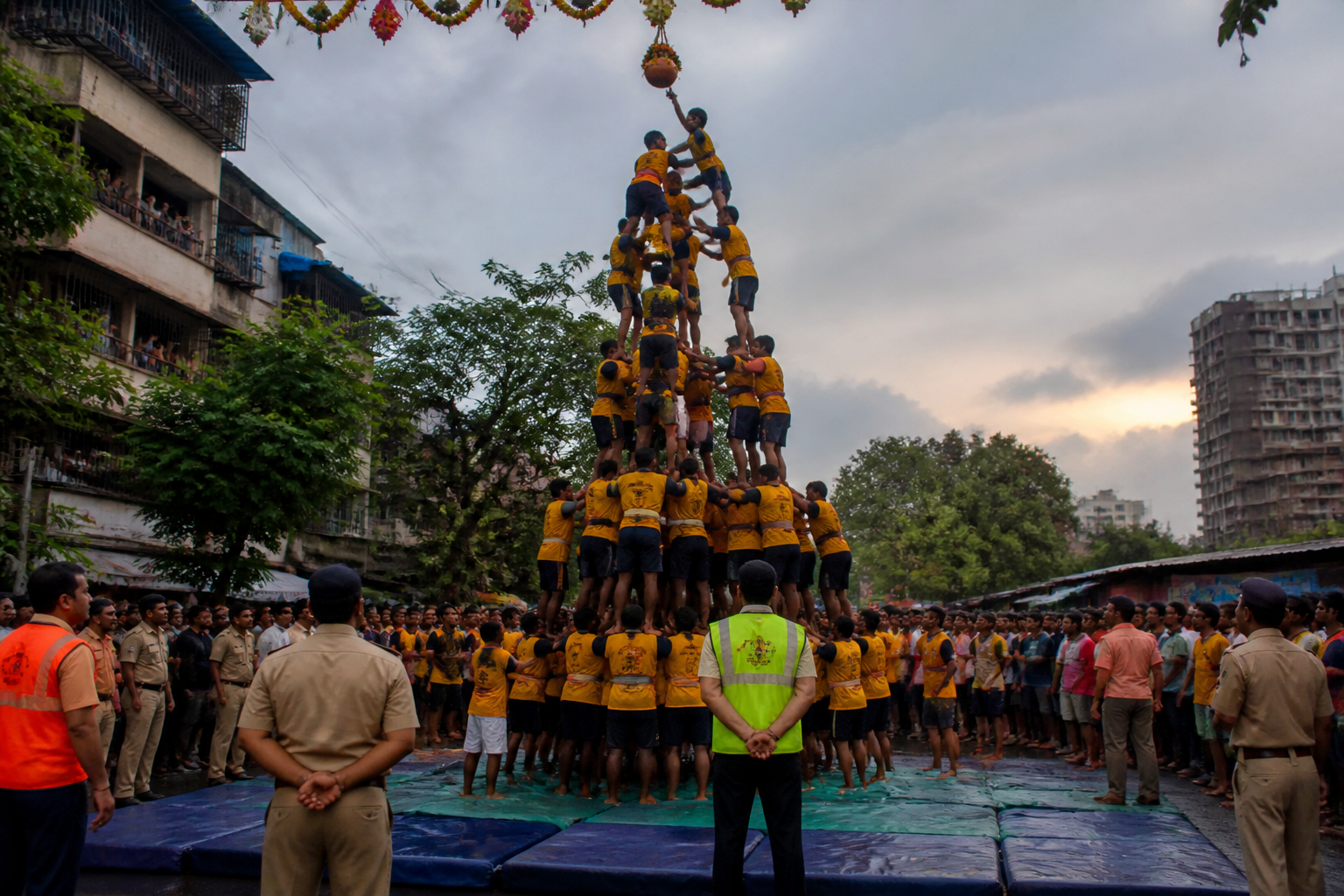
Dahihandi, also known as Govinda, involves teams forming human pyramids to break a suspended clay pot. The festival is deeply established in Maharashtra, and the report describes the event as becoming increasingly elaborate. It identifies higher pyramid levels, competition between teams and larger prize amounts as factors associated with greater risk. It also lists falls from height and serious injuries to the spine, head, arms and legs among the dangers that can arise during the activity.
The central governance question is not whether the festival should exist. It is how public authorities, organisers and participating teams manage risk when a recreational or cultural event involves controlled but potentially severe physical danger. The source report does not provide accident statistics, injury totals, safety compliance data or details of event regulations. Without those figures, it is not possible to measure whether the risk has increased over time or compare safety outcomes between different celebrations.
Bhoir’s account nevertheless shows the difference between immediate event safety and long-term recovery. Safety arrangements at a festival may focus on the height of the pyramid, the presence of protective equipment, crowd control, emergency response and access for ambulances. A serious spinal injury creates a much longer chain of needs: hospitalisation, medicines, rehabilitation, physiotherapy, assistance with daily activities and, in some cases, continuous supervision.
The report says Bhoir’s treatment began after the accident, but the effects of the injury became permanent. It describes his wish to stand on his own feet and return to an ordinary life as having been lost after the fall. That account should not be read as a clinical assessment, because the source does not provide medical records or an independent diagnosis. It does, however, convey the duration of the dependence reported by the family and the way a single injury has altered the household’s economic and care responsibilities.
Those responsibilities have largely fallen on Bhoir’s elderly parents. His father is retired from private employment, according to the report. His mother says the family cannot afford to keep a nurse or doctor at home and that she and her husband manage his care themselves. The report does not state whether either parent receives a caregiver allowance, pension-linked support or assistance from a local welfare agency. It does show that the household is carrying both the practical work of care and the continuing cost of treatment.
This is where an injury becomes a public administration issue. A family may initially receive help from friends and relatives, particularly when the accident is recent and the circumstances attract public attention. The report says that Bhoir’s friends and acquaintances helped in the early period, but that assistance declined over time. A few friends continue to help with medicines, it says. Informal support can be important during a crisis, but it is not a predictable substitute for a long-term system of healthcare and disability support.
The request for direct payment to the hospital also reflects a practical concern. A family facing recurring admissions may find that a cash grant, even when available, does not match the timing or scale of medical bills. Bhoir’s appeal, as reported, is for the government to assume treatment expenses when he is admitted. The article does not establish whether this arrangement is possible under an existing state scheme, whether eligibility has been assessed, or which department would be responsible for processing such a request.
That institutional uncertainty is significant. A long-term injury can cut across several administrative systems: public hospitals and health departments manage treatment; social welfare agencies may handle disability benefits; local authorities may regulate public events; and organisers may have their own insurance or emergency arrangements. When responsibility is divided, families may have to approach multiple offices even though their need is continuous and indivisible.
The source material does not identify the organiser of the 2009 event, the location of the celebration, whether an accident report was filed, or whether compensation was offered at the time. It therefore cannot establish legal liability or determine whether any safety rule was breached. Nor does it provide enough information to assess the role of the local administration, the event organisers or the medical system in the aftermath. Those questions would require documentary records and responses from the relevant authorities.
What the report does establish is narrower but important. A young participant suffered a serious spinal injury after falling from a Dahihandi human pyramid. The injury has, according to the report and his family, resulted in long-term confinement to bed. Treatment and rehabilitation continue. The family’s resources are limited, informal assistance has reduced, and the patient is asking the government to pay his hospital treatment costs rather than provide a general financial grant.
Bhoir has also appealed to younger Govindas not to compete for money and not to place their lives at risk. He has suggested that teams celebrate with five or six levels rather than pursue higher formations. This is his personal warning based on his experience, not evidence that a particular pyramid height is universally safe. The report supplies no technical safety threshold and no official assessment of the number of levels that can be considered acceptable.
The larger lesson for urban governance is that public safety cannot end when an event is over or when an ambulance leaves the site. For high-risk public celebrations, the visible safety question concerns prevention and emergency response. The less visible question concerns who pays and who provides care when prevention fails. Bhoir’s case brings that second question into view without resolving it.
The available evidence does not show whether the government will approve his request, whether the state has contacted the family, or whether similar cases are being handled through a formal programme. These are the next facts that require confirmation. A clear response from the government, details of the applicable medical or welfare scheme, and records of accident-prevention measures at Dahihandi events would help establish whether the case is an individual appeal or part of a wider administrative gap.
For now, the report confirms the long afterlife of a festival injury: years of treatment, reduced household income, unpaid family care and reliance on diminishing informal support. The immediate question is whether Bhoir’s treatment costs will be covered. The broader question is whether families facing comparable, long-term injuries have a dependable path to care after the public attention surrounding an accident has passed.
