


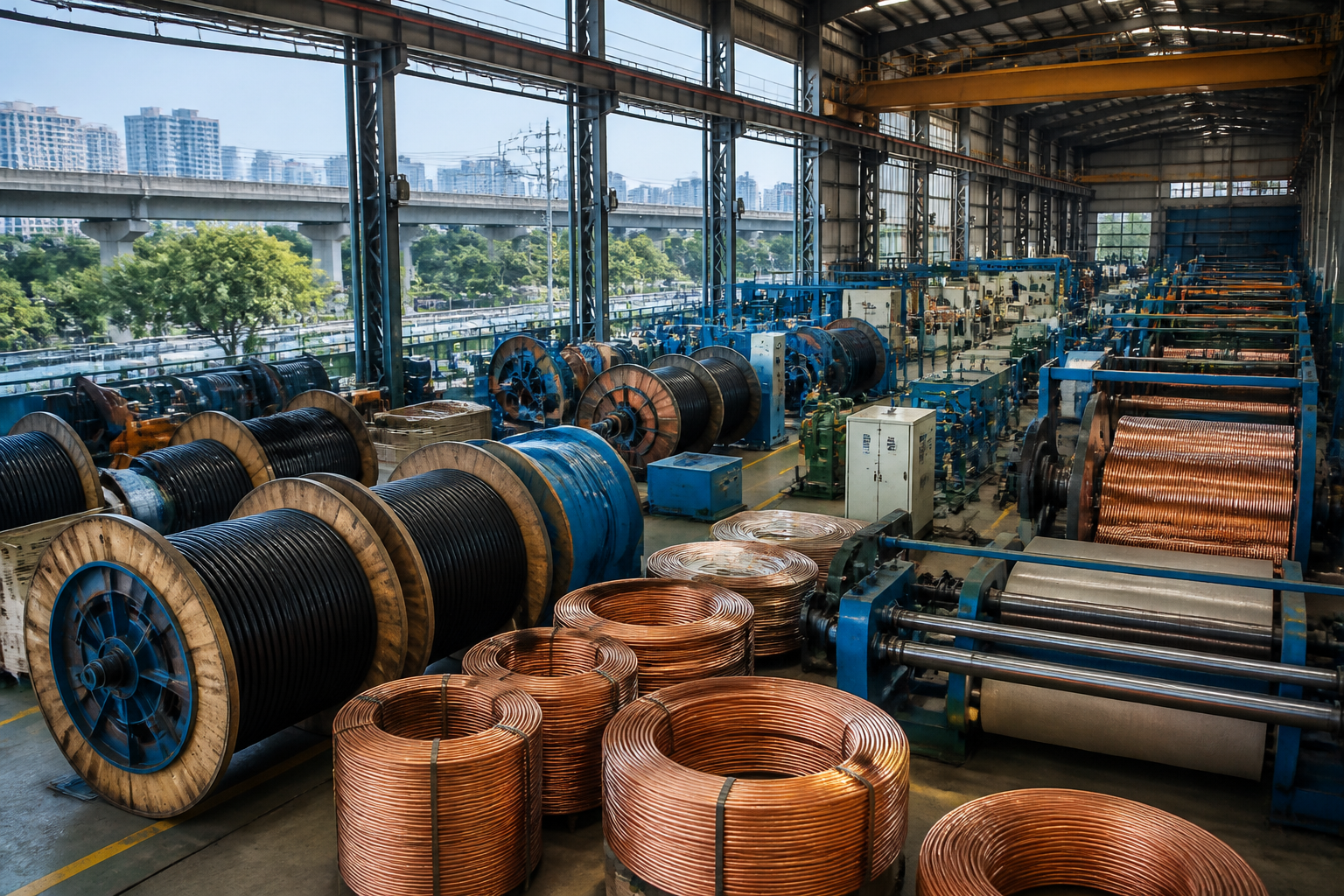
Subheadline: UltraTech’s entry into wires and cables reflects how construction companies are moving deeper into the systems that connect homes, buildings and infrastructure.
Standfirst: UltraTech Cement’s launch of the Ultravolt wires and cables business, backed by an investment of Rs 1,800 crore, is more than an extension of the Aditya Birla Group’s construction portfolio. It places a basic but strategically important building component at the centre of three demand narratives identified by the company: urbanisation, electrification and digitisation. The business begins with a manufacturing facility at Bharuch and plans to reach more than 500 districts, 6,000 pin codes, one lakh retailers and over 5,000 UltraTech Building Solutions outlets. This analysis examines what the move reveals about the changing construction value chain, the infrastructure systems behind India’s urban expansion, and the limits of interpreting corporate projections as established market outcomes.
UltraTech Cement’s entry into the wires and cables industry arrives at a point when the company is seeking to extend its construction presence beyond cement, ready-mix concrete, building products and white cement. The new business, branded Ultravolt, will operate under UltraTech and has been launched with a stated investment of Rs 1,800 crore. The company says it aims to become one of the segment’s top two players within five years.
The immediate announcement is commercial, but its underlying logic is urban. Wires and cables are not usually the most visible part of a building project. They are enclosed within walls, routed through commercial premises, embedded in infrastructure and connected to electrical systems that residents often notice only when they fail. Yet the scale and reliability of these components influence how homes, offices, factories, public facilities and digital infrastructure function.
Kumar Mangalam Birla, chairman of the Aditya Birla Group, described the category as being driven by urbanisation, electrification and digitisation. He also pointed to the company’s expectation of more than 100 million new homes over the next decade, expanding energy infrastructure and the rapid rise of data centres. These figures and forecasts are company statements, not independently established estimates in the supplied material. Their importance here is as an indication of how a major construction group is framing its next market opportunity.
The move reflects a broader attempt to capture more stages of the construction value chain. Cement is a foundational material, but the completed building depends on a larger network of products and services: structural materials, electrical systems, plumbing, fittings, finishing products and distribution. By entering wires and cables, UltraTech is positioning itself closer to the point where construction materials meet the building’s operational systems.
That positioning also draws on the company’s existing relationships. Dilip Gaur, director of Ultravolt, said the business would use UltraTech’s connections with individual home builders, contractors, real-estate developers and engineering, procurement and construction companies. The company also cited a pan-India distribution footprint, more than 20 warehouses and access to UltraTech Building Solutions outlets as part of its platform for scaling the new business.
The distribution plan is unusually specific. Ultravolt initially intends to establish a presence across more than 500 districts and 6,000 pin codes, reach more than one lakh retailers and activate availability through over 5,000 UltraTech Building Solutions outlets. These are planned network targets rather than evidence that the coverage has already been achieved. They nevertheless show that the company views the market as one in which availability, contractor familiarity and retail access may be as important as manufacturing capacity.
The distinction matters because wires and cables are purchased through several layers of the construction economy. Large infrastructure and industrial projects may procure directly through formal contracting systems, while individual home builders and smaller contractors rely more heavily on local retailers and distributors. A business seeking to serve both segments needs manufacturing capacity, quality assurance, warehousing and a distribution system capable of reaching fragmented markets.
Ultravolt’s Bharuch facility is therefore only one part of the expansion strategy. The company has not provided, in the supplied material, detailed production capacity, project cost allocation, employment projections or a timeline for additional plants. Nor does the announcement establish how the new business will perform against existing manufacturers. The stated ambition to become a top-two player within five years remains a corporate target, not a verified market outcome.
The company’s emphasis on data centres adds another layer to the story. Data centres require substantial electrical systems, although the supplied announcement does not quantify the cable demand associated with them or identify specific projects that Ultravolt will serve. Birla’s reference to the sector places data infrastructure alongside housing and energy systems as part of the group’s understanding of future demand. It also illustrates how digitisation is becoming part of the construction industry’s investment narrative, even when the product being sold is a conventional physical component.
For cities, this connection between digital infrastructure and basic electrical products is significant because urban growth is not limited to visible roads, buildings and transit systems. It also requires networks that distribute power, connect devices and support the operation of homes, offices, industrial premises and public services. The announcement does not provide evidence on the adequacy of India’s electricity infrastructure or on the quality of existing cable installations. It does, however, identify wiring as a component positioned across residential, commercial, industrial and infrastructure applications.
Sriram Rangarajan, Ultravolt’s chief executive, said the business would begin with home wires, flexible wires and cables for residential, commercial, industrial and infrastructure uses. He also said the company planned to expand over time into electrical accessories. The proposed product range suggests an effort to serve multiple construction segments rather than remain focused on a single housing category.
The company is also presenting the launch as a consumer-facing proposition. Rangarajan described wires as the “lifeline of a house” and said safety, performance and future-readiness would be central to product development. Those priorities are relevant to the built environment, but the announcement does not include independent product testing, safety data, certification details, warranty terms or comparisons with competing products. Such information would be necessary to assess whether the proposed consumer-first approach produces measurable improvements.
The business also shows how large construction companies are using their existing institutional relationships to enter adjacent categories. UltraTech’s building-products strategy gives the new operation access to a network that includes contractors, developers, home builders and building-solution outlets. That can reduce the distribution challenge faced by a new entrant, although the supplied material does not establish how much of this network is already operationally integrated with Ultravolt.
For the construction sector, the development points to a value chain becoming more consolidated around large firms with manufacturing, distribution and contractor relationships. This does not mean that smaller manufacturers or specialist distributors will disappear. The announcement contains no market-share data, pricing information or competitive assessment. It does indicate, however, that established construction companies see advantage in using their existing reach to sell products beyond their original category.
The urban question is whether this expansion translates into better-performing buildings and more dependable infrastructure, rather than simply a wider product portfolio. The answer will depend on factors not established in the launch announcement: product quality, compliance, contractor practices, installation standards, customer awareness, after-sales service and the ability to supply projects across different regions.
The next phase will therefore be measured less by the announcement than by execution. Ultravolt will need to build its Bharuch operation, establish the proposed retail and warehouse network, and demonstrate that its planned reach across districts and pin codes can be converted into reliable availability. It will also need to show how its residential, commercial, industrial and infrastructure offerings perform in a market where the company itself expects demand to be shaped by housing, electrification and digitisation.
What the launch confirms is that wires and cables are being treated as a strategic construction category by one of India’s largest building-material companies. What remains uncertain is the scale of demand, the competitive response and whether the proposed network can deliver the safety, performance and service standards invoked by the company. Those will be the indicators to monitor as the business moves from corporate strategy to construction-site reality.
