


PM Surya Ghar’s residential rooftop solar programme has crossed a significant capacity threshold, but the latest installation figures show that India’s challenge is no longer simply generating interest. It is converting applications into functioning systems at a consistently higher pace.
According to data reported from the PM Surya Ghar: Muft Bijli Yojana portal and compiled by JMK Research & Analytics, India had 16,185.48 MW of installed residential rooftop solar capacity covering 54,65,417 households as of August. A separate cumulative figure in the same reporting indicates more than 46.44 lakh installations covering roughly 55.28 lakh households and taking installed capacity to 16,369 MW. The differing totals appear to reflect different reporting cut-offs or measures, but both point to the same broad development: the programme has moved into a large-scale implementation phase.
The August numbers also expose the unevenness of that expansion. Monthly residential rooftop capacity added under the scheme fell by about 11.6 per cent from 1,592 MW in July to approximately 1,407 MW in August. At the same time, more than 4.48 lakh applications were received during August, compared with over 3.57 lakh installations. Applications therefore continued to outnumber completed installations, leaving a sizeable pipeline between household intent and commissioned rooftop systems.
That gap is central to understanding the programme’s performance. Applications represent demand for the scheme, while installations show the point at which a household has moved through the process of approval, procurement, installation and connection. The August data suggests that demand remains substantial, even as the monthly pace of capacity addition fluctuates.
Uttar Pradesh led the states in August, with 228.95 MW of residential rooftop solar installations. Maharashtra followed with 212.51 MW, while Andhra Pradesh added 192.39 MW. The state ranking matters because residential rooftop solar is not being adopted uniformly across the country. Implementation depends on the volume of applications, the ability of households to complete the process, the availability of installers and equipment, and the distribution network’s role in connecting systems and handling surplus power. The supplied data does not separately quantify each of these factors, but the difference between applications and installations makes clear that enrolment alone cannot describe programme delivery.
Uttar Pradesh received 89,901 applications in August and recorded 73,709 installations. Maharashtra received 79,679 applications and reported 61,110 installations. Andhra Pradesh recorded 22,557 applications against 14,648 installations. In each of these leading states, completed installations were below applications during the month. The figures do not establish how many applications remain pending, how long individual households waited, or whether all applications were technically eligible. They do, however, show that the leading installation markets also have substantial unresolved demand.
The programme’s scale becomes clearer when its cumulative numbers are placed beside the monthly data. More than 80.62 lakh applications have reportedly been received for residential rooftop solar plants, against over 46.44 lakh installations. The difference is not necessarily a measure of failure: applications can be withdrawn, rejected, delayed or still be moving through the process. But it is an important indicator of the administrative and operational workload created by a scheme that has attracted millions of households.
The subsidy commitment is similarly large. More than ₹30,885 crore has been released so far, according to the supplied report. The subsidy is intended to reduce the cost barrier for households installing rooftop systems. The scheme also allows eligible households to obtain up to 300 units of free electricity each month, depending on system capacity, generation and consumption. Where applicable, surplus electricity can be exported to the distribution network, creating a model in which households act as both electricity consumers and producers.
That prosumer model changes the relationship between homes and the electricity system. A rooftop installation is not only a private asset placed on a building; it can also become a connected unit within the distribution network. Its value depends on how much electricity the system generates, how much the household consumes, how surplus power is treated and whether the local network can accommodate two-way flows. The supplied material does not provide state-wise figures on exports, savings or distribution-network constraints, so the economic and operational effects cannot be measured fully from the August data alone.
The pace of installation has nevertheless increased sharply over the period cited in the report. Daily installations rose from 5,038 in October 2025 to nearly 16,328 a day in July 2026, described as an increase of about 3.2 times over three quarters. This growth indicates that the programme has developed considerable execution capacity. Yet the fall in monthly capacity addition from July to August shows that rapid growth does not automatically produce a smooth month-to-month trajectory.
The distinction between installation speed and capacity growth is important. Daily installation counts measure the number of households or systems completed, while megawatt additions measure the total capacity commissioned. A month can record many installations without adding the same capacity as another month if system sizes differ. The supplied figures do not provide the average system size by state or month, preventing a more detailed comparison. Even so, the combination of high daily installation rates and a monthly decline in added capacity points to a programme whose performance needs to be assessed through several indicators rather than one headline number.
The national electricity context reinforces the importance of this transition. India added 35.13 GW of net new power generation capacity in the first half of 2026, a 54 per cent year-on-year increase, according to figures attributed to the Institute for Energy Economics and Financial Analysis. Renewables accounted for more than 87 per cent, or 30.58 GW, of the total additions. Solar alone contributed 26.34 GW, or roughly three-fourths of the capacity added during the period.
Residential rooftop solar is only one part of that national expansion. Large solar projects, wind installations and other generation assets also contribute to the country’s capacity growth. The residential programme is distinctive because it distributes generation across household buildings and links energy policy directly to citizens’ electricity bills and consumption patterns. Its success therefore involves more than the addition of megawatts: it also depends on whether households can access the subsidy, secure installation and obtain a functional grid connection.
This is where the application-installation difference becomes a useful measure of implementation rather than merely a backlog statistic. With more than 80.62 lakh applications and over 46.44 lakh installations reported cumulatively, the programme has attracted demand well beyond the number of systems already commissioned. The figures show both public interest and the scale of work required to turn that interest into built infrastructure. They do not, by themselves, reveal the reasons for the gap. Those reasons could only be established through additional data on approvals, cancellations, vendor capacity, equipment supply, inspections, net-metering or other connection stages.
The institutional structure is also significant. Households interact with the programme through applications, installation providers and the electricity distribution system, while the subsidy is linked to a central government scheme. State-level performance varies considerably in the supplied August data, making distribution companies and state implementation arrangements an important part of the delivery chain. However, the report does not provide a comparative account of state policies, processing times or distribution-company performance.
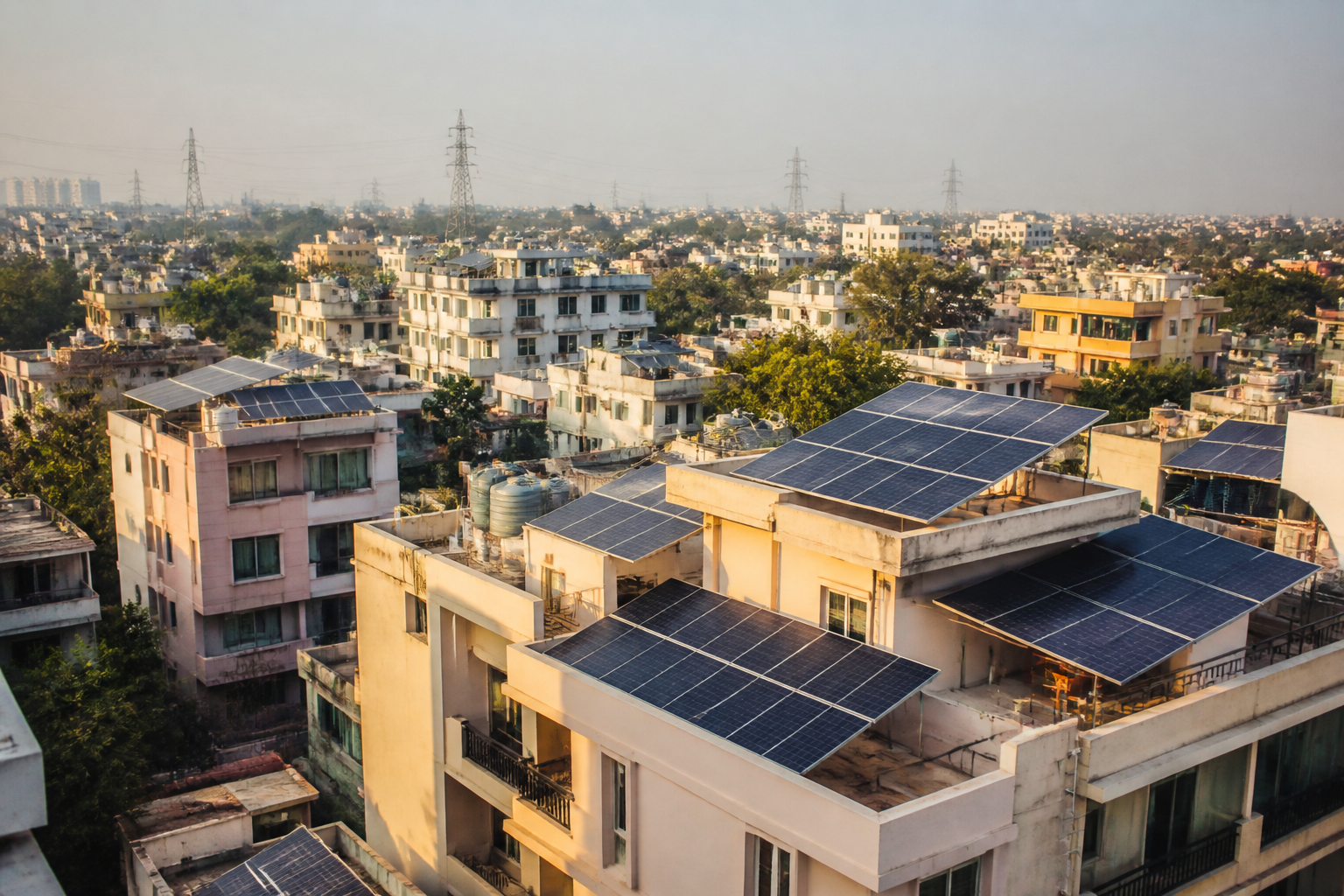
For urban India, the programme brings energy infrastructure into the building stock itself. Rooftops become potential generation spaces, and households become participants in a decentralised electricity system. This has implications for residential construction, building ownership, roof access and the technical condition of existing homes, although the supplied material does not quantify how these factors affect adoption. It does establish that the scheme is operating at a scale large enough for these household-level questions to become part of national infrastructure delivery.
The evidence confirms three features of PM Surya Ghar’s current phase. First, residential rooftop solar has reached more than 16,000 MW of reported installed capacity. Second, Uttar Pradesh, Maharashtra and Andhra Pradesh were the leading contributors to August installations among the states identified. Third, applications continue to exceed installations, even as the daily installation rate has risen substantially from late 2025 to mid-2026.
What remains uncertain is equally important. The supplied figures do not establish the reasons for the August month-on-month decline, the status of pending applications, the distribution of subsidy across states, or the actual electricity savings achieved by participating households. The next useful indicators will therefore be whether the installation pipeline narrows, whether monthly capacity additions recover, and whether the programme’s rapid growth is sustained across states and distribution networks.
