


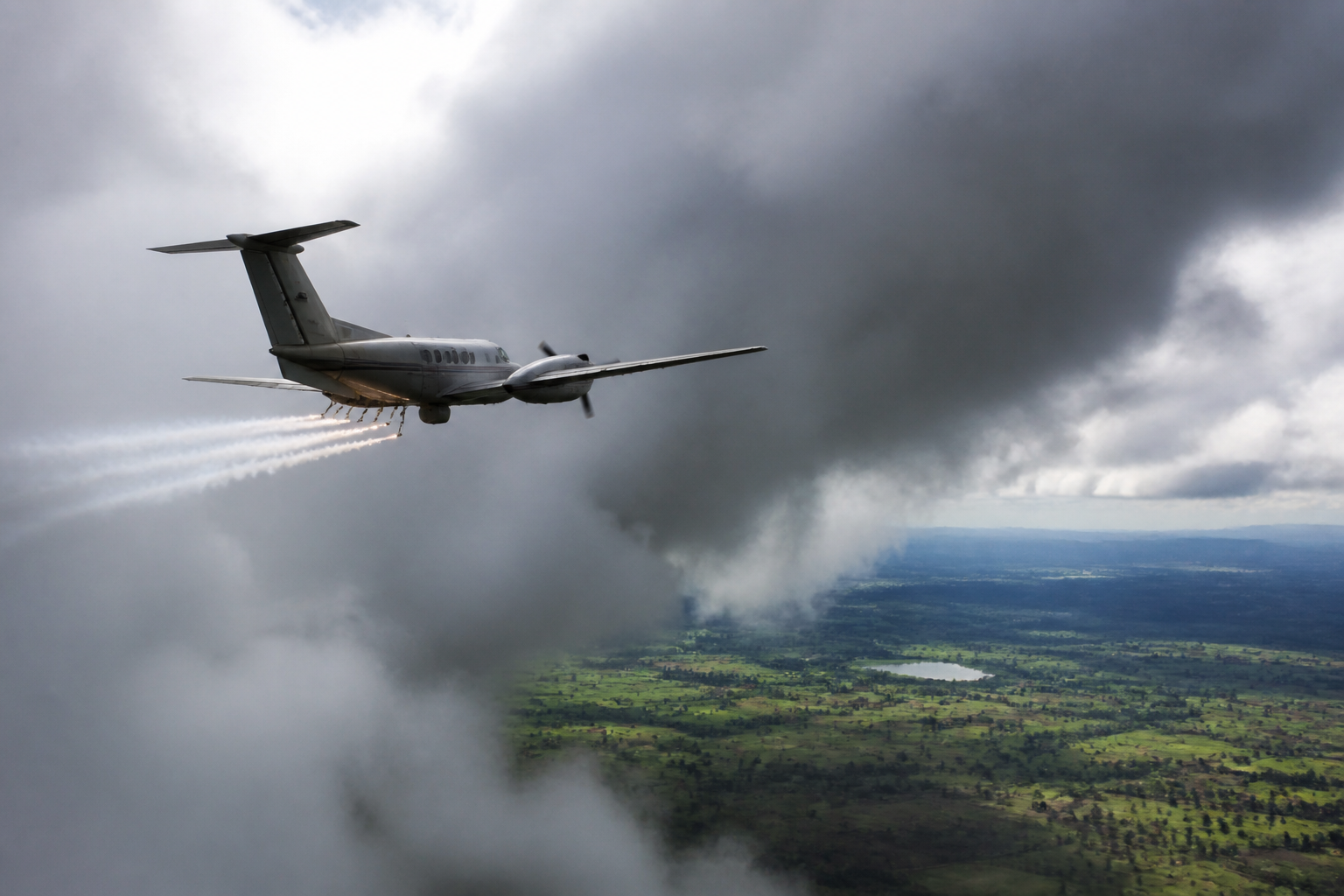
Karnataka’s latest cloud-seeding operation is being presented as a response to drought, water scarcity and the needs of farmers. The state has begun the process again this year and has created two committees to oversee it. But the operation also raises a larger question for a state facing recurring rainfall stress: how far can a weather intervention help when the basic condition for rain suitable clouds with sufficient moisture is not guaranteed?
The information available in the supplied report describes cloud seeding as a process intended to accelerate rainfall from clouds that already contain moisture. It does not create clouds from clear skies or generate water independently. Instead, aircraft release chemical particles into selected clouds, with the aim of encouraging small droplets or ice crystals to combine and fall as rain. That distinction is central to understanding both the promise and the limits of the programme.
According to the report, Karnataka has increasingly used cloud seeding in recent years, particularly as drought conditions have become more frequent over the past decade. The state has now begun another operation and has established an administrative structure for monitoring and technical assessment. A monitoring committee, led by the state’s additional chief secretary and development commissioner, is responsible for overall supervision and review of the project.
A separate technical advisory and evaluation committee is chaired by the director of the Karnataka State Natural Disaster Management Centre and includes eight members. Its responsibilities include providing technical guidance and updating information about the cloud-seeding operation and its effects every two hours. The arrangement places the project at the intersection of government administration, weather monitoring and disaster management rather than treating it solely as an aviation or agricultural intervention.
That institutional structure matters because cloud seeding depends on decisions made within a narrow window. The aircraft cannot simply be sent into any cloud formation. The report says technical teams will monitor atmospheric conditions, wind speed and cloud density using the Meteorological Department’s Doppler radar. They will then identify cumulonimbus clouds that have the potential to produce rain but are passing without rainfall.
Once such clouds are identified, specially equipped aircraft are expected to fly within or below them and release chemicals through flares. The aircraft are described as carrying weather radar and flare systems. The chemical particles are intended to attract or combine with small water droplets inside the cloud, increasing their weight so that they fall as rain.
The report lists silver iodide as one of the most commonly used substances. It says silver iodide can help convert droplets in colder clouds into ice crystals. Potassium iodide and dry ice, or solid carbon dioxide, are also mentioned. For warmer clouds, sodium chloride, or common salt, is described as a substance that can attract water droplets and help them form larger raindrops.
These details show why cloud seeding is not a uniform operation. The choice of material depends on the type of cloud being targeted. A cold cloud and a warm cloud do not behave in the same way, and the intervention must be matched to the cloud’s physical conditions. The operation therefore depends on meteorological observation before it depends on aircraft deployment.
The supplied report says rainfall may occur between 30 minutes and one hour after the process. That is presented as a possibility rather than a guaranteed outcome. The timing also illustrates the difficulty of measuring results. Rainfall after a seeding operation does not, by itself, establish how much rain was caused by the intervention and how much would have occurred naturally. The report does not provide a detailed evaluation method, a control area, or a measurement of additional rainfall attributable to the operation.
It does, however, cite a previous success rate of 35 percent. The figure is important because it indicates that earlier operations did not produce rainfall in every attempt. At the same time, the supplied material does not define what success means in that calculation. It does not state whether the percentage refers to seeded clouds that produced measurable rain, the number of flights that met their operational targets, the area that received rain, or the additional rainfall recorded after seeding.
That missing definition is not a minor technical detail. A programme intended to support farmers and address water shortages requires a clear distinction between activity and outcome. The number of flights, clouds seeded or chemicals released would measure the operation itself. The amount of additional rainfall, the location of that rain, and its effect on reservoirs, crops or local water availability would measure its public benefit. The available report does not provide those figures.
The state’s decision to continue cloud seeding reflects the pressure created by water scarcity. The stated objective is to compensate for a lack of water and protect farmers’ interests. That objective gives the programme a clear public-interest rationale, but it also means that evaluation cannot stop at whether rain fell somewhere after a flight. For farmers, the relevant question is whether rainfall reached the places and time periods where it could reduce agricultural stress.
The operation also raises questions about the relationship between emergency intervention and long-term water management. Cloud seeding can only be attempted when suitable clouds are present. It cannot replace rainfall when the atmosphere lacks the required moisture or cloud structure. Nor does the supplied material establish that cloud seeding can provide a reliable substitute for storage, groundwater management, irrigation planning or drought preparedness. The report presents the programme as an additional measure, not as a complete solution to water scarcity.
The two committees appear intended to address some of these concerns by combining administrative oversight with technical review. The monitoring committee is responsible for broad supervision, while the technical committee is expected to advise on the operation and assess its effects. The promise of updates every two hours suggests an effort to make the operation responsive to changing weather conditions. It also creates an opportunity for the state to build a more detailed record of decisions, targets and outcomes.
For that record to be useful, the public would need to know how clouds were selected, what atmospheric conditions were present, what substances were used, where aircraft operated, and how rainfall was measured afterward. The supplied material does not establish whether all of those details will be released. It also does not include an environmental assessment, a public-health evaluation, or a cost figure for the current operation. Those are significant gaps in assessing the programme’s overall value.
The use of chemicals is likely to remain part of the public discussion, but the available information does not support claims about their safety or risk beyond identifying the substances described in the report. Any assessment of environmental or health effects would require evidence about dosage, dispersal, exposure and local conditions. Those questions cannot be resolved from the operational description alone.
The broader urban and regional issue is the state’s growing dependence on technical responses to variable rainfall. Cloud seeding is visually and politically legible: aircraft, radar and chemical flares provide a concrete image of government action. Drought management, by contrast, often depends on less visible systems such as water storage, distribution, demand management and institutional coordination. The current operation therefore offers a test not only of rainmaking technology but also of how the state defines, measures and communicates emergency relief.
What the available evidence confirms is that Karnataka has begun another cloud-seeding operation, that the government has established monitoring and technical committees, and that aircraft-based seeding will depend on identifying suitable clouds through radar and weather assessment. What remains uncertain is the scale of the operation, its cost, the precise evaluation method, the environmental assessment and the amount of rainfall that can be directly attributed to it.
The next stage will be to examine the updates produced by the technical committee and compare operational activity with independently measured rainfall. Until those details are available, cloud seeding in Karnataka should be understood as a conditional weather intervention one that may assist under specific atmospheric circumstances, but cannot by itself remove the structural risks associated with drought and water scarcity.
